20 minutes ago
Foreign investment in Kosovo falls

Periskopi(7 years ago)
(7 years ago)Foreign direct investments in Kosovo over the years are marking decline. The declining trend of international capital, according to experts on economic issues, is an important indicator of the loss of confidence of potential investors in Kosovo. They say political stability is one of the factors that obviously affect the foreign business decision about it [...]
They say political stability is one of the factors that obviously affect the foreign businessman's decision to start investing in another country.
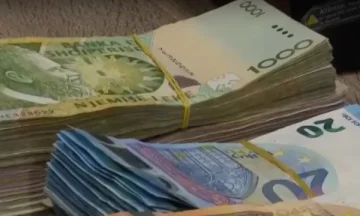
According to Kosovo Central Bank data, 213m euros was the value of foreign investments during 2018, and in 2017 their value was 287m euros.
The highest amount of foreign investment in Kosovo has been 440m euros in 2007, already the lowest, in 2014 with only 151m euros.
Blerim Ramosaj, professor at Pristina University, in a proposal for Radio Free Europe, said political instability in the country has influenced investors not to feel certain that their capital will invest in Kosovo.
In addition, he also cites the inability of Kosovo institutions officials to properly promote the numerous resources the country possesses.
Remember, the decline in investments is also the consequence of poor governance in Kosovo, respectively, high levels of corruption, different forms of arbitrary governance in the sense of receiving tenders from suspicious businesses. So there are a number of factors. Of course, both law instability and investment promotion, whether in the area of tax change of”, Ramosaj said.
Foreign investors navigate in countries where rule order and law, in countries where there is no corruption and economic crime, says economic expert Ismail Kastrati.
In a conversation for Radio Free Europe, he says foreign investors are interested in making investments have guarantees and opportunities to return to the owner. And all these preconditions, in Kosovo, according to him, do not exist.
If an investor comes and runs from office to office without having the opportunity to get an exact answer for his demands, the investor certainly left Kosovo”.
“We have many cases where investors are oriented to invest in Kosovo, have found no environment and have left. Besides foreign investors, this is happening with our diaspora unfortunately. Thus, foreign investments have no environment in Kosovo”, Kastrati points out.
The poor environment for foreign investors, according to Kastrati, has created Kosovo's own leader or institutions officials.
“particularly institutions officials have created inadequate environments or are part of crime and corruption”, he said.
On the other hand, Berim Ramosaj says that even the 100 per cent tax application for products imported from Serbia and Bosnia and Herzegovina affects the decision of foreign investors to hesitate to invest in Kosovo. This, according to him, questions the sustainability of economic implementation and fiscal policies.
Foreign investors, according to him, prefer states in which the market is liberalised.
“A foreign investor sees that a government can make such irrational decisions in an economic sense, but completely coloured political one, obviously that has its own negative effect. I'm not the one who can say that such a tax is bad or good, but it's not economically processed, while the government reasons the tax in a political respect. No doubt any political interference in the area of economic policies is a bad signal for potential investors, because they do not see Kosovo as a serious place in the sense of law sustainability, rules, norms, whether in the field of taxes or other areas“, Ramosaj said.