24 minutes ago
20 years after the fall of Agim Ramadani Why was his nickname Katana?

Periskopi(7 years ago)
(7 years ago)His portrait is often displayed in stadiums by fans. Today, 20 years from the start of the Kosovo battle, we remember Agim Ramadani, military, poet, painter and one of the most important commanders of the Kosovo Liberation Army and the entire war for freedom. Coming to life on May 3, 1963, Agim is one [...]
Today, 20 years from the start of the Kosovo battle, we remember Agim Ramadani, military, poet, painter and one of the most important commanders of the Kosovo Liberation Army and the entire war for freedom.
Born on May 3, 1963, Agim is one of five children raised by Father Hysni and Fetije. Mastered in school and artistically inclined, the middle is performed in the Gjilan technique. When demonstrations that begin after the incident at the Pristina University cafeteria erupted in March 1981, Agim Ramadani takes an active part in them, which costs the arrest.
It is released two months later, and after graduation, it leaves for Croatia, where it is registered at the Military Academy in Zagreb. Dawn from Gjilan graduates as an engineer for land communications, formation that will serve years later not only him but the history of the countrymen in war.
After serving for some time in the Yugoslav Army, Agim Ramadani decides to leave it by deserting him. Emigrates in Switzerland, where it starts life as many Albanians in search of better conditions for itself and relatives.
He pursues his artistic passions and is addicted to national issues. She's intelligent, Dawn, and she realizes that freedom doesn't come with words, she's won by armed warfare. Joining other Albanians, and when the Jashari family falls in Prekaz in March 1998, he decides to return to Motherland and join KLA forces. His military experience and his formation as a ground communications engineer in Zagreb make Agim Ramadan's contribution to the freedom struggle remarkable.
The handsome, informed and wise boy, Agim's first leg is in Albania, where they mobilise young people gathered there in the preparation exercises before leaving for war. His talks are inspiring, and military preparation makes him convincing.
On June 24th 1998, Agim Ramadani finally enters Kosovo and heads the 138 Brigade in the Dukagjin Operative Zone, which was headed by Kosovo's current prime minister, General Ramush Haradinaj. First, he deals with demining territory in the highlands he operates, helping a large number of residents cross the border safely and go safely to Albania, away from the enemy bullet.
Commander Agim Ramadani, in the freedom fight, receives the nickname “Katana”, the thin and sharp sword used by samurai warriors in Japan, accurate and deadly.
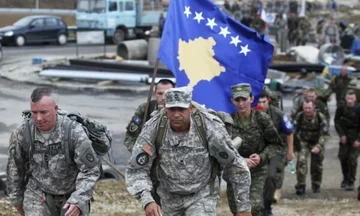
Commander “Katana” becomes part of the legend in one of the most important battles of war. On April 9, 1999, at the top of the operation “Arrow”, Agim Ramadani and “Cobra” of Brigade 138, launch a frontal attack with the enemy in the early hours of the morning. The goal is to break the Albanian-Albanian border so that the weapons and logistical materials coming from Albania were to cross freely to supply the Kosovo Liberation Army.
Kostunica's battle, after 86 years, removes the line between Albanians of the republic and those in the fight against Slavic elector. It makes the boots of soldiers, which (absolutely not figuratively) kick the border stone by eventually throwing it down. Commander “Katana” after achieving the goal is documented by distributing cigarettes to his friends. Freedom is now closer than ever.
If I rest,
Your freedom with dirt;
And my blood.
If they kill me without a fight. ”
In one of the verses of his poems, Agim Ramadani makes clear what his background is and which ideal he is guided by. Commander “Katana” becomes part of eternity two days later, when I close my eyes on April 11, falling into battle. The pain between friends is great. Albania loses a precious native and brave boy, Kosovo a son who gave his life for her freedom.
The 138 Brigade immediately after the fall of the commander takes his name, called “Agim Ramadani”. Kosovo's war ends in June 1999, the school “Bashim” in Zeger, the nation's first hero, today bears his name.
Agim Ramadani, with skillful intellectual and military formation, good patriot and brave warrior, left his wife and children in Zurich putting the machine on the shoulder and held the radio taken in hand to fight for freedom.
A statue of the commander today is located near the city theater, and near the bronze boot is a borderstone from those who were broken today 20 years ago in Kostunica.