4 minutes ago
Banks ruthless in assessment of assets left mortgage

Periskopi(8 years ago)
(8 years ago)Commercial banks operating in Kosovo are overestimating the value of real estate left as mortgage or collateral, in case of borrowing, say experts on financial issues. In Kosovo over 1.2 million citizens are clients of 10 commercial banks, about 382 thousand of them have different loans, whether for companies or households. [...]
In Kosovo over 1.2 million citizens are clients of 10 commercial banks, about 382 thousand of them have different loans, whether for companies or households.
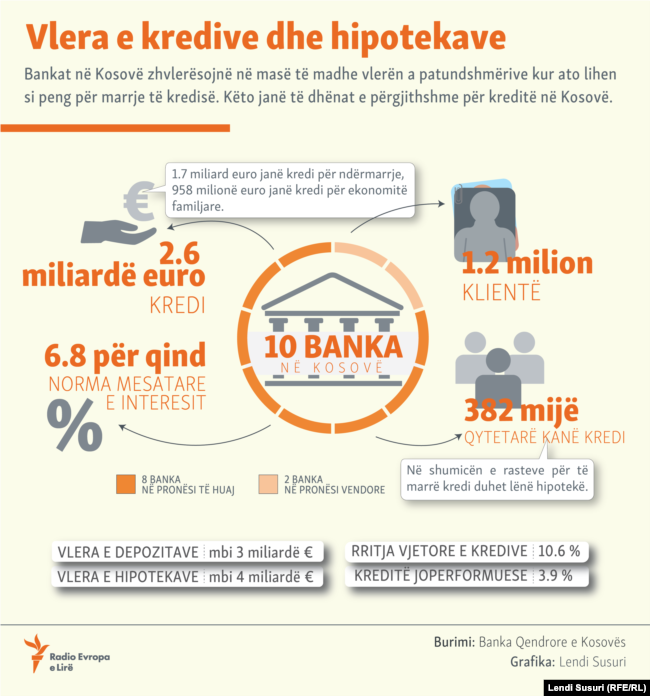
The value of loans for enterprises and households has reached over 2.6 billion euros, while the value of all real and playable assets, left as mortgages, according to the Central Bank of Kosovo (BQK) for the month alone, has reached about 54m euros.
Among those citizens who have taken loans to one of the commercial banks is Albert from Pristina, who as collateral at the bank has left an object of residence. He considers that the value of the object is several times greater than the value of the loan it has received. Albert says the bank has depreciated its wealth to 40 percent.
“Banks work for their own interests and normal, which my property value has been depreciated by 40 percent less, from the real market price. It is not fair to be underestimated in this percentage” says Albert.
Things that can be left on the mortgage are real estates, such as soil, buildings, and anything that is firmly and consistently embedded with soil or building.
Experts on financial issues, meanwhile, estimate that the overall value of all property that is both playful and real could reach over four billion euros.
Majid Bektashi, professor at Pristina University, simultaneously former head of the Kosovo Central Bank Board, tells Radio Free Europe that commercial collateral banks depreciate up 60 per cent of the real value on the market.
For assessing real estate in Kosovo, there is a regulation of the Central Bank of Kosovo, in which it says that “all assessments should be in line with generally accepted rating standards, which are known as the European Rating Standards, and that at least should be based on the definition of market value.
However, real estate values are not specifically set in this regulation. The main problem is to assess real estate. In such cases the value of mortgages is several times greater than the value of loans. In this case, the value of loans borrowed from corporations or other firms affects banks to protect their interest in devaluation, for approximately the real value of mortgage between 30-40 percent of the real value”, Bektas said.
Based on the real estate assessment regulation is realised by licensed assessments, which must prepare a written statement independently and impartially.
In Kosovo the Association of Appreciatives operates, operating within the framework of the Kosovo Economic Ode. Gent Sejdiu, secretary at the association, says real real estate assessment is realised at market price. But, he says, it is possible that later banks with their domestic policies may change the rating due to eventual credit risks.
“is validated according to market prices, comparison methods are made, different methods exist, reference is taken in property areas, and European standards become property assessment based. Financial institutions from the association require real market value, but then based on their internal policies, due to risk, banks may change the assessment” says Sejdiu to Radio Free Europe
The depreciation of assets that serve as collateral has specifically caused businesses to hesitate to take loans at commercial banks, Bektash says.
“Because banks want to have very strong guarantees if the recipient loan is delayed or fails to return loan” Bektas said.
If customers do not have the opportunity to pay off their obligations to the banks in which they have taken loans, this real estate will be released through public auctions, but in almost all cases sales fail, because citizens so far have no interest in buying the wealth left.