a few seconds ago
Phillips: Sharing or exchanging territories - the worst option

Periskopi(8 years ago)
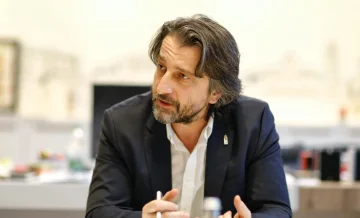
(8 years ago)Foreign Policy expert David Phillips says the idea of dividing or exchanging territories between Kosovo and Serbia is the worst option for resolving problems between the two countries. Phillips, director of the Peace Building and Human Rights programme at Columbia University in New York, says the Union [...]
Phillips, director of the Peace Building and Human Rights programme at Columbia University in New York, says the European Union and the United States should mediate a solution that answers Serbia's concerns but does not affect Kosovo's sovereignty.
Voice of America: Professor Phillips, you are against the idea of exchanging territories, or correcting or changing borders between Kosovo and Serbia. If the two countries agree and if this is the only way to move forward, what is there to be against you?
David Phillips: It's not the only way forward. There are other options. At the moment, Kosovo does not have many good options, but dividing or changing borders is the worst option. It would create instability, it would be dangerous, cause violence in Kosovo and Serbia, and we should remember that the 1990s were a bloody period in the Western Balkans. The principle of democratic and pluralistic states is something many people sacrificed and gave up their lives for. We must not abandon that principle especially when other options, which are better than separation or exchange of territories.
Voice of America: Like what?
David Phillips: Let's think about what is important to Serbia. First we must remember that Serbia lost Kosovo, Kosovo will never go back to Serbia, will be an independent state forever, so Serbia should be realistic for its goals. First of all, it wants to have decentralisation in line with the principles of the Ahtisaari plan. This idea is designed through the Association of Serbian municipalities and should have a flexibility on both sides to determine AKS authorities. What is important is that Kosovo does not give up security functions -- that is, police and local courts -- should maintain competencies for local and urban planning, as well as management and ownership of natural resources. The other priority for Serbia should be protection of status for Serbian monasteries, such as Decani. It is possible to resolve these substantial concerns, without compromising Kosovo's sovereignty. The time has come for dialogue in Belgrade to bring a conclusion. It's both over. Serbia is responsible for delays and obstructing dialogue, the European Commission has not insisted that Serbia implement the agreements that have been reached and from President Obama's administration until now, the United States has not been fully committed. So it is time for Kosovo's political leaders to increase commitment to an agreement that gives answers to substantial Serb concerns, while simultaneously defending the principle of sovereignty and territorial integrity.
Voice of America: When I say the only way forward, I mean that it's the only way both sides can agree to, because all the options you mentioned are true, but the fact is that Serbia has not agreed on either one of them, so if that's the way to agree like Belgrade and Pristina, that's what I mean when I say the only way forward...
David Phillips: Let's be clear about something: Serbia is the one detecting the steps. Serbia should be given instructions by the European Commission, by Mrs. Moghrin about what is possible to be realised through Kosovo-Serbia dialogue. What is possible is an agreement for the Association of Serbian municipalities and protection for cultural icons and monasteries. What is not possible is separation or changing borders. It would be a formula for failure and would be dangerous and a source of instability. And if Serbia disagrees, Serbia must face the fact that it will remain isolated in Europe, Article 35 (of European neighbourhood and enlargement negotiations) will keep it out of the EU and will not be able to achieve the goal of normalisation, peace and prosperity. Serbia was the aggressor, Serbia is responsible for crimes and must now face the fact that Kosovo has lost and must reach the most favourable pact within a given period. Negotiations cannot continue forever, there must be a deadline for reaching a final point.
Voice of America: The truth is, there has been no progress between Kosovo and Serbia for 20 years. What, then, is wrong with such a course?
David Phillips: It's dangerous, it will destabilise the region, it will include population transfers and violence. And this is just a short list of evil with the division or exchange of territories. There are other options that are applicable, if the European Commission is willing to play its role, not only gather the parties for a photograph together but engage in real diplomacy, real mediation. Reach an agreement that is satisfactory for Serbia and enable us to solve this problem once and for all and set a deadline. At the end of Mrs. Moghrin's mandate we should have an agreement and if not then, Serbia should put aside its EU aspirations, because it will never enter the EU unless there is normal relations with Kosovo, so let us move forward. Enough of this for 20 years.
Voice of America: But if Kosovo gets guarantees from Serbia that it will recognise, receive guarantees that it will become a member of the United Nations, would that not be a favourable agreement?
David Phillips: The only way for Kosovo to become a member of the UN is if Russia and China don't veto. So international guarantees may sound good when we talk to cameras, but actually the evidence lies in concrete results.
Voice of America: What do you think changed in the international community because it is shown by claims that Washington and the European Union can accept this idea?
David Phillips: I've read the statements and there's nothing there to suggest that the United States agrees with partition. There is nothing in Ambassador Delawi's interview to suggest that the United States supports him. And as far as the recent meeting of the prime minister and Serbian Deputy Prime Minister in Jared Kouchner is concerned, we have not seen a White House statement about that meeting. We heard what Dacic said repeating his position that all options are on the table. Serbia is not the one deciding here. The international community should play its role as mediator and should have a fair agreement enabling Kosovo to move forward, recognise and Serbia to accept as sovereign and independent state and then deal with other issues like EU countries that have not recognised Kosovo, UN membership. Division is not the right way, partition is a dangerous and destabilizing proposal. This idea must be abandoned.
Voice of America: What I mean as a difference is that in the past this idea has been rejected, and now we hear formulas like “both sides must be flexible” and “ne we will agree with whatever the sides agree to”...
David Phillips: The American government does not have a consistent policy towards Kosovo, it does not cost the Western Balkans any importance. I don't think we should read more than enough in these vague statements. For now, American politics is what it was. He recognises Kosovo with current borders. This has not changed. Other states that have not recognised Kosovo have the opportunity to do the same that over 100 countries have recognised. We need to think about Serbia's central interests and we can resolve without taking dangerous steps towards partition that would create destabilisation.
Voice of America: One of the main arguments in international relations that conflicts with this kind of solution is very dangerous to build states on ethnic grounds and democracy, states build on multiethnic foundations. But the truth is, for many reasons the North has not been integrated, has it...
David Phillips: Yes, the principle of pluralism and democracy is a cornerstone of American politics, as well as of the EU stand for countries that want to membership. The reality is that if the EU is not ready to mediate an agreement that allows Serbia to recognise Kosovo with the current borders, then Albanians will start thinking about uniting Albanian territories and creating an Albanian state to include lands where all Albanians live. That would be a logical result of the EU's failure of mediation. That's why this should serve as the alarm bells for Mrs. Mogher. Let's impose a deal on Serbia, make a compromise for it attractive, and move forward. Otherwise we're going to start changing the map of Southeast Europe and that would have unpredictable consequences.
Voice of America: But what would be the problem of uniting Albania and Kosovo if the two countries agreed in the future?
David Phillips: I'm neutral to that proposal. If Albanians, Kosovo and Albania want to join, and Albanians in other countries like Presevo and Macedonia want to join them, or establish a federal relationship, it is a decision that belongs to the Albanian nation. There is nothing wrong with the unification of Albanian territories. This is the line Vucic is using for the union of Serbs. This is exactly the game Milosevic was playing, spreading conflict and war and carrying out ethnic cleansing. But before that happens, the EU must choose -- whether it will be mediating and propose an agreement that protects Serb communities and Serbian culture, or will allow the opening of a troubled Pandora Box. 38:54 If the EU fails to mediate an agreement between Serbia and Kosovo, there is nothing preventing Albanians from thinking of other options, including the unification of Albanian territories. It is time for diplomacy to show that it can solve these problems, and the only solution is for Serbia to recognise Kosovo as an independent and sovereign state. The division or exchange of territory are just code for uncertainty and chaos and violence. They're not a functional alternative.
Voice of America: Suppose this proposal is made, put on the table and Kosovo and Serbia agree to do so, whether it is a bad or a good idea. What would prevent its realization after agreed upon?
David Phillips: This is not a deal that will be made behind closed doors. There must be transparency. Consultation should be made with the Kosovo assembly, civil society must say its word. It is not an agreement that will be discussed and reached between presidents and then presented to their public. The peoples of Serbia and Kosovo should say their word, there are many practical issues that need to be resolved: the Trepce mine, what to do with the Serb minority in other parts. We need an effective plan and partition is not an effective solution, it's a path to chaos, confusion and violence. It is also a matter of responsibility. Does a separation agreement mean that the issue of missing persons will be forgotten? Will compensation issues be eliminated? It is easier and more positive to solve current issues.