42 minutes ago
Border correction could violate Kosovo's sovereignty

Periskopi(8 years ago)
(8 years ago)The idea of a peace agreement between Kosovo and Serbia involving “correction of the border”, which has been promoted by the presidents of the two countries, Hashim Thaci and Aleksandar Vuciqi, within the framework of the European Forum in Alpbach, Austria, could open extraordinary problems unless the details of the eventual realisation of a [...]
Former head of Kosovo Constitutional Court Enver Hasani, professor of Law and International Relations, speaking of Radio Free Europe, says the eventual realisation of the “border correction” would put Kosovo in a unfavourable position, while reflecting Negative Effects Even for the Balkans.
Such a step, such as “border correction”, as Hasani says, would undermine standard parameters for Set Borders International law. This, according to him, is not known which criterion will be determining, along with ethnic criteria, and will make the process unpredictable.
International recognition of the independent and sovereign state of Kosovo, as Hasani says, has occurred according to the standards of identification and appointment of administrative borders, which were established in 1974, standard that was implemented in all republics of the former Yugoslavia, but in all former communist federations.
“ towards Serbia. This, it means, is the element that makes Kosovo's territorial identity more unpredictable and the consequences are extremely negative for the Balkans and for territorial problems that exist in Europe, everywhere. Correcting the borders is totally unacceptable, because it should become identification, fix borders, as they are done with other republics and other Kosovo neighbours, and then could be discussed on other questions”, Hasani said.
He has added since the present moment, when it comes to the idea promoted by the presidents, Thaci and Vuciq, looking constitutionally, cannot be about correcting the borders, but about exchange of territories, about the fact that there is still no identification of borders from both countries. The break-up of international border demarcation parameters, according to Professor Hasan, leaves room for different ambitions about changing borders in the Balkans, especially in Macedonia, as well as breaking the concept of the Dayton Agreement, with which the war in Bosnia and Herzegovina had ended.
Politicalologist Ramush Tahiri, meanwhile, tells Radio Free Europe to reach an evental agreement for “border correction” between Kosovo and Serbia, there are normal procedures, as well as for each state. According to him, there must be mutual recognition among states in advance, there should be guarantees and recognition of borders, as well as marking those borders on the ground. After these procedures, as Tahiri says, independent states can hold talks on restructuring borders.
“Goodpo, it seems that Vuciq and Thaci have agreed that in the agreement for normalisation of relations between Kosovo and Serbia, Vuciq explains also as the final right division between the Serbian people and the Albanian people, the issue will be ignored. It means, both recognition and Kosovo's accession to international organisations either the joint request for the United Nations to accept Kosovo and that there is no obstacle from Serbia and that the limit considered to be correct is”, Tahiri stressed.
Tahiri, however, has added that Kosovo risks breaching the state if in a border correction agreement, it enters without grounds or without guarantee of sovereignty and territorial integrity, as well as if eventually there may be turbulence in Serbia and Kosovo, while the latter does not have internationally defined the border towards Serbia.
If the process, in which Kosovo would enter without defined territory, would be interrupted, then its sovereignty and territorial integrity would be damaged, as well as its international subjectivity as state.
In the name of peoples?
The idea of “correction of borders” is not viewed only by Serbian President Vuciq as solving the problem between two peoples, Albanian and Serbian.
During a media conference under the European Forum in Alpbach, Austria, President Thaci has said that “we are willing to reach the agreement between Albanians and Serbs”, President Thaci stressed.
But do both presidents have the legitimacy and legitimacy to speak for the two peoples?
Professor Hasani says that neither Kosovo nor Serbia have a mandate to resolve the Albanian-Serbian issue and that this issue does not belong solely to political leaders in Kosovo and Serbia.
The “in the first order, that megalomane statement, is unstable for political reasons. Neither Kosovo nor Serbia can solve the Albanian-Serbian issue, because the Albanian-Serbian issue is not the issue of this issue in Pristina and Belgrade, but it is an issue affecting regional interests and transatlantic interests. It means, they have neither capacity, but neither a mandate nor a Vuciqi nor Thaci, to deal with the matter”, Hasani said.
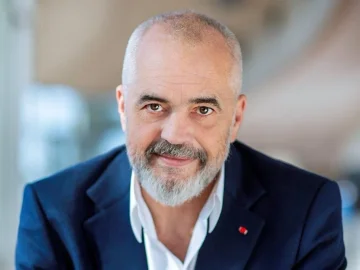
But, politicologist Tahiri says that to solve the so-called Albanian-Serbian century conflict, it is obvious that Serbian President Vuciq does not want to talk with Albania's president, Eddie Rama. Similarly, according to him, the latter also does not want to talk about the matter with Serbian President Vuciq, because Kosovo -- from 1912 to today -- has created a kind of political entity.
The “seems to have co-ordination, but also agreement between Albania and Kosovo on determining the ethnic border in the northeastern part of Albanians lies in front of the Serbian people. In fact, they have authorized Hashim Thaci, as president of Kosovo, who also on behalf of Albanians, but actually on behalf of Kosovo, to establish the right limit, by respecting both the linguistic criteria, but also the ethnic criterion, for the most part possible, but not insisting on the population's exile and on completely ethnic borders, that there be no Serbs here and that border there should be no Albanians, said Tahiri.
However, Professor Hasani has stressed that Kosovo's sovereignty is territorial and that if it is directed towards realising the idea for “border correction” with Serbia, which is currently undefinable, then will be questioned The country's sovereignty and territorial identity, which is prohibited with the Kosovo Constitution.