a minute ago
Seven years of political, technical dialogue with Serbia

Periskopi(8 years ago)
(8 years ago)Since 2011, Kosovo and Serbia's delegation to Brussels have signed a string of agreements, but most of them have not been implemented, or have been partially implemented. Finally, the Government of Kosovo has issued a summary report showing that most EU-brokered agreements have not been implemented by [...]
It was March 8th 2011 when Kosovo as a state for the first time sat down at the table of talks with Serbia under technical dialogue, which was beginning between the two states, mediated by the European Union. After several achieved and stalled agreements were being implemented, a year after 2012, this dialogue was raised to a political level.
Already when seven years of political and technical dialogue with Serbia has become, almost no agreement reached is being implemented overall. The achievements and challenges of this dialogue have already been summed up in a report drafted by the Haradinaj Government and concerned primarily the unwilling authorities in Serbia to implement part of the agreements reached, RTK reports.
As far as the agreement on establishing association remains, the Government considers the challenge in implementing this agreement the opposition parties in Kosovo to be opposed. Therefore, it is considered that it will be challenging to achieve the balance between requirements set out by the Constitutional Court and the interests of the Serb community.
In the agreement on the integration of the Kosovo Police and the extension even in the north, the challenge, according to the executive, remains ID documents, labour contracts, professional statements, duty oath and promotion system.
While the justice agreement, where extending justice even to the north of the country, remains the challenge of direct communication of Kosovo institutions with those in Serbia. Serbia stamps the documents with the inscription: “Republic of Serbia Kosovo and Metohija under UN administration and Resolution 1244”. This stamp is placed in the original documents of Kosovo courts and other bodies in the north.
In the civil defence section, although 483 northern Serbs have integrated, they have contracts with Kosovo institutions, in practice they do not exercise their positions in accordance with Kosovo's laws. They do not report to Kosovo institutions.
Meanwhile, the Government report found that the agreement reached for energy in Brussels has not marked any progress. As a result, the lack of its implementation is hindering COSTT from meeting obligations under the Energy and License Law, as well as meeting obligations, according to the EC directive and the Energy Community Treaty.
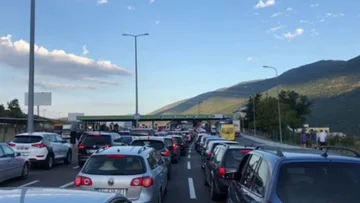
As for the customs issue, the report stresses that Kosovo's customs are implementing the integrated border agreement, but no progress has been achieved by the Government of Serbia for two years in the construction of 3 permanent checkpoints in Jarinje, the White Land and Muciba.
In freedom of movement, the challenge remains to register the facts of the civil situation by illegal structures and to reject Serbia of regular documents issued by Kosovo.
The agreement on removing barricades and releasing the Ibër Bridge in Mitrovica is considered to be partially implemented. According to the report, all of the Government's obligations have been carried out, while the process has been imposed on the part of the Northern Mitrovica municipality.
While the regional co-operation agreement, which envisions Kosovo's accession representation, although it has noted progress, it has often been followed by negative and misinterpreting commitments on Serbia's part. According to the Government report, in some cases Serbia is actively committed to putting Kosovo in a difficult position when it comes to using the symbols and its name. While the deal for Diplomat, which was considered a good step for Albanians in the Valley, has remained only on paper.