3 minutes ago
Rasp: Belgrade is using Kosovo Serbs for dialogue

Periskopi(7 years ago)
(7 years ago)The voice of Kosovo Serbs has disappeared and all mechanisms have been put into service by a political group, the Serbian List, which is not doing anything positive for the Serbian people, says in an interview for Radio Free Europe, former Labour and Social Management Minister in the past government mandate, Nenad Rassic, leader of the Party [...]
The voice of Kosovo Serbs has disappeared and all mechanisms have been put into service by a political group, the Serbian List, which is doing nothing positive for the Serbian people, says in an interview for Radio Free Europe, former Labour and Social Management Minister in the past government mandate, Nenad Rassic, chairman of the Democratic Progressive Party.
He emphasises that official Belgrade is using Kosovo Serbs as an instrument for deployment before dialogue, but for other reasons as well. Despite both sides in tough courses, Rassic expects the final phase of Kosovo-Serbia dialogue to begin soon.
Radio Free Europe: Mr. Rassic, how can you describe the situation in the Serb community in Kosovo, but also their political representation in Kosovo institutions from the Serb List, which participates in both levels of power, central and local?
Nenad Rassic: What they did in the year we are leaving cannot be measured in a positive sense. Unfortunately, in a negative sense, because they have been used as a mechanism that, after all, wanted, has, in effect, imposed a fatal policy on potential correction, separation, or changing borders, consider it as you wish. With this idea itself, it has damaged and endangered Serbs so much, especially in the south (Iber River), that we are already talking about the potential ecstasy that could happen if that fatal idea is to come to light or be on the negotiating table.
Therefore, unfortunately I don't even see a positive example from the Serbian List, but I see full negative examples, and that's our biggest problem. This is the biggest problem in northern Kosovo, where our voice has disappeared and where all mechanisms have been put in service only for a political group, which ultimately works nothing positive for the Serbian people.
Radio Free Europe: In two cases this year we have seen that political representatives of the Serb community have boycotted Kosovo institutions. In March, the Serbian List has said it has abandoned Kosovo Government. Meanwhile, recently four mayors of northern municipalities have resigned. Have such actions resulted?
Nenad Rassic: I don't know if there may be any legal consequences, but as far as the political consequences are concerned, in this case, with these mechanisms, with a captive system that functions according to a direction that is not local, but more regional, I think the consequences at this point can be quite limited. Why would I say that? Initially, I said even earlier about what's better, if we compare the current situation in Serbia where rights are actually minimal with the one here in (Kosovo) it has been that here we have been able to say what we think. This has been allowed and continues today. There was a chance to express itself, to speak. Meanwhile, in the current case, unfortunately, all mechanisms -- especially mechanisms like television stations and other mechanisms -- are used just to plant the conviction that, for example, separation is the best thing for Kosovo Serbs.
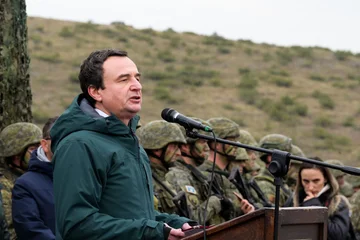
Goran Rakiq, chairman of North Mitrovica, addressing Serb protesters in this municipality, following the northern municipal mayors' decision to resign. November 27, 2018.
Since the establishment of the tax on Serbian goods is becoming an improvisement of the alleged humanitarian disaster, which would eventually have to enable a part of Kosovo's north to be split, united or corrected. What does that mean? The mechanisms that have been used to prevent Kosovo Serbs from speaking are great and very powerful. What is most tragic, all those media, not only in Serbia, but also I am talking about local media in the Serbian language in Kosovo, are almost as much as entirely dependent on the financial assistance they receive from the funds of the Republic of Serbia. That means that almost everyone is obliged to serve bad ideas, such as setting limits, correction, or whatever you call them. In any case, this manifests itself catastrophicly in the local Serbs, who simply no longer have the strength to fight against all those tools and all those radical mechanisms, which every day affect us, either verbally or via television screens or even through the institutional expectations used against citizens.
Radio Free Europe: Are you thinking that Belgrade, in this case, is using Kosovo Serbs as an instrument to create itself as best in future dialogue?
Nenad Rassic: Absolutely yes and it's not just about the dialogue process. You also use them for many, I call things of less importance, like the impact on the economic sphere in any form, so that representatives of the Serbian List can be closer to them. They are used where the Serb List or Kosovo Serbs can only be established as a mechanism for straining relations.
In the negotiations process or agreements, it is always easy for Belgrade to exploit Kosovo Serbs so that they can say okay, we will not participate in the Assembly, we will tear down Government or any other mechanism, only to make their efforts concrete, whether in a political sense.
But I say they even go one more step away. There are even links to the economy, which they can use through Kosovo institutions mechanisms. At this point we come to the conclusion that Serbs are only means to someone else's plans and plans of someone who does not live at all in Kosovo. In addition to those expectations that I am mentioning and that official Belgrade is using through the Serbian List, responsibility is not at all the smallest of both Pristina and the European Union, because they are mute observers of what is happening in Kosovo's space, and that is what irritability. It seems that all are being accompanied, for their own interests and no one for the interests of Kosovo Serbs, and that is the greatest disappointment.
Radio Free Europe: Do you expect there to be a faster approach to dialogue?
Nenad Rassic: I think so. Despite the fact that both sides are on strict courses, I consider all of this to be recorded and that it's not entirely that way. Even this last letter sent by the President of the United States Donald Trump speaks of what maybe someone there is losing patience to play with us for years and decades. Therefore, I think that this is more imagined and is becoming more of a matter of internal need and that in general it is not an obstacle that could be a problem for continuing dialogue. So when it is estimated that conditions for reaching an agreement are ripe, they will easily and easily sit at the table. But in this case, it will be different from other meetings, because I expect from the next period, whenever future meetings are scheduled, they will be fewer in number. In fact, if there will be one, two or eventually three meetings, a decision will be made on them. Otherwise, I don't like the term "final agreement" because it's not, but it might be called beginning the final agreement. To finalize the deal will take a few years.
When we talk about normalisation, either, as I would call it, harmonising relations between Serbs and Albanians in the Balkans, it will be a process, because you cannot stabilise relations with only one signature. The signature may only begin normalizing relationships. Only after that must true reconciliation be made on the ground among peoples. Of course, reconciliation requires a level of tolerance, responsibility, and understanding of the other side so that harmony or peace can be achieved, whatever we call it. So, I'm sure the dialogue will happen soon, in several rounds and then we're left to apply it as we consider it to be on the ground. Most important is reconciliation on the ground, among people.
Radio Free Europe: You mentioned the letters of President of the United States Donald Trump, who were sent to the two presidents, Kosovo and Serbia, Hashim Thaci and Aleksandar Vuciq. How do you evaluate those letters?
Nenad Rassic: In fact, I was the first four months ago to speak, based on the impression they left through the “language of the body” that they (Thaci and Vuciq) have already reached agreement. So I was impressed with their attitude towards each other, their handshakes, as if they had agreed on something. On the other hand, if that's correct and if I was right about what I said, that meant they talked in the background, out of the eyes of opinion or didn't give opinion any information or just a little information.
Therefore, President Trump's letters can be understood in two ways. The first one, is what I say, that they're hearing about a deal and Trump, in no direct terms, has been informed of this and now sends letters to say okay, you've already talked about the frames. Let's go now to concreteize and sign the deal or go to the approval period in your lands or your institutions. This is the first way. It may also be second, which can be explained in the way that we say Trump doesn't know the relationship between Serbia and Kosovo, or, I don't know, in detail, and that someone from his administration has proposed these letters to start and stimulate further talks. It would surprise me that if someone from the U.S. Presidential Administration did something like that to send brave letters to both presidents. So if I had to split it into percentages, I think 80 percent is the first option I mentioned and 20 percent the second option.