a day ago
Hepatitis B's oldest case, 16th - century plague

Periskopi(8 years ago)
(8 years ago)This zombie was found in 1983 in the Basilica of San Domenico Maggior, Naples. It belongs to a 2-year-old child who died about 1569. Tests conducted at the time of the discovery signaled that the baby may have been touched by the leaving. Now DNA evidence on the remains revealed the truth. The child does not [...]
This zombie was found in 1983 in the Basilica of San Domenico Maggior, Naples. It belongs to a 2-year-old child who died about 1569. Tests conducted at the time of the discovery signaled that the baby may have been touched by the leaving. Now DNA evidence on the remains revealed the truth. The child suffered, not from leaving, but from hepatitis B. In some cases children affected by this disease can develop what is known as syndrome
Gianotti-Crosti, a sort of quantum infant corruption that often provokes to appear in the face some signs that might be confused with the ones that leave. That's exactly what got the scouts confused when they did their first studies, but now thanks to DNA samples taken from the skin and mummie hair, Pisa University researchers have managed to extract the full genom of a type of hepatitis B virus.

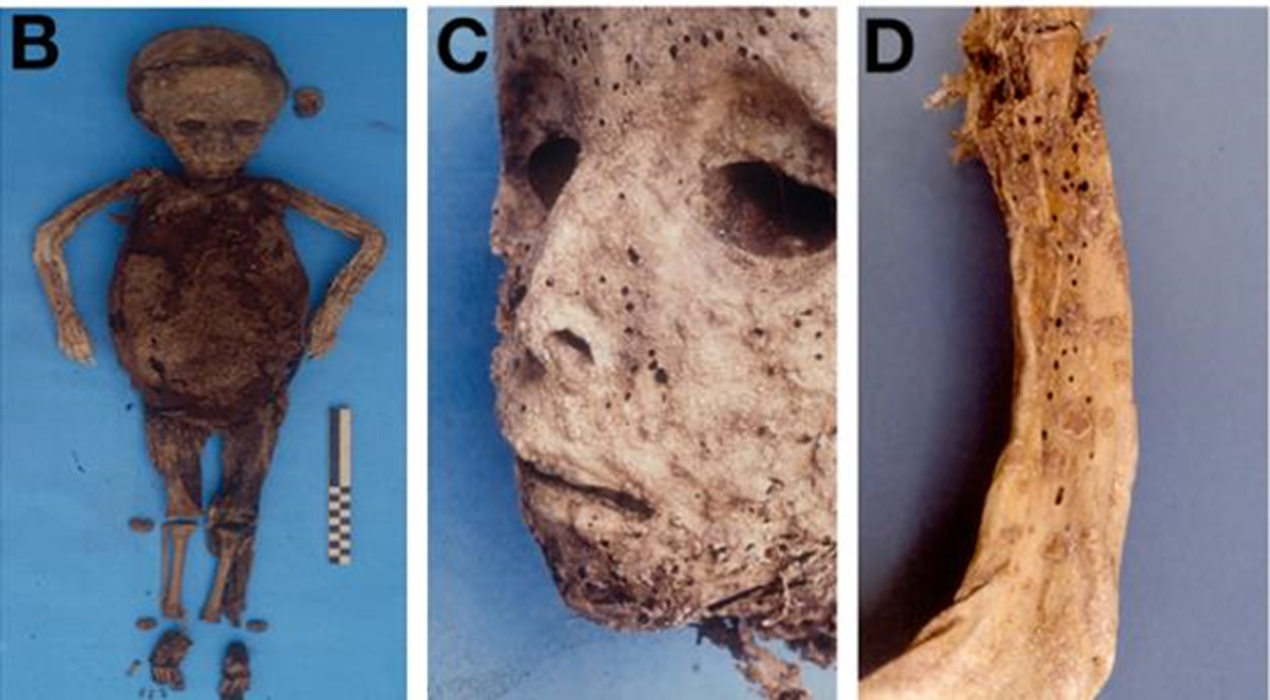
What has attracted the most attention was that it resembles many kinds of modern viruses, which means that this virus has evolved very little over the centuries. What scientists do not yet know is an evolutionary time structure of the virus, in short they do not know at what point did these mutations occur that differentiate the ancient virus with that of currentity. However, this discovery assumes the earliest proof of this disease. So far, the first record for hepatitis B dates back to 1885, the date on which the disease was diagnosed in over 100 workers working at a shipyard in Germany. /The world.al