7 minutes ago
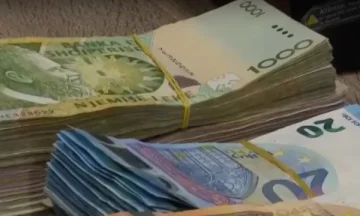
That's what the ministers spent on lunch and official dinners.

Periskopi(9 years ago)
(9 years ago)In order to perform tasks and tasks within responsibilities, some public officials are allowed to spend lunch, dinners, drinks and gifts for various official meetings to be covered by the Kosovo budget. These expenditures within the budget are classified as “responsions of representation”. But with the aim of more efficient budget management [...]
In order to perform tasks and tasks within responsibilities, some public officials are allowed to spend lunch, dinners, drinks and gifts for various official meetings to be covered by the Kosovo budget. These expenditures within the budget are classified as “responsions of representation”.
But, with the aim of more efficient management of Kosovo's budget for this category of expenditures, in 2008 an administrative guide has been adopted, which has defined the way and the amount of representation spending for top public officials, GAP reports.
According to this instruction, there are 12 positions within the institutions of the Government of Kosovo that are eligible for representation spending. According to Article 5 of this instruction, the prime minister and his deputy have no restrictions on this budget category.
The ministers have the right to spend up to 500 euros a month, deputy ministers up to 200 euros, political advisers up to 100 euros, ministry cabinet chiefs up to 50 euros, and so on.
Representation spending is used only for covering the expenses of official meetings and cannot be used for other purposes. These expenses should be argued with bills, and in the event of exceeded restrictions, the excess amounts must be covered by officials themselves, said further in the GAP report.
But how much have public officials spent on representation during 2016?
Resultation spending enters the economic category of <x0 frugs and” services. “According to the Ministry of Finance's annual financial report 2016, which gives little detail, during 2016 alone, some 2.9m euros have been spent on official lunches both at home and abroad, or 3% more than in 2015”, the GAP report says.
In a request submitted by the GAP Institute for Respondance Expensions for 2016, the Office of the Prime Minister, the Ministry of Finance, the Ministry of Education, Science and Technology, the Ministry of Environment and Space Planning, the Ministry of Culture, Youth and Sports, and the Ministry of Foreign Affairs. While the Ministry of Justice publishes weekly spending reports that include spending on representation, but not in the format of our demand. The only time the Prime Minister's Office has responded to this request has been 2013 with the 2012 data.
In comparison to past years, we have accepted the lowest level of responses from ministries this year. This shows that the Law for access to public documents is not being respected, and that declarations of the Finance Ministry for increasing budgetary transparency are not true. Of the 13 ministries that have agreed to respond to our request, the Ministry of Infrastructure has responded at total annual expenses. The Ministry of Management of Local Power has declared that during 2016 it has paid the spending of representation for several months of 2015. This form of finance maintenance, but also of reporting on the part of some ministries, is not a context of administrative instruction for sub-repression spending 6.2”, the report said.
The data from these 13 ministries reveals that 202,777 euros were spent during 2016 for representation.
The European Integration Ministry cabinet has spent mostly, or 29,531 euros. The Ministry of Labour and Social Management ranks behind it at 22,745 euros and the Ministry of Public Administration at 19,509 euros.
According to the administrative directive for the appointment and presentation spending from the cabinet of the right ministries to representation spending have: Ministers, deputy ministers, ministry cabinet chiefs and political advisers.

The minister, who has spent mostly on representation during 2016, is European Integration Minister Bekim Colaku with 14,372 euros.
Minister Colak on September 9, 2016, has made his resignation public by the minister's post, but the spending report indicates that he has used the budget during the months of September and October. Following it are Minister of Public Administration Mahir Jagcilar with 13,560 euros and Labour and Social Management Minister Arba Abrashi with 12,189 euros. The top ministers, as well as ministers Ljubomir Maric and Hykmete Bajrami, have gone through a multiple month limit of 500 euros.

As for the expenses of deputy ministers, it is Deputy Minister of European Integration Ramadan Ilazi, who has spent mostly on representation -- a total of 11,380 euros. Following him are Deputy Minister of Agriculture, Forestry and Rural Development Radolub Mililovic with 3,275 euros, and Deputy Labour and Social Management, Qazim Nundman, with 3,224 euros. Top Czech deputy ministers have exceeded the 200-euro monthly limit.

While in the ranks of political advisers, there has been no overcoming in this category, GAP reports.
In this Link. . . . . . . . . (? . . . . . . . . . . . . . . . . . . . . . /Telegraphy/