3 minutes ago
“Deputes thought to undo the Special with the logic of Zanzi bart”

Periskopi(8 years ago)
(8 years ago)The effort of a group of Kosovo Assembly deputies to break up the Special Court through abolishing the Law for Specialised Chambers has failed, due to the fact that Kosovo Assembly Chiefship failed to secure the quorum to call an extraordinary session. This effort is being described as inconsistent, yes [...]
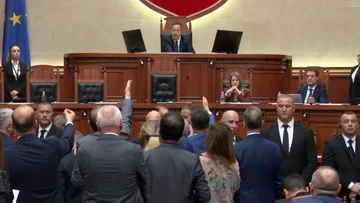
The effort of a group of Kosovo Assembly deputies to break up the Special Court through abolishing the Law for Specialised Chambers has failed, due to the fact that Kosovo Assembly Chiefship failed to secure the quorum to call an extraordinary session.
This effort is being described as inconsistent, and is even compared to earlier attempts by political leaders to abolish government coalitions, such as that of “Zanzi bar”.
Politologist Adem Beha, in an interview for Koha.net, has said that such efforts are inconsistent and that they come from a political elite as well as inconsistent.
The party's “Liders have alleged that they could abolish the Special Court with the same logic as trying to abolish government coalitions once in Zanzi Bar. This mindlessness points to this leadership's inconsistencies with the state, citizens and international obligations. What needs to be abolished is this very Zanzibarian political culture that you can find in most political parties in Kosovo”, said Beha legalist at the Department of Political Sciences at the University of Pristina.
He says the Special Court has come as a result of this political leadership's irresponsibleness to give the country justice, victims peace, and criminals punishment.
In this interview Beha speaks in detail about how the Special Court came to be. It also indicates whether the Court can be re-united.
Time.net: How have you seen developments in the Kosovo Assembly last night about the power attempt to abolish the Special Court Special Chambers Law? What's the rush?
Beha: I view these efforts as inconsistent of a non-serious political elite. Party leaders have alleged that they could abolish the Special Court with the same logic as trying to abolish government coalitions once in Zanzi bar. This mindlessness points to this leadership's inconsistencies with the state, citizens and international obligations. What needs to be abolished is this very Zanzibarian political culture that you can find in most political parties in Kosovo.
Time.net: Can we still remember what happened to the establishment of a special Court?
Beha: I must remind you that this Special Court has come as a result of this political leadership's irresponsability to give the country justice, victims peace, and criminals punishment. If there were a political consensus after 1999 for the establishment of such a court for prosecuting alleged crimes, Kosovo would be closer to democracy and further from authoritarianism, closer to the EU and further from isolation, closer to the constitutional state and away from the rent state. The base of this court should be sought by the assumptions of Carla del Ponte's first memoaries.
In her memoaries, the prosecutor's office: Confrontations with the worst criminals of humanity and the culture of impunity”, Carla Del Ponte cast the first doubts about the involvement of former UCK members in crimes against humanity, war crimes and other crimes on the grounds on which suspicion, later, the Dick Marty report would be drafted and the Special Court established. Del Ponte starts the chapter for Kosovo, with the statement that <x2 violence, fear and poverty silence witnesses”. It explains the difficulties in pursuing war crimes in a country like Kosovo without real institutions, with an Albanian population that had not yet found and buried their dead, where there was no practice of rule of law -- excluded here from the Lex Tylonis code, which more concerned a code of revenge described by Homer and the ancient Greek tragedy. According to Del Ponte, until U n NMIC intended to create order and law, despite limited resources, UCK military leaders portrayed themselves as heroic defenders of a victimised people, demanded political power and “used violence to eradicate enemies and opponents. The alleged crimes accused of by the head of The UCK in Del Ponte's memoaries comes out of the worst. It mentions 100 to 300 persons (this number is used with a high incompatible from Del Ponte) kidnapped and transported from Kosovo to Albania, which were located in Kukes, Tropoj and Burrel.
In 2008, the Parliamentary Commission for Legal Affairs and Human Rights at the Council of Europe appointed the Dick Marty Senate to investigate these claims, and in January 2011 the EC Parliamentary Assembly approved its report. The report supposes two types of accusations: the first charges concern the killings, detentions and disappearance of minority members and Albanian political opponents by members of the KLA during and after the war, while the second kind of charges has to do with murders, organ extraction and trafficking. Since The Hague's Tribunal had a mandate to try crimes committed during the war on the territory of the former Yugoslavia and not crimes committed after the war, part of Dick Marty's post-June 1999 crime report claims could not be addressed within the Tribunal, respectively. Consequently, the EU, rather than the UN, as expected to create a Task Force to investigate alleged crimes in Dick Marty's report. Clinton Williams, prosecutor of the Task Force he did not dismiss Marty's claims, instead said there is sufficient evidence of the establishment of charges against senior KLA officials. In April 2014, Kosovo Assembly deputies, with 89 votes and 22 against, ratified Kosovo agreement - The EU opened the way to establishing the Special Court.
The special came from the failure of leadership to give the country justice, victims' peace of punishment criminals, says Beha
Time.net: How do you see the reason for such a judgment?
Beha: One of the main reasons for the establishment of such a type of court and its deployment outside Kosovo was the lack of capacities, both EULEX and Kosovo institutions, for witness protection. In fact, both local justice mechanisms and EULEX, although the latter has had all the necessary capacities available to protect witnesses, have failed in Kosovo. U n NMIC and EULEX together have managed to try only 78 war crimes cases in Kosovo. This is hybrid failure both locally and internationally. Kosovo, along with these two missions, has failed to protect witnesses, brings justice to victims and follows perpetrators of criminal acts.
Time.net: Can the Special be undone?
Beha: The Special Court cannot be undone without changing the Constitution of Kosovo, the Article 162 with which Specialised Chambers and the Specialised Prosecutor's Office are established, respectively. The change of the Kosovo Constitution is currently impossible without approval of the Serbian List. Article 144 of the Constitution of the Republic of Kosovo envisions that 1/4 of the Parliament's deputies can propose changing the Constitution, and any change requires 2/3 of all MPs in the Assembly, including 2/3 of the deputies of the non-US communities, and that changes can be adopted in the Assembly only after the amendments have been proved constitutionally constitutional by the Constitutional Court.
We need to recall the whole process. In April 2014, Kosovo Assembly deputies, with 89 votes and 22 against, ratified Kosovo agreement - The EU opened the way to establishing the Special Court. To enable its establishment, the Constitution of Kosovo would have to be adopted. The Kosovo government had proposed to the Parliament an amendment on 7 March. On March 9, 2015, Kosovo Parliament Speaker Kadri Veseli had submitted the same amendment to the Constitutional Court to assess his constitutionality. Under this amendment, the Kosovo Constitution would be added Article 162. Article 162 founded Specialised Chambers and the Specialised Prosecutor's Office. Despite the fact that the Vetevendosje Movement in its comments sent to the Constitutional Court argued that this amendment was intended to create parallelism in Kosovo's judicial system, the Constitutional Court argued that the proposed amendment had four structural elements, which connect with the justice system in Kosovo: 1) the establishment of rooms specialising in the framework of Kosovo's justice system; 2) the establishment of the Specialised Prosecutor's Office; 3) the establishment of a specialised room in the framework of the Constitutional Court of Kosovo and 4) the appointment of a specialised Ombudsperson.
On 15 April 2015, the Constitutional Court of Kosovo, in its 18-page act, had found that this amendment did not diminish the human rights and freedoms defined with Chapter II and III of the Constitution of Kosovo. At the Kosovo Parliament session, held on June 26, 2015, the coalition P The DK-LDK had decided on the agenda this amendment to the adoption of constitutional changes, but had failed to get the approval of deputies in the Kosovo Assembly. Against constitutional changes through this amendment and opening the way for the establishment of the Special Court were V V, AAK and Initiative. On the other hand, nearly two months later, on August 3, 2015, the coalition P DK-LDK secured 82 votes, necessary for constitutional changes and, the same day, the Kosovo Assembly adopted Law No/05/ L-053 for Specialised Rooms and Prosecutor's Office.
The ad hoc courts, of the Special Court type, have shown relatively good success where they are installed, and are now known as international third-generation courts -- that is, after those of Nuremberg and Tokyo (first generation), and the International Criminal Tribunals for the former Yugoslavia and Rwanda (second generation). However, the Special Court in Kosovo is deeply different from Lebanon's Special Court, Foreign Chambers in Cambodia Courts and Special Court for Sierra Leone. All three of these have been created with international agreements between the UN and the respective country, and are considered hybrid courts, for the fact that local involvement is both as prosecutors or judges in judicial processes. The Law for Special Chambers and Special Prosecutors of Kosovo (special Court) was founded by internal law, but, despite that, neither judges nor local prosecutors will be part of this court.