a few seconds ago
Albanian minerals towards Spain

Periskopi(9 years ago)
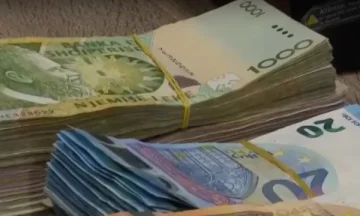
(9 years ago)Mines and fuels exports to Spain increased more 4 times for the January-October period, compared to a year ago. Referenced to data published by the Statistics Institute (INSTAT), exports to the <x1mial Group, fuel and electricity” account for 9.3 billion dollars in the first 10 months of this year, from [...]
Referenced to data published by the Statistics Institute (INSTAT), exports to the <x1mial group, fuel and electricity” account for 9.3 billion dollars in the first 10 months of this year, from $2 billion last year.
A total of 36.1 billion leks and fuel have been exported over the course of 10 months, contributing 0.5 percentage points to the total export.
Albania currently lives over billions of euros of minerals hidden in the depths of the earth, but in many cases, minerals are too deep, too difficult to surface or too poor and expensive to process.
Crom, copper, coal, oil, and other minerals are thought to be in large quantities. It is estimated that Albanian underground is worth over $6 billion. Theoretically, the total amount of extractable coal mineral deposits results in 10 million tons. But these billions of dollars are very deep, in some cases below sea level. The cost of extraction is too high. However, chromium is the most profitable today after oil in Albania.
Bulqiza, which extends to the northeast part of Albania, with an altitude ranging from 330-1800m above sea level, with an area of 728 km2, is one of the most coveted areas for the construction of galleries and from underground, “thesarin” of the chrom. Also interesting are Tropo, Kukes, and Krasta, which carry tons of chromium.
We once took third place in the world for the production of chromium after South Africa and Russia.
Before the 1990s, the main task was to extract metal minerals. An estimated 33.6 million tons of chromium are thought to have been extracted from underground. This belongs to the Communist era until the 1990 ' s.
Their discovery, exploitation and processing constitutes an important activity for the country's economy. Traditionally, after 1944, the mining and mining industry, such as chromium, copper, iron, coal, has provided considerable income.