a few seconds ago
Alarm coming from empty banks, birth loss, migration empty schools in Kosovo
Periskopi(an hour ago)
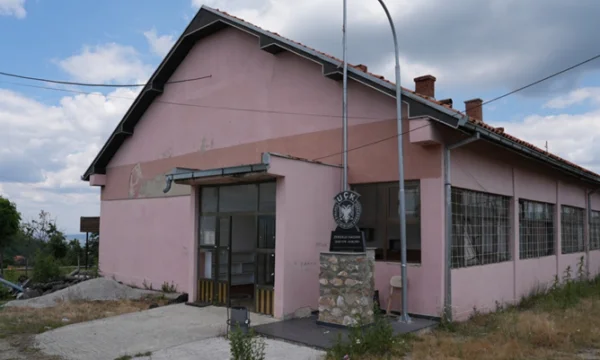
(an hour ago)In the village of Dablede, the school yard is empty.
Summer break is not the reason. No more bells.
No more teachers, no students.
The school has been closed for four years because there are no children left in the village to attend.
Once, it was parallel to the School Starting “Against Mjeda” in Cabash.
For the last time, she opened her doors in 2022 when there were only four students.
Shortly thereafter, even the last families left the village.
“From that moment has been unable to develop learning, and the Directorate of Education [of the Year's Town] has decided that the school in Dumbledore will be closed”, municipality spokesman Nicholas Ukaj tells Radio Free Europe.
Dumbledore is not an exception.
In many Kosovo municipalities, classes are being emptied year after year.
The education ministry's data provided by Radio Free Europe shows that from 2020/2021 to 2024/2025, pregraduate education lost over 30,000 students.
The decline continued in 2025/2026, when about 5,000 students were enrolled less than a year ago.
Just a little kilo after Dumbledore, the Litzca line?
Just a few miles from Dumbledore, in Lettice, residents fear that history can be repeated.
In the divided parallel of the School Begin “
Among them is Lindon Lieman's son, who will begin third grade in September.
For Liman, the small number of students is a sign that even this school may not have a long life.
The next year or two will not have students at all here”, he tells Radio Free Europe.
If the school is closed, his son will have to continue teaching in Stubble or the Year.
More than a distance of about four miles [4 km], travel conditions disturb him.
It's a concern, especially in winter. The children are still young”, he says.
The municipality of the Year says that, currently, there is no decision to close any other school.
However, it acknowledges that the ongoing decline in the number of students could make the reshuffle of the school network inevitable in the coming years.
When classrooms empty, municipalities take the burden
And the reorganization does more than just combine parallels or close schools.
It also affects teachers and the way education is financed.
Until last year, teachers' salaries were financed according to lists sent by municipalities.
This year, the Ministry of Education changed Grant's Education formula.
The funding is already based on the number of students and no longer on the number of teachers.
For municipalities, this implies that part of the teachers are no longer covered by the state grant.
According to a report by the Institute for Advanced GAP, for 2026 municipalities reported about 27 thousand teachers, but 3,101 were not included in the Grant for Education.
For the following year, 2027, it is estimated that another 263 teachers from the institution will remain outside the grant.
He adds that this situation has put municipalities in the face of a difficult choice.
They should either harmonise the number of educators with the new funding formula what contract cuts can mean for those considered to be “above rate” or to keep them at work and pay their budgets.
Only four municipalities -- Pristina, Ferizaj, Fushe Kosova and Obilqi -- have a number of teachers fully complying with financing approved by the ministries of education and finance.
The Roots of shrinking
Procrastination is not a random development.
According to experts, it is the result of two processes that are changing the structure of Kosovo's population: increasingly low births and migrations.
Anthropology professor at Pristina University, Tahir Latifi, says demographic trends leave little room for optimism.
If we look at birth statistics, which ultimately show how many students we have in schools, the picture is clear”, he tells Radio Free Europe.
According to Latif, ten years ago the fertility rate in Kosovo was 2.10 children per woman. In 2026 it dropped to 1.54.
Part of this decline, he says, is linked to migration.
When you look at birth statistics in the past five years, about a third of the births registered in Kosovo are from the diaspora”, says Latifi.
Kosovo Statistics Agency data shows that 32.955 births were registered in 2025, but 22.045 of them occurred within Kosovo.
The last census, in 2024, also shows the same direction.
Kosovo has about 1.6 million residential residents -- approximately eight percent less than in the 2011 census.
For Latif, institutions have not long read of this demographic change.
If they don't read their 2024 registration data, which is alarming, I don't know where we're going. Although it has been known that some villages are being emptied, millions of schools have been built again, without need”, he says.
The Consequences Do Not Stop at Schools
Experts warn that, if the trend continues, the consequences will be felt in every link -- from school organisation and municipal financing to universities and the labour market.
According to Dukagjin Pupovci, former deputy minister of education, the effects have already begun to be seen in higher education.
“... because the number of students is dropping, unless universities are internationalized and students start coming from outside... which I don't expect to happen”, he tells Radio Free Europe.
Kosovo Statistics Agency data shows that the number of students at public universities and private colleges has dropped from 95.335 in the 2020/2021 academic year to 64.817 in 2024/2025 50 percent.
Pupovci warns that influence will not be limited to the education system.
We can face a lack of qualified workforce in the future, especially with high qualifications. We're going to be forced to import labor power or this will become an obstacle to economic development. You cannot organise factories or businesses when people are missing”, Pupovci says.
A System to Adjust
According to him, the decline in the number of students is not a problem that can be solved only by closing schools or by cutting down teaching.
He says the education system should adapt to the new demographic reality.
The first “should be adapting the funding formula to the current state. The new formula should create a balance between financial sustainability, the quality of education and the protection of students”, Pupovci says.
Changes, according to him, will also be required in higher education.
For example, in the public sector we have five law faculties and equally economics. There's no need for such a number of colleges now. It can be two and it's going to be”, Pupovci says.
If these changes are possible and sufficient, it remains to be seen.
But demographic projections do not provide encouraging signals.
Kosovo Statistics Agency data shows that by 2060 the residential population could drop to about one million while the births continue to decline.
For Pupovci, this means that contracting the number of students is not a transitional phase.
“... unless a major demographic change occurs, like massive migration from abroad and the involvement of immigrant children in our schools. Such a wave is not expected, because Kosovo is not an attractive country”, he says.
Dumbledore missed school when he was childless. In Letnica, parents still hope that this will not happen.
But, with classes empty year after year throughout Kosovo, the question is no longer whether education will change, but how soon.
The education ministry did not respond to Radio Europe Free for Comments on the concerns raised. /Periscope/