4 minutes ago
Women are securing warrants through vote, but men continue to dominate the Parliament.
Periskopi(a month ago)
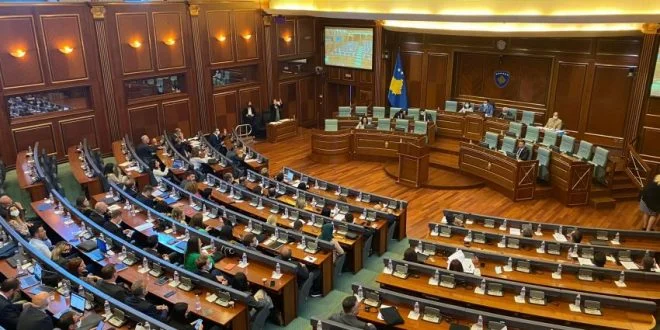
(a month ago)Women continue to remain under-represented in Kosovo politics, though recent parliamentary elections have marked an apparent increase in their presence in the Kosovo Assembly and a gradual advancement beyond the gender quota mechanism.
According to analysis published by Institute for Democracy and Development (D4D), Out of a total of 120 elected deputies, 41 are women, or about 34%, while 79 are men or about 66%.
The report estimates that this result represents an improvement compared to traditional gender representation levels and exceeds the minimum threshold of 30% of legal quota. However, the analysis stresses that women continue to be sub-represented in relation to men and that substanial equality has not yet been achieved.
Data shows that the challenge starts at the running stage. Out of 1,180 candidates certified for parliamentary elections, 789 or 67% were men and only 391 or 33% women.
The representation of women on election lists has fluctuated between 33% and 35% to almost all political subjects, reflecting minimum respect of gender quotas, but not a real race for increasing women's participation, Telegrafi broadcasts.
According to the analysis, male candidates have received 71% of the total vote, while women have received 29%. However, when compared with the average vote for candidate, the gender gap is significantly narrowed: women have received, on average, 5,329 votes per candidate, while men, 6,329 votes per candidate.
The D4D report estimates that this proves that women remain competitive whenever they get involved in the race, while the main obstacles relate to access running, ranking and supporting within party structures.
The analysis according to political subjects shows that gender inequality remains present in almost all parties.
The Vetevendosje movement, as the largest political subject, also has the highest number of elected 21 MPs, but men continue to dominate with 36 deputies, bringing women's representation to about 37%.
A similar model is noted in the Democratic Party of Kosovo, where 7 women and 15 men have been elected, as well as in the Democratic League of Kosovo, with 5 women and 10 men. In both cases, representation of women remains close to a third of MPs, in line with minimum legal quotas, but far from real equality.
Even in the Alliance for the Future of Kosovo and the Serbian List the gender report remains similar, with about 33% women and 67% men, pointing to a stable interparty model where women provide representation largely due to quota mechanisms.
The report states that some smaller subjects present more balanced cases. The KDTP has a woman and a chosen man, reflecting equal gender representation, although their impact on the overall composition of the Assembly remains limited.
One of the report's main findings relates to the gender quota role in electing MPs. Out of a total of 41 women elected in the Assembly, only 7 deputies or about 17% have entered through the correct gender quota mechanism, while 34 women or about 83% have secured the mandate directly through the vote, reports the report. Telegraph, broadcast Periscope.
According to the analysis, this presents an important indication that gender quotas are no longer the dominant factor in providing female representation. On the contrary, a significant portion of women are managing to compete and win mandates directly on the electoral market.
However, the report stresses that the fact that seven women have still needed quota intervention testifies that structural and electoral barriers continue to exist. For this reason, the gender quota remains a necessary security mechanism to prevent sub-representation and ensure a minimum level of involvement.
The distribution of mandates won through quota also shows differences among parties. The Democratic Party of Kosovo has secured three mandates through gender quotas, the Alliance for the Future of Kosovo two mandates, while the Serbian List and KDTP from a mandate.
According to the D4D, this shows that some political subjects continue to have less or less capacity to ensure women's choice through direct voting, relying more on the correcting quota mechanism.
In conclusion, the report estimates that gender quotas have played an important role in increasing women's representation in Kosovo, but current data shows a gradual transition towards a model where more and more women are providing mandates through free electoral competition.
However, while some of the women still depend on quotas, the mechanism remains necessary to ensure fair representation and address structural inequalities in the political system. /Periscope