8 minutes ago
Kosovo follows US in Gaza
Periskopi(2 months ago)
(2 months ago)In Gaza one of the most dangerous and unstable areas in the world, Kosovo is entering an international stabilisation mission, mandated by the United Nations for the first time.
Her soldiers are settling in a field where the border between control and chaos is unclear.
Under these conditions, Kosovo gets closer to the global scene, but, at the same time, the risks associated with it.
The International Stabilizing Force (ISF) stems from a 20-point plan by US President Donald Trump to end Israel's Gaza war.
It is envisioned as a multinational force, which will be deployed in this enclave to train police, help secure borders and maintain order, and support the demilitarisation of the territory by Hamas.
This Palestinian group, declared terrorist by the United States and other powers, has been controlling Gaza since 2006 and sparked the war with its massive attack on Israeli territory in October 2023.
It signals willingness to give up the Gaza government, but not by weapons, while Trump keeps his stance back.
If [Hamas] don't do what he said, if he doesn't behave properly, then he'll face a real big problem, which the American president has never experienced before.
The composition of the UN International Stabilisation Force has not been fully defined, but, according to UN Resolution 2803, it is expected to act in co-ordination with Israel and Egypt, as well as with a newly trained Palestinian police force.
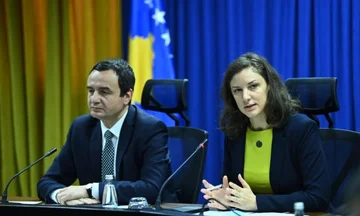
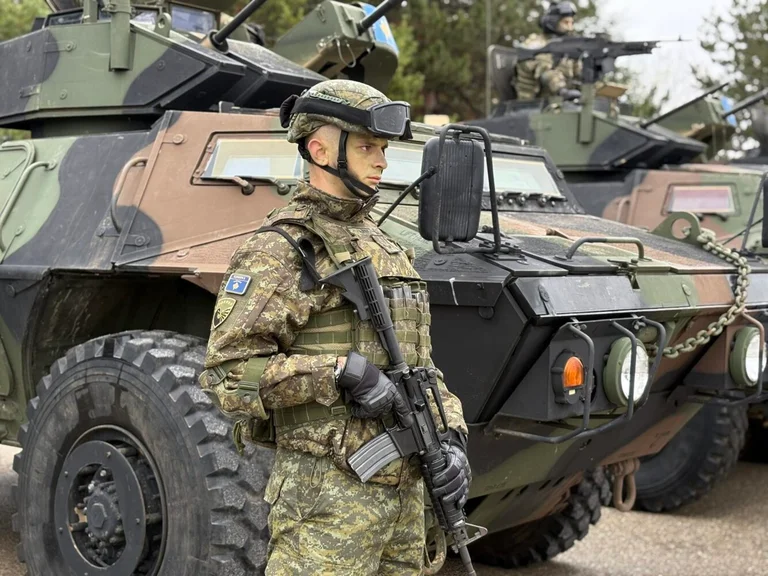
Kosovo Prime Minister Albin Kurti now in office announced since late January that the Kosovo Security Force will participate in the International Stabilisation Force for Gaza.
Less than three months later, the Kosovo Assembly approved its sending to this conflict area and, last weekend, it became known that a team of soldiers has already been sent there to make the country's assessment where it will operate as part of the peacekeeping mission.
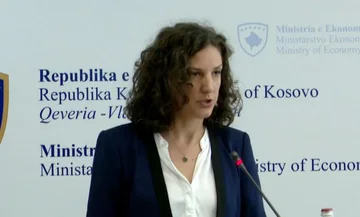
Kosovo Defence Minister Ejup Macedonia, currently in office, presents this as a turning moment for the state of Kosovo.
The “is the first time Kosovo is part of a UN-appointed mission. This also shows the trust our partners have in our military capacities to provide support in a high-sensitive area, such as the Middle East”, says Macedonia for the Free Europe Radio Expose Programme.
KSF involvement in this mission is not random.
Macedonia explains that since the end of last year, Kosovo has been part of preparations for creating an international stabilisation force, in full co-ordination with the United States. An American liaison officer is even directly involved in the KSF.
So our team's going to Gaza is in full co-ordination with the United States of America, especially with the International Stabilisation Force command, which will lead the entire operation in the Middle East”, the minister points out.
According to plans, the Kosovo Security Force team for verifying the situation would stay several days in Gaza and then draft a report. It is not yet clear when the first contingents will be deployed, but according to some reports, this could happen in May.
Free Europe Radio requested confirmation from the US War Department, but received no answers.
Macedonia, for security reasons, says it cannot provide much details, but confirms that the first Kosovo contingent will consist of 22 members. According to him, they will undergo rotation by the end of 2027, when the International Stabilisation Force mission is expected to be completed.
“Normically, we are aware of the risks our contingent may face, but we are doing everything we can to ease these risks, create logistical conditions, so that the KSF container within the framework of the International Stability Force manages to professionally perform and provide support to Gaza”, says Macedonia.
Khaled Elgindy, Middle Eastern expert, argues that in a conflict like Gaza, rooted in a long history of confrontations and repeated wars the International Stabilizing Force faces two major risks: to be directly involved in combat, or to be used because of Israel's apparent power inequality as a means of advancing Israel's security agenda, instead of truly defending Palestinians.
“It cannot be separated from the political context. Hamas is a resistance movement and will try not to hand over all weapons. The population, on the other hand, is extremely vulnerable. We have seen what the Israeli Army in Gaza has done what many experts consider genocide. So how can a military movement in both Hamas and the population be carried out in an environment, generally believing that they are facing a existential danger?
Charles Kupchan, of the Council for Foreign Relations in Washington, estimates that the International Stabilizing Force mission still remains the indefinite “”.
According to him, it is not clear what the troops will have and whether they will engage in the forced disarming of Hamas a situation that, he says, can seriously expose to danger on the ground.
For Kosovo, however, Kupchan minimizes the risk, describing its mission as limited to size and largely symbolic.
I would say there are not many serious risks, except that any soldier is hurt or killed during the mission, as well as the possibility of a political reaction against this commitment. In general, this is a low risk contribution”, says Cupchan for Expose.
In addition to Kosovo, Albania has pledged to send troops to Gaza, along with countries like Turkey, Indonesia, Morocco, Kazakhstan and Azerbaijan.
US General Jasper Jeffers, appointed at the helm of the Stabilisation Force, has declared it is expected to count about 20,000 soldiers.
Its mandate includes supporting the Peace Board in monitoring the ceasefire between Israel and Hamas.
Kosovo has become part of this board, after signing its Charter in Davos in February, and is included in the facility of the initiative.
Last week, the agreement on membership in Bord was ratified in the Kosovo Assembly.
Kupchan sees all of Kosovo's commitment as an investment in its relations with the United States, and especially with President Donald Trump's administration.
The “Ide is that Kosovo is aiming to show that it is not only a loyal ally but also an active ally a country willing to make sacrifices with blood and tools to contribute to the common good. The goal is not only to prove willingness to contribute but also to create trust that can serve in the future, when it needs international support, especially in EU or NATO membership processes”, says Kupchan.
At a time when many European countries have been reluctant to get involved directly, Kosovo's engagement in Gaza is seen as a clear lineup with the US in the Middle East.
However, Kupchan relates this approach, saying that for a small state, it is largely pragmatic.
He insists it is a mutually profitable peacekeeping mission, or a “in-win” situation for Kosovo.
Elgindy agrees that, despite the still unclear mission of the International Stabilisation Force and dangerous context on the ground, many countries are joining it mainly to gain political advantages in relation to Washington.
In Azerbaijan's case, for example, we know he has close relations with Israel and the Israeli army. So each has its own reasons and interests, beyond the desire to see Gaza stabilised”, estimates Elgindy.
He, however, warns that such initiatives are unlikely to bring lasting peace between Israelis and Palestinians, because they deal only with Gaza management and put out the root problems between the parties, such as occupation, residential and Palestinian citizenship.
He adds that because of the huge inequality of power and lack of a common plan for Gaza's future, the Stabilizing Force can serve Israel's security interests more than just peace.
Without addressing the root causes of conflict, any stabilisation mission risks remaining temporary or even becoming part of the problem, according to him.
But for President Trump, the plan agreed on peace in Gaza is and will remain a historic turning point.
It took 3,000 years to get to this point, can you believe? And, that's gonna remain like this”, he said after his signature.
What is certain, according to the acting minister, Macedonia, is that, for a small state like Kosovo, entering a major conflict like the one in Gaza is not only a security issue, but a test of the very role Kosovo intends to play in international order.