28 minutes ago
Conflict between two laws blocking investments in Kosovo
Periskopi(a month ago)
(a month ago)A property is the first thing anyone should secure when deciding to invest in Kosovo. But when it is state, the situation becomes complicated.
A clash between the Law on Forests and the Law on Public Property has created an institutional stalemate in Kosovo, making it difficult to take over state property and delay investment projects.
The two laws were adopted by the eighth Parliament of Kosovo legislature in 2023, by a margin of about seven months.
What's the problem?
The forest law, passed on March 9, 2023, gives the Kosovo Forest Agency (APK) the competence for management of state pastures and forest lands, therefore to consider the demands to rent state lands.
Under this law, up to 20 hectares of forest land are leased with its approval the Agency. For between 20 and 50 hectares, the Ministry of Agriculture, Forestry and Rural Development (MBPZHR) decides, while more than 50 hectares are granted only on Kosovo Government's decision.
But after adopting the Law on Public Property on October 26, that same year, the situation became unclear.
This law provides for preliminary consent to obtain property in use to provide the Public Property Management Office (ZAPP).
This body has already been created as a special office within the prime minister's office.
Only after the ZAPP has been assured that the property being required by a potential investor is not in the interest of being used by any public institution continues its rental procedures.
These procedures end with final approval by high state institutions.
Under this law, state property could be rented for up to 15 years, with a decision to gather governments or municipal assemblies.
While renting for 99 years of public property must decide Kosovo's Assembly.
What caused this?
Because of the lack of legal harmonisation, The APK has suspended review of the requirements for temporary exploitation of public lands.
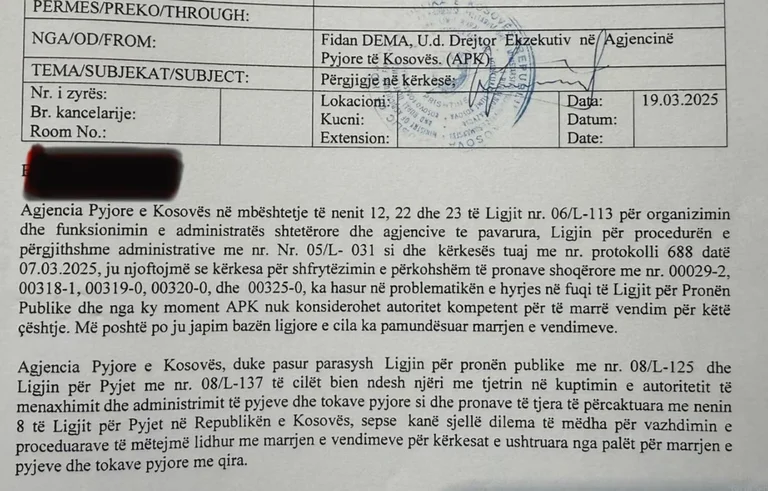
In an official response to the Agency for the request of an interested foreign investor, which Radio Free Europe has provided, it reportedly without a legal clarification about competencies, it cannot proceed with procedures.
“E is unable to continue with further procedures without taking action to complete/reform and legal harmonisation, and what might be the competencies that the Kosovo Forest Agency has regarding management and management of forests, pastures, and public forest lands in the Republic of Kosovo”, said in the APK response, of March 19th 2025.
For a year now, the potential investor has failed to rent the required state property.
Some interested foreign investors complained of long wait in reviewing the demands for rent of public property, but hesitated to speak publicly of their cases, fearing it could create problems in the process of acquiring property in exploitation.
The APK said that in terms of how it is being dealt with pending investor demands, the MBPRZH should be asked.
But neither did the latter.
Meanwhile, the prime minister's office said that the ZAPP, as the new entity created, has addressed any request forwarded by the APK, adding that “the evolution of the Forest Agency within this subject is inevitable”.
The government also reportedly held meetings between institutions, including the APK and businesses that exploit rented forest land, clarify legal irregularities and protect public interest.
Discouragement for Foreign Investors
In practice, this situation has created major delays for businesses aimed at investing in public property.
The chairman of the Kosovo Economic Ode, Lulzim Rafuna, says the suspension of reviews of the requirements is leaving investors in uncertainty.
There is no limit that is set within which the answer returns. There are businesses that are waiting for seven months to one year, and have no answers yet, due to these uncertainties”, it relates.
According to him, this situation is displaceing foreign investors to develop business in Kosovo.
“We have foreign investors who have come to do a study on potential investment and have immediately faced this legal challenge. And, in some form, that has made them uncertain for them to invest in Kosovo”, Rafuna says.
Albania's Example
Nikolin Jaka, chairman of the Chamber of Commerce and Industry in Tirana, says that there have also been cases in Albania when local and foreign investments have been postponed due to institutional non-coordination, but that has been worked to ward off obstacles through digitisation of services.
Despite the consolidated legal framework, businesses in Albania continue to seek more clarity about the concept “one-stop authenticity” for the use of public property, it indicates.
According to this concept, an investor in Albania can conduct several administrative procedures in a single office, without having to go to many institutions.
Jaka claims Albania today is a favourable country for investment, while citing that “has no major restrictions on foreign capital”.
“Costos competitive work processes and the most advanced digital procedures for business registration and licenses”, but also Albania's “strategic location” and “pax5> it counts as other facilities.
“In practical terms, the investor in Albania today can register business relatively fast even online”, says Jaka.
Meanwhile, investors in Kosovo need to further expect a legal clarification to exploit public property, the country currently does not have a government with full competencies, nor a nation that can approve law changes.