11 minutes ago
American Economic Oda urges the Government of Kosovo to reduce customs duties for air conditioning, TV and telephones
Periskopi(a month ago)
(a month ago)The American Economic Oda in Kosovo has asked the Kosovo government to cut the customs tax on air conditioning, TV and telephones. The OEK proposal is presented as a measure against inflation and informality, stressing that Kosovo has the highest customs tax rates in the region for these products.
The American Economic Oda has handed over to the Kosovo government a detailed proposal for lowering the customs tax on some important products.
The proposal calls for lowering customs taxes for air conditioning, LCD and LED TVs, as well as smartphones.
The document, which the Nacional newspaper has seen, stresses that Kosovo applies customs rates among the highest in the region for several categories of products.
Citing the Kosovo Statistics Agency (ASK), OEK estimates the annual inflation rate in June 2022, compared to the same period in 2021, marked 14.1 percent.
According to the proposed document, this level is about five percentage points over inflation rates registered simultaneously in the United States and the European Union.
The proposal that has been handed over to the Government stresses that Kosovo, unlike other states, has no means of monetary policy to fight inflation, and that fiscal measures remain the only way of intervention.
Air efficiency conditioners as the main argument
In its proposal, OEK argues that the <x0-type air conditioning “inverter” presents the most efficient energy alternative to heating residences during winter.
According to the document, reverse-cycle air conditioning is “300% efficiency”, which means that three to six thermal power units are produced from an electric unit.
Among other things, KESCO is said to have published data that for families heated with electricity, heating costs may reach as much as 6050 percent of the total energy bill.
The proposal estimates that the massive adoption of inverter air conditioners would reduce consumption during peak hours, easing pressure on the country's energy infrastructure.
In a regional comparison, according to the document, Serbia applies the lowest customs rate of 5 percent for air conditioning, while northern Macedonia and Bosnia and Herzegovina apply 15 percent.
In addition, it is said that the European Union's standard rate for air conditioning is only 2.2 percent, which is evidently below the current 10 per cent rate applied in Kosovo.
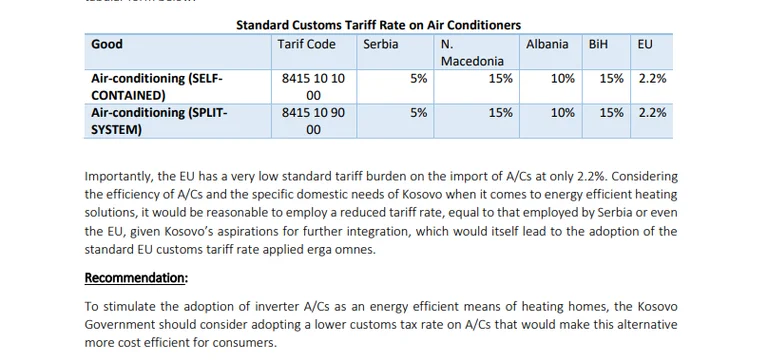
The OEK recommendation is for the Kosovo government to lower the customs rate for air conditioning, bringing at least to Serbia's level, or ideally, the EU, given the country's integration aspirations.
Television Equipment during peak hours
The OK proposal also addresses LCD and LED TVs as another category where Kosovo can intervene with customs reductions.
The document underlines that new televisions with LCD and LED technologies are obviously more energy efficient compared to older catodic TVs (CRT), achieving efficiency to twice.
Independent Media Commission data shows that about half of Kosovo's citizens watch television more than two hours a day.
Even according to the document. Sixty percent of new families, designated under the age of 28, have home television.
Kosovo currently applies the 10 per cent customs rate to LCD TVs, while North Macedonia and Bosnia and Herzegovina have 5 percent.
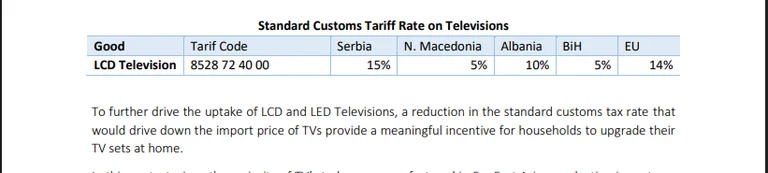
The European Union, in turn, applies the 14 percent rate, which is higher than the rates of some countries in the region, but this is explained by the structure of existing European FTAs.
Oda recommends lowering the customs rate for LCD and LED TVs, in order for prices for Kosovo consumers to match those of consumers in neighbouring countries.
Smartphones fight smuggling
The smartphone sector presents, according to the document, the most urgent and politically more sensitive case for intervention.
According to estimates cited in the proposal, Kosovo's mobile phone market is estimated to have a volume of around 50m euros annually.
However, official import figures for 2020 show only 7.5m euros in customs revenues of 750,000 euros and VAT revenues of 1.485m euros.
The large gap between market rating and official import testifies to the considerable presence of the informal market, according to the document.
Customs and Kosovo Police have been reporting phone smuggling for more than a decade. Only recently, a police action in six Kosovo locations resulted in the seizure of over 200 smartphones.
The proposal argues that formal businessmen, who pay customs duties, are competingly penalised against informal operators offering artificially low prices.
Moreover, consumers are exposed to serious risks: IT vendors have documented cases of changing original batteries, cameras and selling Chinese models as original products.
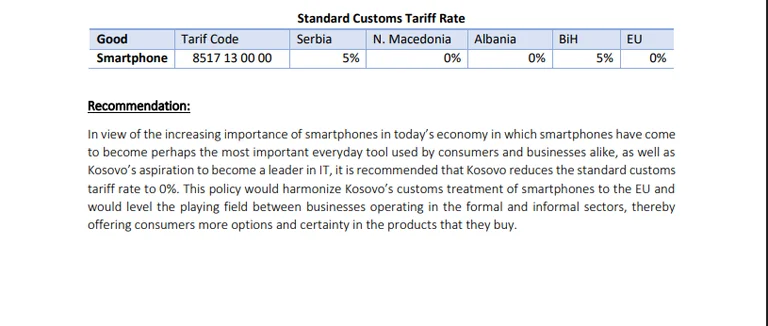
By regional comparison, Albania and North Macedonia apply customs rates 0 percent for smartphones, while Serbia and Bosnia and Herzegovina apply 5 percent. The EU rate is also 0 per cent.
At the end of the document, the need for changing the Kosovo Customs Code is stressed.
The Proposal stresses that the Kosovo Customs Code, No. 03L-109 has been in force since 2008, and the standard rate of 10 percent has not changed over this period.
Stressing that tax legislation has undergone numerous and substantial changes, the proposal shows that the customs system has remained almost unchanged.
The document stresses that the proposed measures are relatively simple from the implementation point of view and “can be implemented through the Ministry of Finance through a government decision”.
The proposal argues that lowering the customs for smartphone would not lead to considerable revenue loss, given that the informal market currently does not contribute to the state ark.
The document's latest goal is to equal Kosovo consumers' conditions to those of consumers in neighbouring countries, while Kosovo remains, according to most economic indicators -- the region's poorest country.