14 minutes ago
Hasani: Kosovo's membership agreement on the Peace Board cannot be changed, its failure to process for approval in the Parliament, the total immature
Periskopi(3 months ago)
(3 months ago)The agreement for Kosovo's membership on the Peace Board, the initiative of US President Donald Trump, was not prosecuted for approval in the Kosovo Assembly. The Parliamentary Commission for Foreign Affairs on Tuesday did not approve the draft law on the agreement signed by former President Vjosa Osmani on January 22nd, after the Vetevendosje Movement [...]
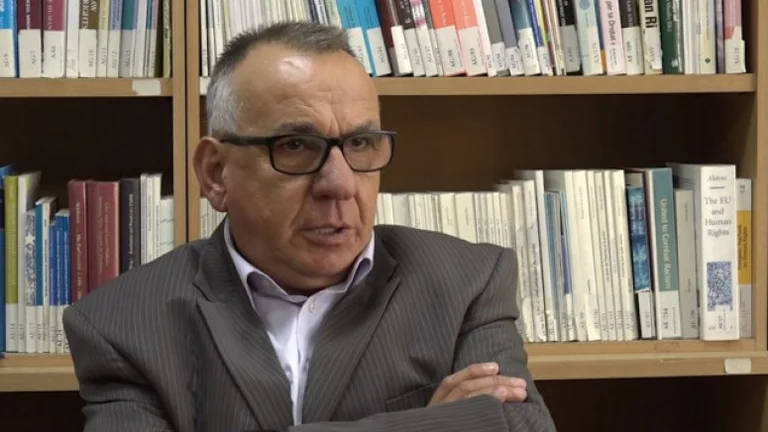
International Law Professor Enver Hasani said in an interview for Journal Express that this cannot be done “immediately”, calling the behaviour of LVV deputies on the parliamentary commission “total maturity”.
“The Assembly could change its laws unilaterally, but not even Kosovo's international vows”, he says.
If MPs have remarks on the contents of the agreement, Hasani says that according to the international and constitutional standards, “the same procedure under which the agreement or treaty” is under way.
When there is no consent of the other side, then any attempt to change the treaty or the basic agreement is insulting to the other side, the non-sysisity of the party taking that step and considered to be the exit of the treaty or agreement, legally signed by the chief of state of Kosovo, in accordance with the Constitution and the country's constitutional law”.
Hasani says Kosovo “should clarify with the American side if it aims to exit the membership pledge at the Peace Board. Membership in the Peace Board cannot be made separate from the full acceptance of each provision of the Peace Board Charter”.
The Parliamentary Commission for Foreign Affairs has not approved the draft law on the Peace Board Agreement for Kosovo membership, with Vetevendosje Movement having remarks on Article 2 of the bill and demanded that it be changed under it. Can the Parliament change the content of an international agreement already signed by the president, or in a legal way, it should be ratified only as such, without interference in the text?
Hasani: Never. This is the total immature. MPs should ask the legal department at the Ministry of Foreign Affairs if they do not know, and they will show international standards when and how a treaty signed by the head of state, the government chief and foreign minister can be changed, but has not passed the ratification procedure in the Parliament. The Assembly could change its laws unilaterally, but not even Kosovo's international vows.
In the concrete case is the Peace Board Charter, which has the status treaty or international agreement under Article 18.1 of the Constitution of Kosovo, which concerns alliances, as well as political and military issues.
If MPs have remarks on specific formulas (such as Article 2), what is the proper mechanism: changing the accompanying bill or renegotiating the international agreement itself with the signatory parties?
Hasani: According to Article 18.4 of the Kosovo Constitution, reflected also in the Kosovo Law on International Accords, “ment or withdrawal from international agreements will have the same decision-making procedure as the ratification of international agreements”.
This is the international and constitutional standard of all civilized countries, so the same procedure must be followed, under which the agreement or treaty is related.
What are the legal and international consequences if a state tries to ratify an agreement with unilateral changes in content?
Hasani: No legal effect produces for the other side unless there is an agreement between the parties, or if the other side later accepts such changes in the treaty or the basic agreement.
When there is no approval of the other side, then any attempt to change the treaty or the basic agreement is an insult to the other side, the incompatibility of the party taking that step and considered to be the exit of the treaty or agreement, legally signed by the chief of state of Kosovo, in accordance with the Constitution and the country's law.
Proceeding from an international treaty or agreement, according to the Vienna Convention on Traffic Law, is conducted according to the procedure envisioned in the treaty itself (entin 54). In the absence of such a provision, the exit is allowed only in special cases designated by the convention (entine 56).
Does it require clarification with the American side of Kosovo's accession from its commitment to membership on the Peace Board, and should its Charter be respected in all of its terms for membership?
Hasani: Kosovo should clarify with the American side if it aims to exit its commitment to membership on the Peace Board. Membership in the Peace Board cannot be made separate from the full acceptance of each provision of the Peace Board Charter.
Even here, the Kosovo Constitution is clear because it follows the standard of Western civilized countries. In Article 20.2 of the Constitution, which regulates the transfer of sovereignty, it is explicitly defined as follows: “if a membership agreement ratified by the Republic of Kosovo for participation in an international organisation in an exclusive way requires direct implementation of the norms of this organisation, the law under which the membership agreement is ratified with the votes of two-thirds of the Parliament's deputies (2/3) and those standards have preeminence over the laws of the Republic of Kosovo. ”
The two-thirds qualified majority are required both for membership in an international organisation and for ratification of an international treaty or agreement under Article 18.1 of the Constitution. This is about two concrete situations related to the Peace Board. /Periscope