7 hours ago
Possible elections put CEC in the face of unresolved problems
Periskopi(2 months ago)
(2 months ago)The trouble of last year's election processes in Kosovo will not be able to find solutions this year if the country goes to parliamentary elections in a few weeks, for the third time in a little more than a year. Kosovo Assembly MPs have until 28 April to elect the new president [...]
Kosovo Assembly MPs have until 28 April to elect the new president of state, in the opposite case, early elections should be held within 45 days.
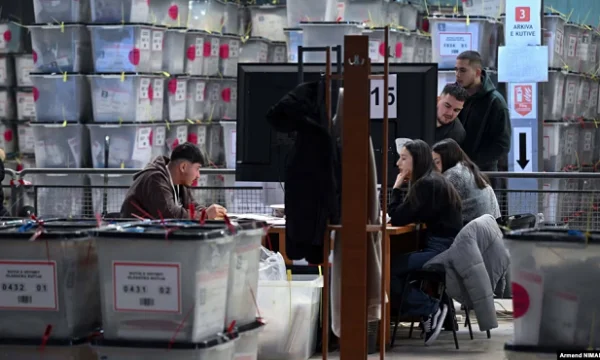
Counting the candidates' votes for deputies, voting outside Kosovo, and the commitment and training of the staff to manage the elections are just some of the troubles identified by the Central Election Commission (KQZ), accompanying two sets of general elections ( held on February 9th and December 28th 2025), as well as two local election blocks (on October 12th and November 9th 2025).
To address them, the CEC has recommended that the Law for General Elections and Electoral Rules be changed, but this would prevent the eventual holding of early elections this year between May 31st and June 7th.
Alban Krasniqi, a member of the CEC from the ranks of the ruling party, Vetevendosje Movement (LVV), says legal changes take time to test and implement, without jeopardising the integrity of the election process. Thus, according to him, the inability to address shortcomings from past processes endangers their repetition.
“Under such circumstances, the focus of the CEC inevitably shifts from long-term reform to emergency management of necessary activities. This means that many of the problems of past elections can be repeated, as insufficient time limits the possibility for substantial changes and their implementation”, Krasniqi told Radio Free Europe (REL).
Even representative of the Democratic Party of Kosovo (PDK) in the CEC, Ilir Gashi, shares the same stance.
The rapid elections do not allow apparent intervention or improvement of the defects past elections”, he tells REL.
According to the Kosovo Democratic Institute researcher (KDI), Eugen Cakoli, it is unrealistic to expect to address problems essentially, when the country can go to the elections again within a short time.
Cackolli says changes to electoral legislation “require time and political stability”, and that international practices suggest they take place at least 6-12 months before an election process.
“What can be done in such a short term is more about managing the process, for example, the most careful selection of the election staff, increasing training standards and avoiding repetition of the problems recorded by the same staff”, he claims the REL.
Chocolate says it takes serious commitment to reform. Otherwise, we risk the same model producing the same problems in progress, while the ongoing trust gradually weakens”, he estimates.
What changes should be made?
The amendment to the Law on Elections, made in 2023, among other things, has enabled voters to vote as many as ten candidates for MPs. Among the CEC's recommendations is the return to previous practice: voting for up to five candidates for MPs.
According to LV's Krasniqi, field experience has shown that the high number of candidates slows down the process, and increases the risk of manipulation and technical errors during the count.
Moreover, the selection of 10 candidates creates an unnecessary burden on voters, complicating their decision-making, and reducing the true goal of democratisation of the vote. Simplifying this process would ensure more accuracy, speed and transparency in election management”, the CEC member estimates.
And according to Calcol, the first three years of changes created more room for errors in last year's elections.
The mayor was the method of counting preferential votes over 240 thousand changes during the recount show that we have a problem in the model itself, not just in implementation”, he tells REL.
With the change of law in 2023, for the first time, physical voting was possible at the consulate embassy for citizens rightly living outside Kosovo.
In this respect, according to Krasniqi, the need is to facilitate registration procedures and voting abroad.
“Concretically, the need for increasing the number of polling stations abroad, which would affect facilitating the participation of the whip in the election, and would also reduce the financial costs of this operation”, he says.
Meanwhile, Gashi The PDK estimates that the law needs changes that determine the use of technology, “specifically scan and read optical reading of waste”.
What went wrong in last election?
Krasniqi says manipulation of the candidates' votes for MPs has been among the main problems that have been recorded by the December 28th elections.
He says it has been disturbing not to report irregularities from observers and counting teams, as deviations as a result, “that caused additional financial costs and delays in the Certificate of results” were confirmed only after the recounting of votes.
For the CEC, this is a clear lesson that good administrative organisation is not enough if there is no accuracy in counting. Therefore, our priority now is the enterprise of strict precautionary measures guaranteeing the protection of the will of citizens and eliminating any possibility of future manipulation”, Krasniqi says.
In local elections, however, Krasniqi has seen the large number of assistance votes, which has not met the criteria the law envisions.
“Then, in some cases, the failure to arrive in time with balloting to voters registered for voting outside Kosovo in the second round for mayor of municipalities was very serious problem”, he says.
Gashi considers that “serious challenges” over the past year were the power “efforts to intervene in decision-making, as well as attempts to vote outside the legal framework”.
According to him, difficulties have also presented early election announcements at the end of the year.
“Other challenges have been voting up to 10 candidates who have made voting difficult, lack of scan and optical reading of balloting, assistance voting, staff recruiting... The absence of a director selected from unwarranted neglect under the chairman's direction, as well as the influence of power, have brought difficulties. Also, inadequate election operations management”, Gashi says.
But, according to KDI's Cacol, the problems with which recent elections in Kosovo are not new. This time it came out much more clearly on the surface”, he says.
CEC faced early elections
Organising elections, whenever they can be announced, members of the CEC see it as constitutional but challenging.
LVV's Krasniqi says that the fulfillment of hundreds of operational activities, planning and procurement of materials and services within short time terms poses risks, and makes it difficult to manage the election process effectively.
It cites the unappreciated materials of past processes, digitalisation of services, logistical aspects, recruiting and training of secretariat officials, the Municipal Election Commissions, as well as members of the countries' councils and counting teams.
In such a situation, election organisation remains a serious challenge for the CEC, both technical-administratorial and human capacities, which should be seriously considered before any political or institutional decision, including the Constitutional Court's own judgments”, Krasniqi says.
For Gashi of the PDK, the challenge is also the complete composition of the CEC, “namely the lack of even one member from the opposition”.
“also, efforts to intervene by power and side-by-side, in favor of power requirements, are of concern. Unfortunately, several other members, unable to exercise the role for which they have been delegated, act in the service of power, with or without awareness”, he says.
Nine members of the CEC were sworn in before former President Vjosa Osmani on 27 March. For the appointment of a tenth member, she addressed the Constitutional Court, as LVV claimed they belonged to three members on the basis of the election result. Even after the Constitutional decision, which declared Osman's request unacceptable, the vacuum in the CEC was not closed.
After the end of Osman's presidential mandate, the issue has remained in the hands of Presidential Taskman Albulen Haxhiu. /Periscope