6 minutes ago
REL: After Foreign Law, Serbian Education and Health Future in unclear Kosovo
Periskopi(6 months ago)
(6 months ago)The League of Full Implementation of the Law for Foreigners to the status issue of educational and health institutions which in the majority Serb environments in Kosovo operate within Serbia's system is especially problematic, as it confirms that Albin Kurt's Vetevendosje Movement is not giving up the policy of <x0-integration [...]
The League of Full Implementation of the Law for Foreigners with the status issue of educational and health institutions which in the majority Serb environments in Kosovo operate within Serbia's system is especially problematic, as it confirms that Albin Kurt's Vetevendosje Movement is not giving up the policy of the Serbian community's mandatory <x1-x2> in Kosovo, estimates to Radio Free Europe Miodrag Marinkovic from the Centre for Environmental Social Stock Exchange (CASA).
He says the Law for Foreigners in Public Opinion is perceived as a potential bypassing “mechanism”, through which the Government of Kosovo can begin closing the territory institutions of education and health.
According to him, such an approach of Kosovo authorities does not contribute to stability, but, rather, “deepens distrust and the sense of judicial uncertainty among members of the Serb community”.
On the other hand, Dusan Janjic, from the Belgrade Forum for Ethnic Relations, says that the beginning of the integration of education and health, along with the implementation of the Foreign Law, is a political decision, for which, according to him, authorities are entitled.
However, it expresses concern for, as it says, the lack of transparency and stresses that the security risk in Kosovo has not yet passed.
Janzic adds that the European Union ignores the new “reality that was created after the abolition of Serbia's institutions in Kosovo, even though the latter, according to him, has never presented a concrete strategy for the integration of the Serb community.
“There are guarantees from the Ahtisaari Plan. On the basis Kosovo's independence has been declared, which has been transferred to the Constitutions, but this has no connection with the Government of Kosovo. The Kosovo government has never taken the risk of offering what Kurti has warned the Croatian model for the protection of minority rights”, says Janjic for Radio Free Europe.
Kosovo's acting prime minister, Kurti, said on 16 January that the process of Serbian health integration and education will be carried out in co-ordination with the European Union and that the concerns of non-communica communities will be taken into account.
However, it was not clarified which integration models are under consideration, and whether this process will be carried out under the Association of Serb majority municipalities, which Belgrade insists on.
The REL contacted the European Union on this issue and is awaiting the answer.
For the Association of Serb majority municipalities was agreed on under the EU-brokered Kosovo-Serbia dialogue in order for the Serb community to ensure a certain level of self-advancing.
Under a draft state that the European Union drafted, association would also have to regulate the income issue, financing from Serbia's budget, respectively.
In September 2024, Kosovo Minister of Internal Affairs Jedal Svecla warned that health and education institutions in the majority Serb environments in Kosovo will be specifically treated, separately by the closure of Serbia's other institutions, recalling that these two areas, according to the Ahtisaari Plan, enjoy broader autonomy.
The Serbian and official Belgrade list did not comment on the Kosovo authorities' request that over the next two months work on the integration of Serbian health and education, nor did they answer Radio Free Europe questions on the issue.
Earlier, Zlatan Ellek, chairman of the Serbian List, ) the largest party of Serbs in Kosovo to enjoy Belgrade's support, said there will be no integration of Serbia's health and educational system into the Kosovo system, adding that there are <x0-95 red” that dare not be exceeded.
How is the Law on Foreigners related to education and health?
In Kosovo, on 16 January, implementation of the first phase of the Foreign Law began, which will last until 15 March.
This phase envisions a period of information, the organisation of information sessions with citizens respectively.
According to the Ministry of Internal Affairs' direction, published on January 16th, all persons who do not possess Kosovo documents should have work permits or licenses for the exercise of the event, for which request is submitted to the Kosovo Employment Agency.
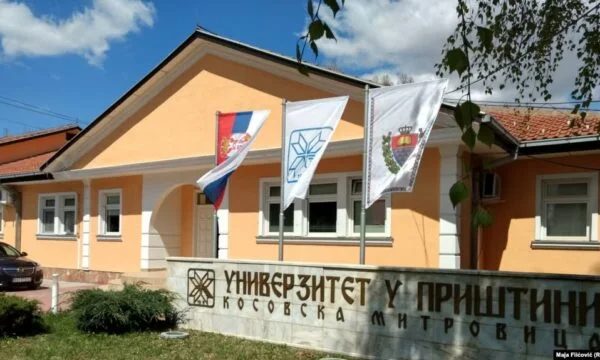
Education and health institutions in the majority Serb environments in Kosovo operate within Serbia's system, towards employees in particular North Mitrovica University professors may face problems after 15 March, when full implementation of the Law for Foreigners begins.
Also, students of this university that come from Serbia or other countries in the region would have to be equipped with temporary residence permits and to meet other legal conditions, depending on the purpose of the stay.
In practice, equipment with work permits or study may be problematic, as Kosovo does not recognise Serbia's institutions ʹ it considers them parallel and illegal.
A Part of a University Staff Reaction
The informal association “Proactive”, which includes professors and collaborators of the University of Northern Mitrovica operating within Serbia's system on January 19th, voiced concern over Kosovo officials' statements of health and education integration, as well as allegations that rumors of this university's shift to Novi Pazar border city in Serbia are based.
This unofficial information about the transfer of the University from North Mitrovica to Novi Pazar was long circulated, but were denied by Professor Slobodanka Peric, dean of the Jurydic Faculty.
Through a public reaction, she said the university would remain in northern Mitrovica, adding that the decision for its shift has never been taken and that neither formal nor unofficially discussed for such a thing.
“Proactive” warned that with the implementation of the Law for Foreigners on March 15th, the University of Northern Mitrovica will be put at risk, so it requested clarification by the institutions responsible for how this institution will function after this date.
Where and how do health and educational institutions function?
After the war in Kosovo in 1999, Serbia moved its health and educational institutions to majority Serb areas in Kosovo.
Even today, local ambulances, health houses, clinical hospital centres in Gracanica and North Mitrovica operate this way, as well as health centres in Pasjan.
Also, pre-school institutions in Serb-run areas, elementary and high school, and the headquarters University in northern Mitrovica operate within Serbia's system.
The centre at the Faculty of Philosophy, Senka Kostiq, which is also part of the informal association “Proactive”, tells Radio Free Europe that employees and students still do not have clear answers to the effect of implementing the Foreign Law.
According to her, it is the responsibility of institutions to react in time and inform the public clearly, fair and transparent about such important issues.
Kostic also estimates that for him any ideas for the shift of the university are unacceptable, as such a “would have serious and long-term consequences for students and employees”.
“First of all, it is not clear how virtually two universities in the same city would function, with similar research programmes and limited capacity. Unless this measure is actually directed against the University of Novi Pazar, and if it has no intention of weakening or gradually closing”, Kostic says.
She adds that the North Mitrovica University's shift would have a negative impact on Kosovo's own Serb population, as “would put out the prospect of young people staying, educated and building a future”.
Officially, Belgrade displaced most of its institutions, which Kosovo authorities closed over the past two years, on Serbia's territory.
Thus, Serbia's Post for Kosovo, temporary municipal organs and Post Savings Bank operate in border towns.
Which integration model would be acceptable?
For Janjiqi, from the Fund for Ethnic Relations, the best model for the full integration of Serbs and Serbia's institutions in Kosovo would be the Croatian one.
“The association of Serb majority municipalities is a mixture of decentralisation and democratisation, in which the European Union has entered. Association competencies at 90% must be the competence of minority self-government... In Croatia, this is called the Serb National Council, here [in Serbia] The Albanian National Council. This is the” model, Janjiq says.
He adds that “The dual” education and health system is not sustainable, but to find a solution needs to continue dialogue between Kosovo and Serbia, mediated by the EU.
This process has been blocked since 2023, when a group of Serbs under the leadership of former Serbian List Vice President Milan Radojiciq conducted an armed attack on Kosovo Banjska, killing a policeman.
There is no solution to the Serbian community, teachers, professors, and without any exception to the Law for Foreigners, Janjic estimates.
Marinkovic, from the nongovernmental organisation CASA, says the most favourable model for the integration of health and education for the Serb community already exists and is internationally agreed.
The “is meant for a functional form of self-government, defined within the European plan for normalising relations, providing for preserving institutional autonomy in the field of education and health, as well as mechanisms for collective protection of the rights of the Serbian community”, he tells Radio Free Europe.
In 2023, Kosovo and Serbia agreed in principle to the Agreement on the road to normalisation of relations, which, among other things, envisions the establishment of the Association of Serb majority municipalities, thus offering the Serb community a certain level of self-defence.
However, Marinkovic stresses that the main problem is the Kosovo government's refusal to implement this plan.
According to him, goals have also increased to replace the negotiation process under the European Union's umbrella with <x0-seat unilateral decisions”.
This approach does not allow for real integration, rather it creates additional uncertainty and deepens distrust. Under these circumstances, the comprehensive dialogue with the Government of Kosovo is possible only with the strong and sustainable commitment of international mediators. The responsibility for this primarily belongs to the European Union, but also to the United States, which recently became more actively involved in this” process, Marinkovic says.
According to his assessment, without effective pressure mechanisms, Albin Kurti's government will not accept compromises.
International Community Attitude
US charge in Pristina, Annu Prattipati, said in early September last year that all Serbian institutions should be integrated into the Kosovo system, including health and education, but that this should be done in consultation with the Serb community.
This cannot be a unilateral process. It is the responsibility of the Kosovo Serb community and the Government of Kosovo to work together, making sure institutions maintain or improve the quality and sustainability of the” services, Prattipati said.
Last week, EU special envoy for Kosovo-Serbia dialogue Peter Sorensen visited Kosovo, who said that continuing the high-level dialogue with Serbia remains key.
“We continue to work on dialogue issues, in the hope that the year 2026 will bring what 2025 did not bring”, Sorensen said in Pristina.
Former German Ambassador to Kosovo Jorn Rohde said in September last year that the 2013 Brussels Agreement included six points related to the establishment of the Serb majority municipalities' association, and that the Ohrid Agreement on the path to implementing the 2013 Agreement clearly clarifys the integration of these institutions into Kosovo's institutional system, under the umbrella of Association.
British Ambassador to Kosovo Jonathan Hargreaves said in an interview for Radio Free Europe in September 2025 that the integration of health and education is a sensitive issue and that the Serbian community has numerous concerns about the process. / REL/ Periscopi/