33 minutes ago
The Parliament blockade can be returned
Periskopi(6 months ago)
(6 months ago)If a political agreement is not reached in the coming period for the election of Kosovo's deputy head of the Parliament by the Serb community, institutional blockades could be restored during efforts to form new institutions. Thus estimates to Radio Free Europe Kadri Kryeziu, former judge of the Constitutional Court of Kosovo, stressing that it is now the case [...]
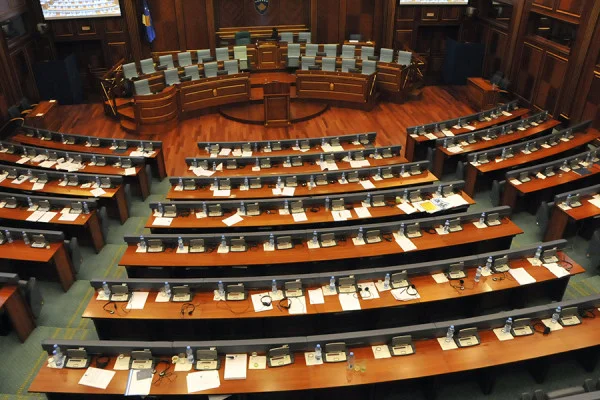
If a political agreement is not reached in the coming period for the election of Kosovo's deputy head of the Parliament by the Serb community, institutional blockades could be restored during efforts to form new institutions.
Thus estimates to Radio Free Europe Kadri Kryeziu, former judge of the Constitutional Court of Kosovo, stressing that it is now a political issue, not a legal one.
The possibility of a new institutional blockade does not exclude even the Bulaq Vulnet, from the Kosovo Democratic Institute, as representatives of the Vetevendosje Movement, according to him, “otherwise interpret the Constitutional Court's decision”.
“It does not rule out the possibility that they can easily cling to a word, part of the text or any disposit of the decision and intentionally interpret it, as they did during the 56 Framework Constitution sessions last year”, Bugak told Radio Free Europe.
On January 28th, Kosovo's Constitutional Court found that Nenad Rashiqi's election as Serbian deputy head of the Parliament in the past legislature, made through lots, was not in line with the Constitution and the Framework of the Parliament.
The court stressed that the right to propose the candidate belongs to the party, which has won most of the reserved seats for the Serb community in this case, the Serbian List, which had nine out of ten mandates.
This party -- the largest of Serbs in Kosovo, which has Belgrade's support -- again won nine mandates in early parliamentary elections on December 28th, while a mandate was won by Nenad Rassic, leader of the Party for Freedom, Justice and Survival.
The institutional blockade could return if Albin Kurti's Vetevendosje Movement, which won in the last elections, continues to reject any co-operation with the Serbian List, while the Serbian List refuses to propose Rashiqi.
The Serbian list estimates Rassic has entered the Kosovo Assembly with the support of incumbent Prime Minister Albin Kurti, and considers him a representative “illegalisation” of Serbs.
Is there a chance of a deal?
Radio Free Europe demanded comment on the Constitutional Court's decision and the possibility of an agreement by both Nenad Rassic and the Serbian List, as well as by the Vetevendosje Movement, but until the publication of this article, there was no response.
Mimoza Kusari Lila declared to Neve 1 that the parliamentary group of Vetevendosje Movement -- which is part of it -- will not vote for Serb List candidates until all details of the Constitutional Court's full decision are considered and determine the proper way of electing the deputy head of the Parliament from the Serbian community -- thus including candidate Nenad Rassic.
She stressed that there are also previous decisions of the Constitutional Court that determine the constitution's constitutional procedures.
Last year's September decision found that the Kosovo Assembly could not be constitutionalised without the Serbian community's election of deputy leader, unless the process is deliberately hampered ʹ in that case, the Assembly can function only in quorum for decision making.
However, the court explained at the time that in the concrete case, the process was not deliberately blocked, as failure to elect the deputy leader from the minority community was attributed to the Albanian majority.
Bulaqum praises Kusari Leela's statements as “irresistibly unstable and wrong” and stresses that the last two decisions of the Constitutional Court were clear.
According to him, the Court clarified that blockades in the constitution were not caused by the failure of candidates from the Serbian List, but by the fact that MPs from the Albanian community did not vote.
“Also, according to the Constitutional Court, they have not respected either the bias or the Constitution, nor the constitutional order of the Republic of Kosovo itself, nor by voting out candidates proposed by the group that is the majority of the Serb community”, Bugakku says.
He adds that Albanian deputies from all political parties in the Assembly have no right to dictate how a community in the Parliament's Headship will be represented.
Challenge of Constitutional Court Decisions
Kosovo faced a deep institutional and political crisis following last February 9th elections, as Albanian parties failed to agree on the election of Speaker of the Parliament, which was followed by a blockade for electing deputy leaders from the Serbian community.
Early elections were announced after two candidates from the Vetevendosje Movement -- Albin Kurti and Glauk Konjufca -- failed to secure the sufficient number of votes to form the new government.
The parties have been led to the Constitutional Court several times, but, according to Bugakku, it still remains unclear what legal implications MPs will have if the Assembly is not constitutionalised within the 30-day legal deadline.
Currently, recounting of votes from the December 28th elections continues, and after the completion of the process, new institutions are expected to begin.
Earlier, the Vetevendosje Movement has demanded from the Constitutional Court that the demands of the Serbian List regarding the constitution be declared unacceptable.
Vetevendosje leader Albin Kurti has also declared that the Constitutional Court acts unilaterally, favouring Albanian parties that have been in opposition.
The Constitutional Court has reacted, stressing that its independence and impartiality are guaranteed with the Constitutions and that no institutions, political or individual parties can interfere with its work.
Earlier, some Western countries and the European Union have called on political representatives and institutions in Kosovo to respect the Constitutional Court and its decisions, praising that independence of justice is the foundation of rule of law. /Radio Free Europe