2 hours ago
Moscow opens communication channels with the US for the Balkans? UN respond if they're talking about Kosovo and other countries
Periskopi(6 months ago)
(6 months ago)For Kosovo, it would not be the first time Russia seeks its own destiny. Because of the rejection of NATO intervention in 1999, in comparison to the annexed crime and the deadlock of international recognitions, Moscow has consistently played the role of its rival citizenship. Today, when relations between the United States and the EU are [...]
For Kosovo, it would not be the first time Russia seeks its own destiny. Because of the rejection of NATO intervention in 1999, in comparison to the annexed crime and the deadlock of international recognitions, Moscow has consistently played the role of its rival citizenship.
Today, when relations between the US and the EU are tense, this Russian influence risks becoming even more open.
This week, Russia's Foreign Minister Sergei Lavrov confirmed that Moscow has opened channels of communication with the United States for developments in the Balkans and that it is ready to deepen them. He also implied that Americans want to engage.
“We have more opportunities to communicate with the US [the EU] for the Balkans, especially for Bosnia and Herzegovina and other countries in the region. Such contacts are continuing. They have not yet produced positive or clear results. But we are open to these contacts and, as far as I can judge, even our American colleagues are willing to develop”, Lavrov said.
Free Radio Europe asked the US State Department whether the US is negotiating with Russia on Kosovo, Bosnia or other Balkan countries, how it co-ordinates with Europe and how it praises Moscow's role in the region, but received no answer since January 20th.
The European Union stressed that it cannot confirm possible exchanges between the third parties.
“The EU is the main political, economic and strategic partner of the Western Balkans and is fully engaged in the region”, a bloc spokesman for Radio Free Europe said.
The incumbent Kosovo government did not comment on Lavrov's statements, but Prime Minister Albin Kurti, at an event in Davos, warned of the indirect threat Kosovo comes from Russia through Serbia -- both states that recognise its independence.
“Anyone who helps our northern neighbour in trying to destabilise us also brings problems to us. Our closest threat in this direction is the Russian Federation”, Kurti said.
In the Western Balkans, Russia has an active role, mainly through its ties with Serbia and Republika Srpska in Bosnia and Herzegovina, while its influence in other countries, such as Montenegro, Northern Macedonia and Kosovo, remains more limited and often indirect.
Through dezinforms, proscient media and energy impact, Moscow aims to slow Euro-Atlantic integration, increase instability in the region and challenge US and EU interests.
The European Parliament has adopted several resolutions condemning these practices and require co-ordinated responses by the European Union and partner countries.
A report by the Kosovar Centre for Security Studies, published in 2024, underscores that a “one of Russia's goals in the Western Balkans is to prevent the alignment of Serbia side West. One way to achieve this is Serbia's firm support of Kosovo's stance and the obstruction of the process of normalising relations between Kosovo and Serbia”.
In the past four years, since Russia has begun its full-scale invasion of Ukraine, Moscow has faced a wall of economic sanctions and diplomatic isolation from the West.
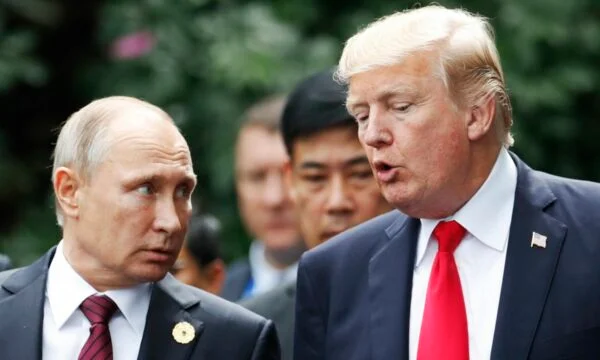
Recently, some of these obstacles have begun to soften, especially after the meeting between US President Donald Trump and Russian President Vladimir Putin last year in Alaska, as well as subsequent talks between officials of the two countries to find a way out of the conflict in Ukraine.
Many European leaders, in turn, have maintained stronger attitudes and have not signaled relief to Russia. But transatlantic reports have strained another series of issues from the situation in Gaza to American ambitions for Greenland, making the international scene more unpredictable than ever.
“I love Europe and want to see it well, but it's not going in the right direction”, Trump said at the World Economic Forum, which was held this week in Davos.
In the past four years, since Russia has begun its full-scale invasion of Ukraine, Moscow has faced a wall of economic sanctions and diplomatic isolation from the West.
Recently, some of these obstacles have begun to soften, especially after the meeting between US President Donald Trump and Russian President Vladimir Putin last year in Alaska, as well as subsequent talks between officials of the two countries to find a way out of the conflict in Ukraine.
Many European leaders, in turn, have maintained stronger attitudes and have not signaled relief to Russia. But transatlantic reports have strained another series of issues from the situation in Gaza to American ambitions for Greenland, making the international scene more unpredictable than ever.
“I love Europe and want to see it well, but it's not going in the right direction”, Trump said at the World Economic Forum, which was held this week in Davos.
Kupchan estimates that the US dialogue with Russia is necessary for Ukraine, but warns that co-operation with Moscow in the Balkans must be avoided, as its interests are “diamatically contrary to the American.
America's top <x0).Partner in the Balkans is the European Union, not Russia. For this reason, what needs to be seen is a much more intensified co-operation and diplomacy between the US and the EU, even though it is difficult now, given that US-European relations, at this point, are not in a good state”, says Cupchan.
He believes Kosovo is on the radar of Trump and that his administration will push Pristina and Belgrade towards progress in negotiations on normalising relations, but estimates Russia may try to prevent this process, as “aims to preserve pan-orthodox unity in the region”.
According to him, Kosovo should be alert to possible Russian efforts “to spark new riots”.
And, Stradner shares a different opinion, Kosovo is part of a broader geopolitical picture, but does not represent Russia's main focus.
I believe the situation in Kosovo, in terms of security, is better than a few years ago. And the last thing the United States wants now is an uncontrolled escalation”, Stradner says.
However, according to Stradner, Kosovo can never forget that key betting on Russian influence is found in Serbia and Bosnia. In addition to political ties, Moscow is available in these two countries, and pressure levers and blackmail are initiated from energy and gas control to economic and media impact used to preserve its strategic space and to influence the region.
Kosovo must develop much closer ties with the European Union and be extremely diplomatic and wise in its approach to the United States”, Stradner says.
Even the EU, according to Stradner, must show true leadership in the Western Balkans, where, so far, it has not been very effective.
But in her words, it's a time when we're all like those <x0macs following laser” we always react to events moving fast, without real control, and without a clear idea of what comes next. While light keeps us stuck in its game, the world does not wait. / REL/ Periscopi/