13 minutes ago
What could happen if the United States attacked Iran? Here are seven scenarios.
Periskopi(6 months ago)
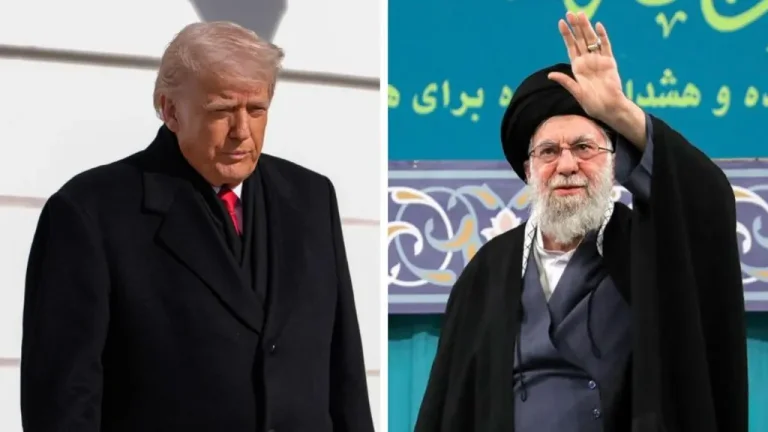
(6 months ago)The U.S. appears to be ready to attack Iran in a few days. While potential targets are largely predictable, the result is not. So if a last-minute deal can not be reached with Tehran and President Donald Trump decides to order American forces to attack, then what are the possible results? Attacks of [...]
While potential targets are largely predictable, the result is not.
So if a last-minute deal with Tehran can not be reached and President Donald Trump decides to order American forces to attack, then what are the possible results?
1. Targeted, surgical attacks, minimal civilian casualties, a transition towards democracy
US Air and Marine Forces conduct limited and precise attacks targeting the military bases of the Islamic Revolutionary Guard (IRGC) of Iran and the Basij Unit a paramilitary force under the control of IRC ballistic launch and storage sites, as well as Iran's nuclear programme, the BBC writes.
An already weakened regime has collapsed, eventually moving into a true democracy where Iran can be reunited with the rest of the world.
This is a very optimistic scenario. Western military intervention in both Iraq and Libya did not bring a smooth transition to democracy. Although it ended brutal dictatorships in both cases, it brought years of chaos and bloodshed.
Syria, which carried out its revolution, bringing down President Bashar Al-Assad without Western military support in 2024, has so far far done better.
2. The regime survives but fashions its policies
This may be widely called the Venezuelan “model”, where the quick and powerful action of the US leaves the regime intact but with its moderate policies.
In Iran's case, this meant that the Islamic Republic survived, which will not satisfy a large number of Iranians, but is obliged to limit its support for violent militias throughout the Middle East, disrupt or limit its domestic nuclear and ballistic missile programmes, as well as facilitate the crackdown on protests.
Again, this is at the most impossible end of the ladder.
The leadership of the Islamic Republic has remained challenging and resistant to changes for 47 years. It seems incapable of changing course now.
3. The regime falls, replaced by military rule
Many people feel that this is the most likely outcome.
While the regime is clearly unpopular with many people, and every wave of consecutive protests over the years weakens it further, remains a deep security and widespread state with a direct interest in the status quo, reports the report. BBC, broadcast Periscope.
The main reasons why protests so far have failed to overthrow the regime are because there have been no significant defects on their side, while those in control are prepared to use unlimited force and brutality to stay in power.
In the confusion following every U.S. attack, it is possible that Iran will end up being ruled by a strong military government comprised mainly of IRC figures.
4. Iran retaliates by attacking American forces and neighbours
Iran has pledged to retaliate against any U.S. attack, saying its “gist is at the trigger”.
Obviously, it cannot be compared to the power of the U.S. Navy and Air Force, but it can still attack with its arsenal of ballistic missiles and drones, many of whom hiding in caves, underground, or remote mountain slopes.
There are American bases and objects scattered along the Arab side of the Gulf, especially in Bahrain and Qatar, but Iran can also target, if it chooses, some of the critical infrastructure of any nation that considered it an accomplice in an American attack, such as Jordan.
The devastating missile attack and fears Saudi Aramco's petrochemical facilities in 2019, attributed to an Iranian-backed militia in Iraq, showed Saudis how vulnerable they were to Iranian missiles.
Iranian Arab neighbours in the Persian Gulf, all of the US allies, are understandably concerned now that any US military action will end up turning them back.
5. Iran retaliates by placing mines in Persian Gulf
This has long emerged as a potential threat to global shipping and oil supplies since the 1980-88 Iran-Iraq war, when Iran really undermined shipping corridors and the Royal Navy miners helped clean them up.
The narrow Strait of Hormuz between Iran and Oman is a key critical point. About 20% of the world exports of liquid Natural Gas (LNG) and between 20-25% of oil and oil byproducts pass through this strait annually.
Iran has performed drills for rapid deployment of marine mines. If he did, that would inevitably affect world trade and oil prices.
6. Iran retaliates, sinking an American warship
A U.S. Navy captain aboard a warship in the Persian Gulf once said one of the threats from Iran he most worries about is a “mob attack”.
Iran is thus launching so many fears with high explosives and rapid cruise ships at one or more objectives that even the powerful defences of the American Navy are not able to eliminate them all in time.
The IRC Navy has long replaced the Iranian Convention Navy in the Persian Gulf, some of whose commanders were even trained in Dartmouth during the time of the Shah.
Iran's marine teams have focused most of their training on nonconventional warfare or “asymmetrical”, looking for ways to overcome or bypass the technical advantages their main opponent, the Fifth Fleet of the American Navy.
The killing of an American warship, coupled with the possible capture of survivors among its crew, would be a great humiliation for the United States.
As this scenario is thought impossible, the billions of dollars in destruction The USS Cole was damaged by an al-Qaeda suicide attack on the port of Adden in 2000, killing 17 American sailors.
Before that, in 1987, an Iraqi plane pilot accidentally shot two Exocet missiles into an American warship, USS Stark, killing 37 sailors.
7. The regime collapsed, replaced by chaos
This is a very real risk and is one of the main concerns of neighbours like Qatar and Saudi Arabia.
In addition to the possibility of a civil war, such as what Syria, Yemen and Libya experienced, there is also the danger that in chaos and confusion, ethnic tensions can turn into armed conflicts, while Kurds, Baltics and other minorities seek to protect their people amid a nationwide power vacuum.
Most of the Middle East would certainly be happy to see the support of the Islamic Republic, no one more than Israel, who has already dealt a heavy blow to Iran's allies throughout the region and fears an existential threat from Iran's alleged nuclear programme.
But no one wants to see the largest Middle Eastern nation in the population of about 93 million to sink into chaos, causing a humanitarian and refugee crisis.
The greatest danger now is for President Trump, having gathered this powerful force near Iran's borders, to decide that he should act or lose his reputation, and a struggle start without a clear outcome and with unpredictable and potentially damaging consequences. /Periscope/