6 minutes ago
EU Monitoring Mission: Serbia's tendency to influence Kosovo vote has been noted
Periskopi(a year ago)
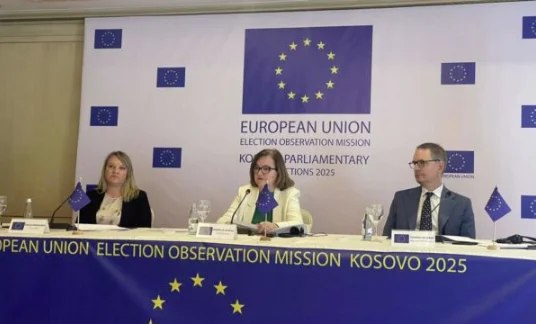
(a year ago)The Election Monitoring Mission from the European Union (EU EOM) at the media conference in Pristina presented the final report on parliamentary elections in Kosovo. European Parliament member Natalie Loisau, speaking of foreign interventions by the state of Serbia in Kosovo elections, stressed that trends have been observed to influence [...]
European Parliament member Natalie Loisau, speaking of foreign interventions by the state of Serbia in Kosovo elections, stressed that the tendency to influence the vote has been observed, reports EO.
I've mentioned them in general. We're witnessing trends from abroad to influence their vote, and that shouldn't have happened between neighbors. Public broadcasting, radio and television, as well as programmes for non-US communities, will improve so that voters from all communities in Kosovo will have better access to relevant information about the” elections, Loiseau said.
She said the report contains a comprehensive assessment and 19 recommendations for improving further election processes.
It is a pleasure to return to Pristina and present to you the final report of the European Union Election Monitoring Mission for parliamentary elections in Kosovo. Since my arrival two days ago, I have met with the president of Kosovo, incumbent prime minister and head of the Central Election Commission to hand over the report and discuss the recommendations it contains. On behalf of our mission, I would like to thank the president of Kosovo for inviting to observe these elections. I also want to express my gratitude to Kosovo citizens. Their devotion to the democratic process is evident.
I also thank the election administration and all election actors in Kosovo. The hospitality they offered us and our observers was and still is warm and open. Our work in Kosovo began in early January and continued through the entire election process. We have deployed 104 observers from all 27 EU member states, along with Canada, Norway and Switzerland. A delegation from the European Parliament also joined the” mission, Loisau said.
She said the recommendations are intended to promote reflection and dialogue among political actors, institutions and civil society.
Our basic <x0) team of analysts and short-term observers have praised all aspects of the process before, during and after election day. Today we publish our final report. It contains a comprehensive election assessment and 19 recommendations for improving election processes in Kosovo. We hope that these recommendations serve as the basis for reflection and dialogue among all actors -- political parties, media, electoral institutions and different communities. These elections were administered under a new legal framework. The new law for general elections sets a solid basis for democratic elections”, the European Parliament member added.
Loisau also said that disabled people continue to face obstacles to vote independently.
The disabled persons continue to face obstacles to vote independently, including polling stations that are peaceful. Based on these observations and international standards, our final report offers 19 recommendations to further improve the framework and electoral practice in Kosovo. We have identified six priority recommendations. These include areas where the action is more urgent and influential. The mission's priority recommendations, which are not listed in importance, are: to strengthen the legal guarantees regarding the composition and conduct of election officials to ensure the impartiality and independence of the electoral administration; to further limit and specify the responsibilities of the Central Election Commission, the Secretariat of the CEC, and the municipal election commissions, to decentralise decision in the electoral administration, where it is appropriate and to ensure efficiency and functioning at the time”, European Parliament member Natalie Lois said. /Periscope/