12 minutes ago
Questions about war in Syria?
Periskopi(a year ago)
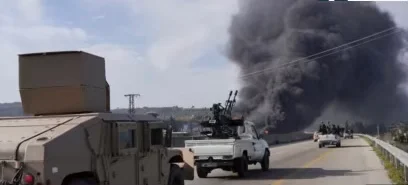
(a year ago)While the outbreak of violence in western Syria has raised questions about the ability of the transitional government to control related factions, violence has also brought Russian and Iranian involvement in Syrian issues into focus. Various human rights groups that are monitoring the situation in Syria have [...]
Various human rights groups that are monitoring the situation in Syria have documented over 800 victims, including civilians, since the outbreak of clashes on March 6th between government forces and loyal fighters of the ousted president Bashar al-Assad.
The rebel groups led by Ahmad al-Saharaa ousted the government through a quick offensive in December 2024, ending Syria's semi-year rule by the Assad family, writes Radio Free Europe, broadcast Periscope.
Assad's government was backed by Russia and Iran. While Russia has kept reports with the new government, Iran has been completely excluded.
Through interviews and public data analysis, Radio Free Europe can offer a clearer mirror regarding what is happening in Syria.
Men executed with firearms
Human rights groups have said that among those killed are hundreds of civilian victims, most of whom were alavis, the minority community that belongs to Assad. On March 11, the United Nations said that entire families, including women and children, had been killed in violence.
The images published on social networks, which have analysed the Ukrainian Radio Free Europe Research Unit Schemes, suggest that much of the heavy violence against alavit civilians took place in the port city of Latakia, where Russia's air base, Himim, lies.
Some videos have shown unarmed men executed with firearms behind their backs, while others have shown victims who were physically abused and humiliated, such as forcing them to bark like dogs and crawl on bodies of the dead.
Nobil, a Syrian from Latakia, who currently lives in Greece, told Free Europe Radio that factions associated with the transitional government entered his native village, Muzajra on the night of March 6th and started shooting at large-caliber rifle houses.
He said six family members, including two aunts and two grandchildren, were killed during the attack, but his brothers managed to leave.
REL found the Facebook account of one of the suspected attackers known as Abu Bakr Mork, also known as Talha. His account was filled with posts regarding attacks on the west of Syria.
In one of his posts, he urged men to go to the area, after saying that women in that area “are widows and do not remain men”. In another post he wrote about “fushalum to clear the remains of the dead regime”, referring to the Assad government.
Home to Russian Airbase
Satellite images provided by Planet Labs and analysed by Schemes show that since March 7, people began to gather near the air base, Emim, operated by the Russians, evidently seeking refuge from the clashes.
“It can be the only safe place where people can stay, given that neither side would want to crash reports with Russia at this moment”, Ior Semyvolos, director of the Center for Middle East Studies, told Schemes.
Russia was Assad's main supporter, offering its forces and Iranian collaborators air protection, while they fought not only against Islamic State militants (IS) but also against rebels who opposed Assad's rule.
The same rebels are now in power, but Moscow has managed to position itself as important partners for the new Syria rulers, who depend on Russia to print their local currency.
The Russians have maintained a considerable presence on their two military bases, separately in Emim.
Systema has confirmed at least 37 large aircraft flights Antonov An-124 from December 2024 to March, identifying 22 arrivals and 15 departures from the air base. Any aircraft of this type can transport up to 150 tons of equipment, suggesting a major movement of personnel or equipment.
By analyzing images published on social networks in recent days, Systema found that Major General Sergei Gashkov, head of the Russian Centre for Concipience and Control of the Refugees Movement in Syria, is currently located at the air base.
It is not surprising that Russia is seeking to maintain strong reports with Damascus under new leadership, as keeping control on the air base of Emim and naval base at Tartus offering strategic access to the Middle East, North Africa and the Mediterranean Sea.
What is Iran's role?
There is no strong evidence suggesting that Russia is involved in promoting riots along the western coast of Syria, but some have accused Iran of playing a role in this.
With Assad, Iran lost a key ally that had allowed Tehran to use Syria as a land corridor to connect its regional collaborators in Iraq and Lebanon.
When the Syrian rebels ousted Assad, Iran's supreme leader, Ajatollah Ali Khamenei, pledged that the Syrians would rise and oppose the rebel government.
Iran currently has no chance to send funds or weapons to Syria, but some key figures guiding pro-Assad resistance to the new government are close to Tehran and trained by the Islamic Republic Revolutionary Guard.
Assad's remaining faithful are led by four figures: Major General Suhail al-Hassan, who is from the city of Aita, among the first settlements that experienced clashes; Muqdad Fatiha, founder of the armed group Coast Shield; Ibrahim Hawija, former Syrian intelligence leader and Ghias Dalla, former officer of Syria's 4th Armed elite Division, which is linked to Iran's Revolutionary Guard and Hezbollah, the Lebanese group declared terrorist organisation by the United States.
Phillip Smyth, expert for Iranian collaborators and Shiite militia, told Radio Europe Free Europe that Iran “wanted an excessive response” from the transitional government and got what it wanted.
Tehran is the happy “that this happened” especially since this shows Iran “can cause major concerns” in Syria, Smyth said.