6 minutes ago
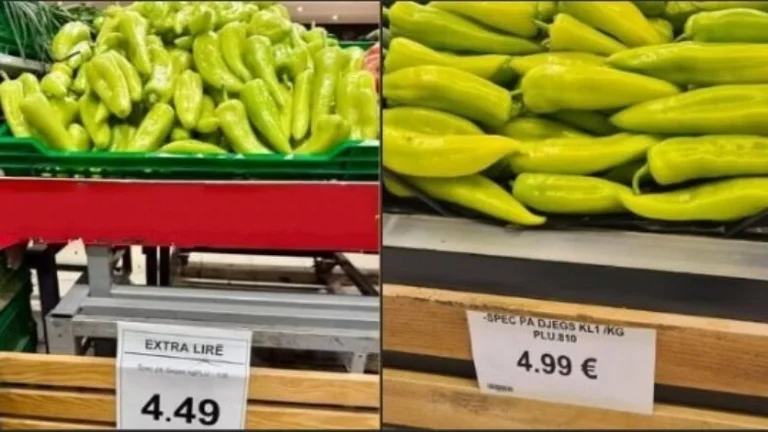
“Five years ago, peppers cost about 1.5 euros per kilogram of milk today up to 5 euros) It's horrible. When tomato peppers become luxury!
Periskopi(a year ago)
(a year ago)Winter in Kosovo brings not only cold, but also high vegetable prices. The tomatoes, peppers, and cucumbers have once become a luxury. Kosovo Statistics Agency data shows that during February, the price of trees and vegetables has been expensive for 5.5 percent, compared with [...]
Kosovo Statistics Agency data shows that, during February, the price of trees and vegetables has been expensive for 5.5 percent, compared to the same period last year.
Consumers like Erin, 23, feel the impact immediately.
Its four-member family has a combined budget of about 800 euros a month.
Erina says she tries to manage the food budget carefully, but that rising prices make it increasingly difficult.
“Prices are too high, to maximum. It's terrible. One kilogram of peppers cost up to five euros, while tomatoes and cucumbers over two euros”, says the dealer for Radio Free Europe.
It shows that there are times when the store is turned into empty hands, because “is blamed for” to spend a lot on something that “would have to be basic” and “not luxury”.
Halil Vlasi, head of a six-member Podujevo family, faces similar challenges.
Busy in various jobs in the private sector, it shows that it earns up to 600 euros a month, but adds that only food expenses exceed that amount.
I don't know how we do it. I only work for food. Now it's even more expensive, because of the festival of Bajram approaching”, Vlads says.
The Comparison He Made Radio Free Europe Current market prices with those in 2020 reveal how drastic growth was.
Five years ago, peppers cost about 1.5 euros per kilo (U.S.) today up to 5 euros.
Tacks or tomatoes cost about 1 euros per kilo ) today the price exceeds 2 euros.
According to the AKS, all agricultural products last year were for 46.8% more expensive compared to 2020.
Why the increase?
Agriculture Professor at the University of Pristina, Imer Rusinovac, cites a major factor: lack of local production during the winter.
Due to difficult weather conditions and inadequate infrastructure, Kosovo farmers find it difficult to grow vegetables outside the regular season.
Lack, then, is met by imports, but imported goods come at higher prices, due to customs duties, transport costs and increased demand.
“A kilo of pepper costs five euros. This situation should be an alarm for institutions. A solution has to be found so that even during this period there will be local products, so that the dependence on import will be reduced and prices stabilised”, Russia tells Radio Free Europe.
What may be the solution?
Kosovo relies heavily on imports from Albania, Turkey, Greece, the Netherlands and Israel.
According to data from Kosovo Customs, the country spent over 1.8m euros on importing peppers, tomatoes and cucumbers in the first two months of this year.
Only for peppers were 1.2m euros spent, while over 14m euros were spent throughout last year.
Some farmers, like Skender Ramadani, see possible solutions, but say they need financial support.
His company “The Fidanese of Godanco” increases vegetable seedlings in greenhouses and in summer cultivates peppers, tomatoes and cucumbers. But production during winter says it is a challenge.
The temperature is unstable. If there must be expensive investments, exceptional conditions are needed to come up with products in the market earlier. It's very difficult”, says Ramadani for Radio Free Europe, broadcast Periscope.
Agriculture expert Rusinovac says that with grants or subsidies from institutions, cultivating these vegetables would become possible in any season.
“The human factor can coordinate and organize closed objects whether it is for humidity or low temperatures, if new heat and technology equipment is installed”, according to it.
“I would try to make sure the donations” were provided, Ramadani says.
Even if two weeks ago we were to go out with products on the market, it would be more favorable for us as well as for consumers”, he adds.
Will the institutions intervene?
Radio Free Europe asked the Ministry of Agriculture, Forestry and Rural Development if it would subsidise farmers who could increase production capacities during the winter season, but until the publication of this article, it received no response.
A statement issued by this minister late last year cited 89m euros in grants and separated agricultural subsidies in 2024, but did not specify what agricultural cultures.
In addition, the price increases have been on other products and services in Kosovo, especially since the outbreak of the COVID-19 pandemic. Hoov inflation has also given Russian invasion of Ukraine, which started in 2022.
Some experts say the heavy dependence on import has widely detected prices in Kosovo.
On average annually, Kosovo imports goods worth 5 billion euros, ranging from basic products to construction products, while exporting under the value of 1 billion euros mostly metal and plastic products.
The average salary in Kosovo is around 570 euros. /Persycope/