20 minutes ago
IKD: The Assembly has had major violations of constitutionality, transparency and accountability of Government
Periskopi(2 years ago)
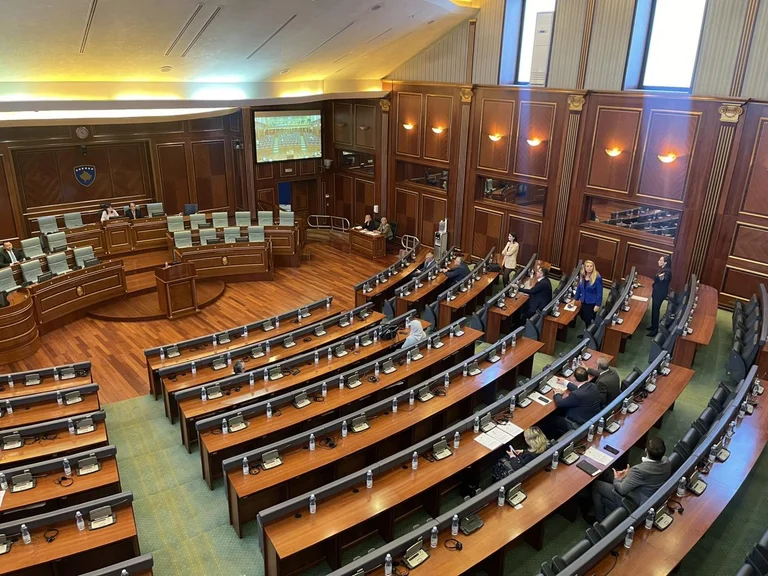
(2 years ago)The Kosovo Institute for Justice (IKD) has estimated that Kosovo's Assembly, at the spring session, has not fulfilled its constitutional role, as there have been major violations in relation to the Constitution, transparency and accountability of the Government in front of the Assembly. Among other things, according to the IKD, the Constitution and the Constitutional Court Act has been violated in [...]
Among other things, according to the IKD, the Constitutional Court's Constitutional Court Act has been violated in the Law for Public Officials, for disregarding the term set by the Court for six months.
IKD senior researcher Naim Jakaj for Economics Online said that the amount of bills for which power is taking pride in having done ʹthe majority of them are international and one-third agreements, changing laws and meeting current laws.
He has said that electoral promises, which are seen in the National Development Plan in the governing programme 2021-2025, have not been adopted, here citing the Law on Consistent Social Residence of the Labour Law.
“During the spring session until the last session, the Assembly adopted 36 bills overall, of which as can be seen are 21 prosecuted in 2023 and 15 prosecuted in 2024. The amount of bills for which political power is saying and is prided in making, the majority of them international agreements, in fact a third of them, in the meantime the rest of them, are laws that change and meet current rules”.
“While electoral promises, activities that are available in the national development plan in the governing programme at 2021-2025 have not been adopted, the Law on Confrontable Social Residence, the Labour Law, law on justice reform, no one is already in force because they collapsed at Constitutional Court”, he said.
Jakaj has said that this legislature, in addition to violating the Constitution, has not observed even the Constitutional Court's judgments, as has been the case with the Law for Public Officials, which has not even been adopted in second reading.
He has said that even at the Law for Salaries in the Public Sector, four days have passed that the Parliament has violated the Constitutional Court's act.
A assembly that has produced in quantity of bills, but in content there is really not something that was more isolated not only in this session but in the entire legislature. There have been, of course, violations of constitutionality and other than constitutional violations, then we also have no implementation of the Constitutional Court's judgments, as has been the case with the Law for Public Officials, where the law has not yet been adopted in second reading, but it contains constitutional shortcomings in the meantime it has not been adopted within a set term of”.
The Law on Salaries in the Public Sector, which has already passed four days when the Parliament is violating the Constitution and the Constitutional Court Act, but besides the Parliament and the Government. That's because they don't apply within the six-month deadline that the Constitutional Court has extended. A six-month deadline is the optimum term that, as a government, as the assembly, it has taken decisions to carry out the prejudices according to the requirements that are set”, he has said.
Jakaj has said that at this session the work of the Parliament has not distinguished from the past years and that it has been followed by a deep lack of transparency.
He has said the job of the Parliament has been followed by decision-making in opposition to the Constitution of Kosovo, as it has been to the Law of the Independent Commission for Media, to the legality of the investigative commissions to weak parliamentary supervision.
Kosovo's “Convention has not fulfilled its constitutional role during this spring session even in cases where it has technically been fulfilled there have been major violations in relation to constitutionality, transparency and accountability of the Government in front of the Assembly. As in the previous years, the Parliament's work has not distinguished from the past years, its work has been followed by a deep lack of transparency in relation to an electronic vote. This assembly, which has not produced electronic voting for MPs, will be remembered. Then, the work of the Parliament has also been followed by decision-making contrary to the Constitution of Kosovo, as it has been to the Independent Commission Law on Media. In the legality of the investigative commissions, as weak parliamentary supervision, there is already a new phenomenon that MPs, when asking questions, are not present. But more than 40 per cent of parliamentary questions remain many times because of the lack of MPs, earlier it has been that only the ministers are now missing even the largest deputies”, he has said.
The IKD researcher has added that the Assembly has faced even more poor work of the Parliamentary Investigative Commissions, adding that the parliamentary majority has become an obstacle to the investigation as required under the Constitutional Commission decision.
The “then has also been found in terms of parliamentary investigative commissions, where the parliamentary majority has become an obstacle to the investigation as it is set, according to the decision to establish the investigative commission. On the other hand, we have also had poor lack or leadership of some investigative commissions from the opposition ranks. The poor work of the investigative commissions has initially been characterised by the parliamentary majority, by their obstacle to meeting the quorum or vote on issues that have been in order days as if we should take the list of witnesses, list of materials or requirements that should be submitted or the deadline when it was submitted or the time when it would have to be investigated”, he said. /Economia Online/