10 minutes ago
Return to talks
Periskopi(2 years ago)
(2 years ago)The visit to Kosovo and to Serbia and Miroslav Lajcak, the European Union's special envoy for dialogue between the two countries, is <x0-burcratic”, analysts Emir Abrashi and Dusan Janjic say of Radio Free Europe. Currently, they say, it is impossible to continue with the dialogue on normalising relations. Likewise, they say, it is [...]
The visit to Kosovo and to Serbia and Miroslav Lajcak, the European Union's special envoy for dialogue between the two countries, is <x0-burcratic”, analysts Emir Abrashi and Dusan Janjic say of Radio Free Europe.
Currently, they say, it is impossible to continue with the dialogue on normalising relations. Similarly, according to them, it is impossible to achieve the implementation of the Ohrid Agreement that has that goal.
Lajcak, during an unprecedented visit to Pristina on June 18th, said Kosovo and Serbia should take steps to implement this agreement, remembering that access to EU funds depends on it.
He met with Kosovo Deputy Prime Minister Besnik Bislimi, while in Belgrade on 19 June, he will meet with Serbia's President, Aleksandar Vuciq.
With Kosovo Prime Minister Albin Kurti, who leads the dialogue on the political level, he did not meet because, as it was said, his trip abroad.
Kurti is staying in Germany at the invitation of the German special representative for the Western Balkans, Manuel Sarazin. There, among other things, he attended the football match between Albania and Croatia, under the Euro-2024 European Championship.
After meeting with Lajcak, Bislimi stressed the importance of “signing and full implementation of the [ Ohrid] Agreement, through a balanced, equal and just plan”.
He, too, said Serbia has repeatedly violated this agreement, especially the provision that concerns the failure to prevent Kosovo's membership in international organisations.
Serbia did this last month, when Kosovo's membership in the Council of Europe was being considered.
Last year, Pristina and Belgrade accepted the Agreement on the road to normalising relations, which became known as the Ohrid Agreement. It was proposed by the European Union, which has been mediating dialogue between the two countries since 2011.
Kurti, however, insists that the agreement be signed before the start of implementation, while Serbia has already drawn <x0 red lines”, claiming that “will never accept Kosovo's membership in the United Nations”.
According to the EU, the agreement is legally binding for both sides, even though it has not been signed.
The agreement, among other things, envisions Serbia not blocking Kosovo's membership in international organisations and accepting its symbols, documents and diplomas.
Kosovo, on the other hand, has taken over to give the Serb community a certain level of self-awareness, which in practice implies the formation of the majority Serb Communist Association.
Can the parties return to the negotiating table?
Emir Abrashi, from the non-governmental organisation Democracy Plus in Pristina, does not believe Lajcak will go out to convince the parties to sit at the negotiating table. This, for two reasons:
“First, it is a fact that the European Union is in a transitional phase [after elections], during which internal negotiations are under way for the formation of new EU institutions. Therefore, the focus in Brussels is elsewhere, not on dialogue for normalisation of relations”.
“Secon second, Mr. Lajcak is towards the end of the mandate, while his reputation as a neutral mediator is especially in Pristina ʹ is badly damaged”, Abrashi says.
Lajcak has had to begin his mandate as ambassador to Switzerland on September 1st this year, but he said he has been asked to remain in the position of the EU envoy for dialogue between Kosovo and Serbia by the end of January 2025.
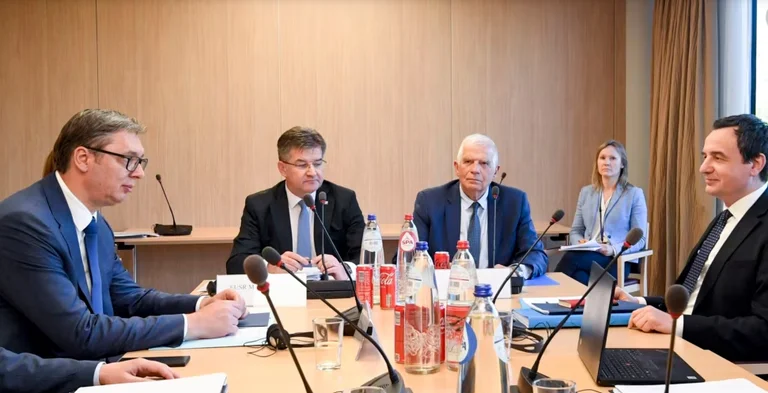
Kurti and Vuciq talked about implementing the Ohrid Agreement for the last time on September 14, 2023, but without any progress, due to conflicting positions.
A few days later, on September 24th, a group of armed Serbs attacked Kosovo police in the village of Banjsk ʹ the northern part of Kosovo, leaving Sergeant Africa Bulnjaku dead.
Kosovo accused Serbia of this attack, but official Belgrade denied responsibility.
Representatives of Western countries, meanwhile, tried several times to persuade Kurti and Vucinqiqi to sit at the negotiating table and discuss steps to implement the agreement, but without results.
Also, the heads of Kosovo and Serbia's negotiating teams, Besnik Bislimi and Petar Petkov, went to Brussels several times to discuss overcoming crises, but neither did they have progress.
One of the recent crises arose after the Kosovo government, at the beginning of the year, decided to remove the Serbian dinar from use which the Serb population in Kosovo rejected because it received revenue from Serbia's budget.
Neither Dusan Janjic of the Forum for Ethnic Relations in Belgrade believes that continuing dialogue can happen in the near future.
He expresses conviction that Lajcak's visit to Kosovo and Serbia has nothing to do with taking concrete steps within the dialogue. According to him, it is “a bureaucratic visit” prior to the EU foreign ministers' discussion of removing punitive measures against Kosovo.
On June 18th, EU foreign policy chief Josep Borrell submitted his report to member states and, according to REL sources, recommended lifting measures against Kosovo.
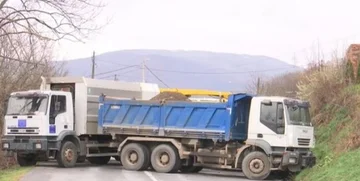
They were decided in June last year, following increasing tensions in Serb-run municipalities in northern Kosovo, as a result of the Albanian mayors' coming to power.
Janjiq: A decade of negotiations without progress on the ground
Janzic says the EU should take responsibility for, as he says, failures in dialogue and worsening the security situation in Kosovo.
He adds that Serbia's president, Aleksandar Vuciq, and Kosovo Prime Minister Albin Kurti, have taken advantage of the space the EU has given “to play” with dialogue and create crisis for personal political points.
In this context, he says, despite dialogue, in the past ten years there has been a severity of relations rather than normalisation.
“The security relations between Serbia and Kosovo have never been worse, relations between Serbs [in Kosovo] and Kosovo authorities have never been worse. So we have had barricades with armed men, then it has been announced the management of the conflict, which has ended with punitive measures against Kosovo, which will now be abolished”, Janjic says.
He believes there will be no serious progress in dialogue if the US and Great Britain no longer participate.
These two countries have so far supported the dialogue mediated by the European Union.
Abrashi: Dialogue has no alternative
Abrashi, on the other hand, says that despite the opposite positions, dialogue on normalising relations has no alternative.
According to him, it is important that political leadership in Pristina and in Belgrade take this process seriously.
He says he expects Pristina and Belgrade to show good will when it comes to resolving open issues.
This can only be achieved by avoiding increasing tensions and with the implementation of all agreements reached in these 13 years of negotiations, even if this means unilaterally,” is expressed by Abrashi.
What is seen as the possibility of increasing tensions by the international community is Kosovo's announcement of the opening of Ibër Bridge in Mitrovica, which divides the city in the southern and northern part, writes Radio Free Europe
Although there is an agreement in Brussels to open this bridge, the European Union says this must be achieved peacefully, in agreement with local authorities.
From the KFOR peacekeeping mission, whose members patrol the bridge, they say any decision to open the bridge for circulation should be taken within Brussels' dialogue.