22 minutes ago
Will Lajcak's continued mission in dialogue succeed?
Periskopi(2 years ago)
(2 years ago)The European Union has suggested that a meeting of Kurti-Wukic will be held on 26 June, in a new effort to revive the dialogue process and conclude an agreement between the two countries. Days earlier the EU has extended the mandate of its envoy, Miroslav Lajcak, until [...]
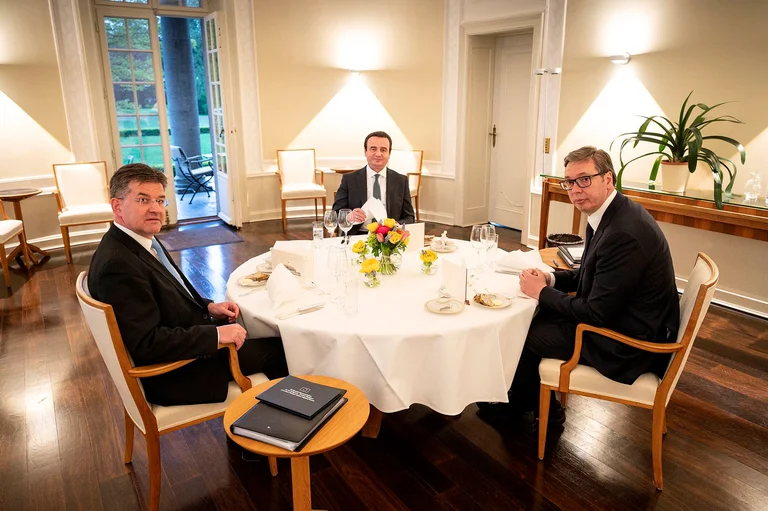
The European Union has suggested that a meeting of Kurti-Wukic will be held on 26 June, in a new effort to revive the dialogue process and conclude an agreement between the two countries. Days earlier, the EU has extended its mandate to its envoy, Miroslav Lajcak, until January of next year, putting European diplomacy in motion to end the normalisation of relations between Kosovo and Serbia.
A visit to Pristina and Belgrade and EU envoy Miroslav Lajcak returned the two sides' reconciliation for a Kurti-Vuchic summit. Both leaders have not been faced for months, except in remote statements, and the EU has indicated they will meet 26 June.
EU spokesman Peter Stano confirmed the meeting of the two leaders next Wednesday in Brussels.
Serbia's “President and Prime Minister Kurti will represent the respective parties, and the meeting will be chaired by High Representative Josep Borrell backed by EU Special Representative Miroslav Lajcak”, Stano said.
The EU's envoy, Lajcak, experienced over the past two days -- in Pristina and Belgrade -- to push forward implementing the agreement on normalisation of relations, a process which had been blocked for months.
“Does not think this is the last visit to Kosovo because I am scheduled to continue my mission until January. So there's still time, and there's still a lot of work that has to be done”, Lajcak said.
But the continuation of Lajcak's mission until January next year was conveyed with criticism from representatives of power in Kosovo, who charged him with saying, “inadequacy to the ongoing parties of the” dialogue.
European Integrity Commission member Agon Batusha has said Lajcak should clarify whether there is an agreement for normalising Kosovo-Serbia relations.
It's good for Lajcak to explain whether there's a deal or not. Because according to Vuciqi and the government of Serbia there is no Ohrid agreement and there is no Brussels agreement. So, what should we apply? We know there are 36 agreements that have been reached in Brussels since 2011 and they would have to be implemented, of course, without violating the constitution, sovereignty and territory of the Republic of Kosovo. But, we must have a specific plan, it should be required that Serbia implement the agreements because as we know Serbia has not implemented any of the agreements. While Kosovo has struggled with its own opportunities to implement some of those agreements that do not violate Kosovo's legal and administrative system”, Batusha said.
In Pristina, Lajcak indicated that he will also work to obtain Kosovo and Serbia from a Development Plan, and announced that it is he who will make the assessment of the parties' priorities in the normalisation process. But official Pristina was tough on the EU for measures imposed on Kosovo, and according to it they will also influence the process of dialogue in Brussels.
“There has been a demand for the deespass, deespass occurred before months and no one is able to ascertain what Kosovo” should do, said Donika Grovalla, foreign affairs minister.
But for the opposition, the government is insincere in relation to the internationals. MP The PDK, Elmi Recica, said the punitive measures, the impasse of Kosovo on the integration path are some of the elements showing the international factor has turned its back on Kosovo as a result of the uncoordinated approach of the Kurti Government.
This Government is hurting the state of Kosovo in essence. We have sanctions even against that in two cases in Ohrid and Brussels this Government has accepted the agreement beyond the 2013-15 agreement that their peak or crown is the Constitutional Court Act of 2016”, Recica told Rtv21.
Politologist Fidan Ukaj calls the EU emissary mission Miroslav Lajcak failed and has criticised the EU for unbalanized access to dialogue.
“The confidence and commitment taken by Lajcak's EU has been in hopes of completing his work in the illustration for completing the dialogue process. With all this, I think this four-year commitment has been a failure because during this period there has been no normalisation of reports between Kosovo and Serbia”, Ukaj said.
The European Union has conditioned both Serbia's European and Kosovo's path with the process of normalising relations by insisting on the implementation of reached agreements in Brussels and Ohrid.