19 minutes ago
Dialogue and Enlargement ʹ right-wing EU prey
Periskopi(2 years ago)
(2 years ago)If polls prove accurate, the elections for the new European Parliament will show increased support for right-wing populist parties and for far-right ones already part of some national parliaments. These forces support a political opinion that tends to be more conservative and nationalist. They are [...]
If polls prove accurate, the elections for the new European Parliament will show increased support for right-wing populist parties and for far-right ones already part of some national parliaments.
These forces support a political opinion that tends to be more conservative and nationalist. They oppose immigration, anti-culturalism and some against EU enlargement.
In the words of German Chancellor Olaf Scholz, right-wing “pulists are ready to destroy what we have built for our children; they arouse feelings against refugees and minorities”.
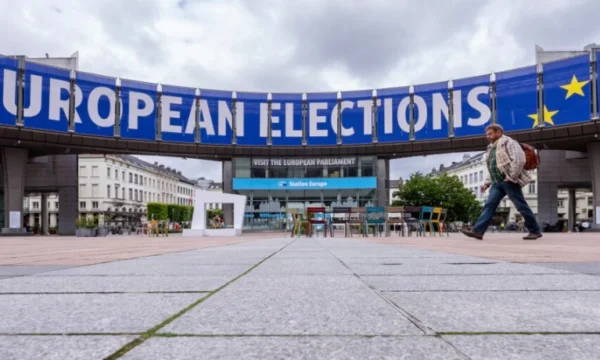
The European Parliament elections will be held from June 6th to June 9th. MPs from this institution are elected directly by citizens over 400 million hits in all 27 member states.
A survey conducted by the European Council for Foreign Relations has found that this process will bring significant strengthening to the radical right.
The reasons range from continued increase in cost of living to fear that open borders endanger national identity and traditional values.
Consequently, the two main political groups -- the European People's Party and the Alliance of Progress of Socialists and Democrats -- will preserve the majority, but with weaker results, according to the survey. They have also experienced a decline in the 2019 elections, the first group at 2.8 percent, and the second for 5.9 percent.
In its fallout composition, the right is 128 seats out of 705. In the future composition, according to polls, it could win almost a quarter of them.
Vesko Garchev, who served as Montenegro's ambassador to Brussels, explains about the Free Radio Europe Expose programme that the European Parliament has less influence than the other two EU institutions, the European Commission and the European Council, but adds that it cannot be overlooked on some important issues. For example, the European Commission cannot take office without a majority vote being confirmed in the European Parliament.
The growth trend of rightist parties will be reflected in the composition of the new European Parliament. But the question is whether those parties will be decision-makers when it comes to the new Commission, or they will be significant minorities within Parliament. This is very important and I am sure that it will determine how the Parliament and other European institutions will work in the years ahead”, Garchev says.
The European Council for Foreign Relations poll has found that radical right parties tend to come first in nine European countries, including: France, Austria and Italy, while second or third in nine other countries, including: Germany and Spain.
Garchev says this is problematic because the impact these elections have on national debates includes the decisions of the Commission and the European Council. Garchev specifically mentions the Western Balkans.
I'm particularly concerned about elections in France here. They can change the game, because it is individual states that form the European Union's approach when it comes to the Balkans”, he says.
Andy Hoxhaj, a legalist at London University College, echoes that attitude. Speaking of Expose, he expects far-right parties to extend EU closure to the Southeast European region.
Many of them oppose EU enlargement with the Western Balkans because, they say, cultural issues and institutional problems. If far-right parties have greater power than they currently have, then the enlargement policy will be in serious question”, Hoxhaj says.
Hoxhaj says this policy will leave even a danger behind that of even greater influence by Russia and China. As more vulnerable countries, he mentions Serbia and Bosnia and Herzegovina. And for that, the EU is responsible.
“... because the EU has left a vacuum in the Western Balkans, since the enlargement policy, in the last 15 years, has only been used for influence in the Balkans, but without a long-term approach to when these countries will integrate, or how they will be integrated. This vacuum then caused major powers, such as China and Russia, to interfere with extraordinary investments in specific infrastructure, such as economy, transport and so on”, Hoxhaj says.
European Commission President Ursula von der Leyen, who will run for re-election this year, has said in his address to the EU situation last September that the bloc must respond to “calling history” and accept a large number of countries, including from the Western Balkans.
The future of the Western Balkans is in our Union”, she said.
The EU has voiced support for the European perspective of Western Balkan countries since 2003, at a summit in Thessaloniki, Greece. But, since then, only Croatia from the countries of this region has joined the EU in 2013.
The others are in different stages of integration, while Kosovo is the most distant it has only applied for EU membership in December 2022.
With the growth of the extreme right, Garchev, now professor of the Practice of International Relations at Boston University, says Kosovo will be further exacerbated with the process of normalising relations with Serbia.
Because of ideology and not interest in the region, far-right parties will stand on Serbia's side and support it against Kosovo. This, then, will further extend the negotiation process between them. And if the American administration changes, it can also draw more from Serbia. In such a scenario, I can also imagine restoring the idea for the exchange of territories between Kosovo and Serbia in the coming years”, Garchev says.
In the elections, after those for the European Parliament, there will also be EU foreign policy chief responsible for mediating Kosovo-Serbia dialogue. In the past five years, Josep Borrell, diplomat from Spain, has held this position that does not recognise Kosovo's independence.
Analysts warn that some nationalist leaders in the Balkans may even try to exploit the political vacuum, resulting from these election processes, to complicate the situation on the ground. Serbia's president, Aleksandar Vuciq, and Republika Srpska's president in Bosnia and Herzegovina, Milorad Dodik, are mentioned both with often pro-Russian views.
Concern in themselves, according to them, is also North Macedonia, where, this month, the nationalist V party MRO-DPMNE has returned to power, winning parliamentary and presidential elections.
“First Balkans, then Brussels”, has said the country's new president, Gordana Silanovska-David.
Analysts do not expect from the right to increase, there will be any political change in terms of Russia and Ukraine, two countries at war, or protection of freedom in Europe.
To halt this momentum, they say that, among other things, social and economic conditions must improve, which will then curb the attraction of populism.
The elections in Europe this year will be the first since the United Kingdom was finalised by the European Union in 2020.
They will be the first even after several important crises, which have radically impacted politics in the EU and its member states, such as the COVID-19 pandemic, Ukraine's full-scale invasion of Russia and the Gaza war.
Turnout is expected to be lower than in national parliamentary elections.
But in the words of the Italian prime minister, Giorgia Meloni ʹ whose party has neo-fascist roots ♫ “patriots' time has come”. /RadioEurope Free/