16 minutes ago
Totaj: A very stubborn course, with the United States, can always be found
Periskopi(2 years ago)
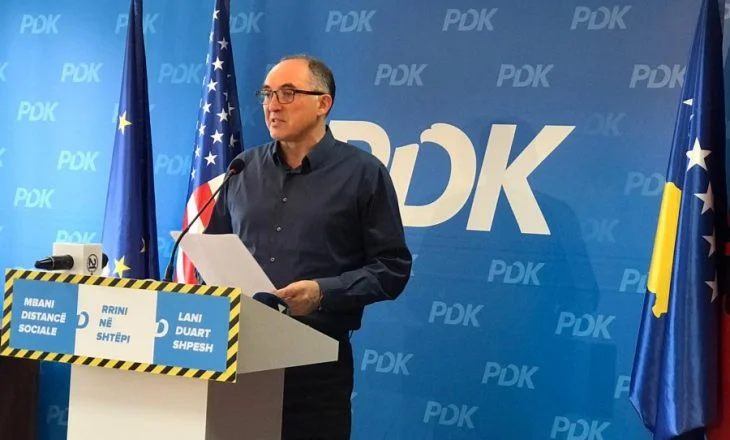
(2 years ago)Democratic Party of Kosovo deputy leader Shacir Totaj says the Kosovo government should show more co-operation and flexibility towards Western allies' demands, especially the United States. He referred to attitudes on issues such as dinar and Association. Mr. Totay, in an interview for the Voice of America during a visit to [...]
Mr Totaj, in an interview for the Voice of America during a visit to Washington, said Kosovo cannot be hostage to the way Serbia behaves. Mr. Totaj, who is also mayor of the Prizren municipality, also spoke of the twinning of this city with Harrisburg in the state of Virginia in the United States.
Voice of America: Mr Totaj, Kosovo is under diplomatic pressure to postpone the Central Bank's decision on the dinar. What should the authorities in Pristina do in this situation, according to you?
Shaqiri Totaj: This is a sensitive and at the same time important topic, and I consider that the international authorities' demands have not been for this decision to be implemented but for a more convenient, more appropriate time to be found so that the Serb community, which does not have any quality of life, does not find it difficult. I consider that the Kosovo government should co-operate with the international community, it should be more flexible and should find a solution that is appropriate because it is not required to implement, but to postpone and find a more appropriate moment to implement their decision.
Voice of America: The biggest table on issues related to normalisation with Serbia has been the one for the Association of Serb-dominated municipalities, and this pressure appears to have increased even more as the debate with the Council of Europe on Kosovo membership approaches. What is your party's position on the issue?
Shaqiri Totaj: Kosovo's government should be much more flexible, much more co-operative and cautious when discussing with the international factor, especially with the United States. What we've seen so far has been a stubborn approach of our prime minister, Albin Kurti, which is not good for Kosovo. We're a state and we have international obligations and those obligations we still have to fulfill, I don't say that there are magic formulas, but I say that if there is will, constructive and flexible access with international partners, especially with the United States, there can always be a solution. We've been through more serious challenges and we've found solutions and I recommend that there be caution, flexibility, and serious readiness to talk and find solutions, which the solution should still be found.
Voice of America: The Association Agreement has been in power for many years. Now you tell Mr. Kurt to apply the request, of course. How would your party operate, and why has it not acted before for its implementation?
Shaqiri Totaj: This is a delicate issue that has been going on for over 10 years. Delayed decisions are affecting us. I don't want to accommodate anyone of responsibility, but it's something that belongs to Kosovo's international obligations and it's something that's been discussed and negotiating even maybe Mr. Kurti's party has been very loud, critical and overly harsh in comments and criticism and prevented it from creating a very difficult climate, but what needs to happen is to be flexible, to listen to the demands coming from our international partners, especially from the US once and forever to close the issue and make a permanent solution. But you see, with Mr. Kurti's coming to power, the level of negotiations has branched, before it has been negotiated for mutual recognition with Serbia, while it is now negotiated only for an association of municipalities that has been the subject even then, but in counter-reward has been the subject of mutual recognition talks, which is now no longer.
Therefore, we cannot make a parallel between the situation then and the situation now because there is negotiating level branchation and it is only about technical issues and there is no discussion of mutual recognition that would actually have been a successful closure to say the case of Kosovo as well.
Voice of America: Serbia has never expressed a will for mutual recognition. How would you say to those who support Mr. Kurti and the government's argument that, in fact, is Serbia that should make concessions and pressure is not the same, but has been greater on Kosovo?
Shaqiri Totaj: Kosovo cannot be hostage to the way Serbia behaves. We need to talk to the international factor, we need to talk to the U.S., we have to fulfill our international obligations and then I'm sure we're developing real developments. Serbia has a destructive approach, a stubborn approach and we should not take an example of why Serbia behaves similarly to us. No, rather we have to be constructive, co-operative, we have to be flexible as we used to be in some crossroads of our newest history, and we have always come out victorious, if we mention Rambouja, Ahtisaari's time, and we always benefit after those negotiations.
Voice of America: A question for developments in the last few days where the Serbian Lists said they would boycott the referendum in the four northern municipalities. How does this complicate the situation?
Shaqiri Totaj: From the Serbian List we have so far seen no constructive approach, so I do not expect them to be constructive, but the constructiveness of the Kosovo side should not be conditioned on the way the Serbian List behaves. The Kosovo government in co-operation with the international factor, especially with the United States, should be goodwill, flexible, constructive, analyse all possible options and not depend on how the Serbian List or other factor in Kosovo will behave.
Voice of America: Part of your visit here was visiting Harrisonburg Virginia, with which Prizren has twins. Can you say this twinning and the concrete issues of Prizren that you are running?
Shaqiri Totaj: We've been fortunate to have made such twinning, in fact the Economic Oda of Prozren along with Harrison Chamber of Congress have signed a co-operation agreement and this preceded the twinning of the two municipalities. The goal is to develop economic co-operation, and for this reason we've been visiting Harrisonburg where we've met with leaders of Harrison, businessmakers, and we've talked about concrete topics what we can develop, some potential investor coming to Prizren or eventually Prizren businesses to have new markets for selling their products in the United States, and as a next step we expect a delegation from Harrisonburg, a business delegation to contact Prizren's economic Ode to see opportunities and other options that we will have access to co-operation. But I also had visitors to the State Department with the sectors related to Kosovo, but also the Department or the office that relates to cultural co-operation, in order to provide a new impulse for a collaboration in the realm of culture, sports and other activities that have room for growth and quantity, but also quality. We've discussed what we can do most to increase this co-operation and I'm very pleased with their approach and willingness to help us in Prizren, but also in Kosovo to increase our activities and contribute to the quality of life in Prizren.