21 minutes ago
“Vidovdan”, Serbian tale that causes war in the Balkans . What really happened 634 years ago?
Periskopi(3 years ago)
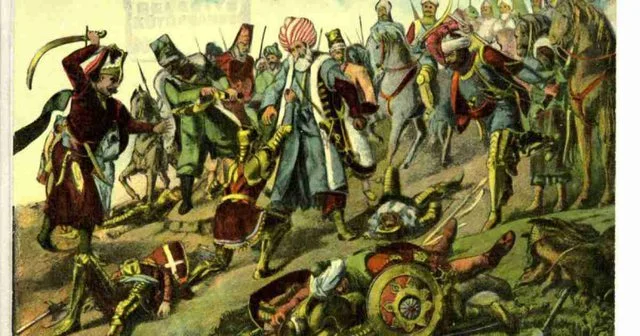
(3 years ago)Kosovo's battle took place in 1389, in Fushe Kosovo, exactly 634 years ago. It was a battle between the Balkan alliance and the Ottoman Empire, which had ended with the latter's victory. Despite the Balkans creating a coalition, Serbian historians have attempted to adopt the battle. To raise [...]
Kosovo's battle took place in 1389, in Fushe Kosovo, exactly 634 years ago. It was a battle between the Balkan alliance and the Ottoman Empire, which had ended with the latter's victory. Despite the Balkans creating a coalition, Serbian historians have attempted to adopt the battle.
To further boost the importance of this day, as they call Vidovdan, Serbia has declared it a national official holiday for all of the Serbian people of June 28th, thus trying to argue their narration “on the right to Kosovo”.
But, according to Albanian Post pronounced, two historians -- Muhamet Mala and Durim Abdullah -- the Battle of Kosovo does not have that significance and the context that tries to give Serbian history.
How did the Kosovo Battle happen, and why did Serbs try to myth it?
History professor Durim Abdullahu says that “in the chronology of the Ottoman Army military's military battles that paved that way for penetrate in the Balkans, the Kosovo Battle (1389) is neither greater nor more significant”.
The much more determining “for the extension of Ottomans in the West has been other battles like that of Marica (1371) or Savra (1385)”, he tells of the AP.
Just like Abdullah, the professor of Albanian medieval history at the University of Pristina, Muhamet Mala, who says that, in fact, the historical truth is that “has developed a common battle, which in importance was neither greater nor smaller than the other battles that have been fought; like Marica's, then Savra's in Albania, the second Kosovo battle that has been fought in 1448<1>.
But, “Serbs have used it for political purposes”.
In fact, Serbian history has mythed and carried it from the historical plain to the mythical plain, and has given it religious character, divine character, unlike reality”, he tells the AP.
It claims that this battle has not been a battle between the Serbs and the Ottoman Empire, “but it has been a common battle that was fought at the end of the XIV, between the Ottoman Empire and the Balkan coalition, where they have participated; Albanians, Bosniaks, Croats, Hungarians, and Vlach”.
So in other words, all those people who have lived on the territory of the Balkans, who have seen themselves endangered by the insight of the Ottoman Empire”, Elaboron Mala.
How did the Kosovo battle develop?
Historian Abdullah indicates that the Kosovo Battle took place in the summer of 1389, in Fushe of Kosovo, and “is primarily known by the sources of Ottoman chroniclers and letters King Tvrkko I from Bosnia has sent to Florence”.
“On one side was the Ottoman Army, in which there were also bodies of two Serbian rulers Marko Krajlevic and Kostantin Dejanovic. Its chief, Sultan Murad I Hudaglandgar, was placed in the centre, while his two sons were on his side, the princes Bayazidin and Yaqani”, he explains.
On the other hand, the professor claims, the Ottomans had a “army consisting of Christian allies, led by Serbian leader Knjaz Lazar Hrebeljanovic.
The “on his right was Serbian ruler Vuk Brankovic, and on the left, the archebore George II Balsha and Dimitris Yonima, as well as Vlatko Vukovic who commanded the troops of Bosnian King Tvko I”.
As for the details and sizes that this battle has been in, historian Abdullah points out that they cannot be known, because based on contemporary sources, data “are generally partial, but, of them, it is understood in spite of a slight Balkan advantage, a Bayazid counterattack caused panic, and the soldiers of Vlatko Vukovic withdrew from the battlefield<1>.
While King Tvko I sent letters to Florence where he declared the Balkans victory, it seems, although he saw a very unilateral military epilogue, the battle was won politically by the Ottomans”.
According to him, this battle echoed heavily for the fact that leaders of both sides were killed in it: Serbian Balkan Lazarus and Sultan Muradi I of the Ottomans.
However, from that time on, Patriarch Danilo III wrote a text “Tegime for Knjaz Lazarzarin” and behind him, the noble Jephimija at N Eulogy for Knjaz Lazarus, the song "Darca of the Knjazitão," the poem "Centora of Maleves" of Peter Onego III, and other texts became the source of an articulation that raised a myth for this battle<3x>
It also shows that the 1892, Orthodox Church listed the day of Vidi, the pagan Slavic god of the sun and war, as the day marked on the Serbian Orthodox festive calendar”.
The “especially after the invasion of Kosovo by Serbia during the first Balkan War (1912-13), this day -- that is, Vidovdan or Lord Vid's Day -- became a Serbian religious and national holiday. Vid's day, June 28th, was imposed as the date of the Battle of Kosovo, since this religious holiday was attributed to this history event”.
The “For the realisation of this syncretism, the Navration was joined by which, Cnjaz Lazarus, as a second Christ, prior to the battle, between an earthly and heavenly kingdom, he chose that heavenly, accepting self-conflict and this act, establishing a heavenly kingdom that was a divine Serbia<1>.
As Abdullah points out, this is the explanation of how what has been called the Battle of Kosovo Myth, “, which has been maintained throughout the 20th century, to peak at the 1989 manifesto in Mazgi, where Slobodan Milosevic (former Serbian fascist president) opened a threatening speech with Serbian nationalists, opening the cover of the drama of wars in Yugoslavia”.
How and why have Serbs mythed this battle?
According to history professor Muhamet Mala, Serbia's “history has mythed and carried this from the historical plain to the mythical plain, and given it the religious character, the divine character, as opposed to reality”.
In historic reality, he shows, this battle has been similar to other battles that occurred at the time, but Serbs have used “for political purposes”.
Why? For the fact that Serbs every time on Kosovo's territory have been minorities, and the lack of population presence has been trying to reason with other arguments. Those arguments are of historical nature, adopting this battle; as only their battle, to show the supposedly historic right to Kosovo's territory, that is the reason”, he explains to the AP.
The celebration of this holiday by Serbs, according to Mala, is “specifically of political nature”.
Rare “has been the history of celebrating a loss, but these (Serbs) do this to absorb the effect of loss through divine character. So we've lost because we've chosen the divine, not the earthly, and they've sanctified Prince Lazarus, who in fact they call the Carr, which is the wrong title, the magnifying title, the degriable title, but by that concept they've made alive the spirit of nationalism that has had to justify the conquest of Kosovo's territory, and the possession of other peoples”, Mala explains to the AP.
So these losses have turned into a concept of historical right, and a divine concept, under which they have the right to keep Kosovo. The Serbian Orthodox Church has also contributed to this concept”.
Historian Mala points out that even today “we see that the church is present in all political circles, sometimes even more nationalistic, and more persistent than many Serbian politicians in terms of Kosovo”.
So this is the Church-Usher conglomerate. Every time politics has failed, that vacuum has replaced the church, which with the church volume has decompressed defeat, as the case has happened in Kosovo, and has continued the myth on the Kosovo battle”.
Otherwise, this year the flagship ceremony of Vidovdan, unlike previous years, will be held at the Gracanica Monastery. This is because, as stated by the Decani Monastery, “due to security causes”, following the tense situation in northern Kosovo.
While Kosovo Serbs on Tuesday, during a protest held in northern Mitrovica and in Gracanica have adopted a statement called Vidovdan's “Declaration”.
It says that if Pristina continues with its activities and arrests, Serbs in Kosovo will be required to respond to all those who wish for us evil, who dream of war instead of peace”.
“We will be united in our right fight to stay and survive in these areas and to protect our homes and families”, the document says.
The statement also mentions the Association of Serb-run municipalities in Kosovo, agreed on under the Kosovo-Serbia dialogue.
The time has come for truth to become white and clear on this Vidovdan: will we have association? Otherwise, we know what to do” points out, among other things, the statement.
Vidovdan has recently mentioned Serbia's president, Aleksandar Vucic, as he spoke of the situation created in northern Kosovo.
“Vidovdan is an important day in Serbian history, and in Vidovdan Serbs will do everything they can to maintain peace, in line with international norms”, Vucic warned.
With this statement of Vucic not surprised, history professor Durim Abdullahu, since the same says that given his past it would not be any surprise to create any incidents.
“As a former minister of Slobodan Milosevic and as a loyal continuator of his previous policies, it is not beyond the real possibility that Serbia's President Aleksandar Vucic orchestrated and initiated any incidents on Vidovdan Day”.
But despite that, he believes this will be more on a declarative and symbolic level, as was Vidovdan's Declaration declared in Gracanica and Mitrovica.
However, in any case, Serbia will see that even escalation will be the most controlled”, he estimates. /gazetatema