9 minutes ago
Year after “
Periskopi(3 years ago)
(3 years ago)Shortly after the start of the war in Ukraine, Scholz warned Germany's twist and military weapons by offering 100 billion euros in special funds to the military. Critics say it wasn't too much a year later. Just over a year ago, German Chancellor Olaf Scholz gave a speech in Bundestag, perhaps [...]
A little over a year ago, German Chancellor Olaf Scholz gave a speech in Bundestag, which will probably also determine his entire mandate as Chancellor, using the word “Age render”. This speech, a reaction after the start of the war in Ukraine, was based on the announcement that the German Bundeswehri would receive a special 100 billion-euro arms fund. On 3 smiley CDU/ The CSU joined the ruling parties to amend the constitution and allowed additional debt to be taken.
CDU critic: “Army lost 1 year”
The conservative opposition CDU/ CSU criticised the following year, that the German Army has not benefited much from this special fund. “Bundeshower has large deficits and age turn has yet to begin at that”, says Roderich Keyeweter, spokesperson for CDU foreign policy issues for the newspaper Augsburger Alliance. “The body has lost a year and is weaker than in August 2022. ”
But the head of the parliamentary Defence Commission in Bundestag, Marie-Agnes Strack-Zimmerman (FDP) counters to deutschlandfunk that in the 16 years the CDU ruled/ CSU under Chancellor Merkel, having the Ministry of Defence under her, “has not done anything” to modernise the army. Marie-Agnes Strack-Zimmermann ranks the successes of the coalition government in 1 year: orders of F-35 fighter aircraft and heavy helicopters from the US, as well as a digitalisation offensive to modernisation of the armed forces. The defence ministry announced that 30 billion of the 100 billion euros available for Bundeswehrin are projected.
By European allies, Germany has been criticised that many major orders have been given to the US. But ultimately a large part of this special fund will stay in Germany because Germany itself has a strong arms industry. Marie-Agnes Strack-Zimmermann says that 100 billion euros cannot be spent so quickly in one year. Producing high-tech weapons takes time. The first American fighter jets F-35 for example will be ready only in 2026.
The amount of money for the army automatically diminishes
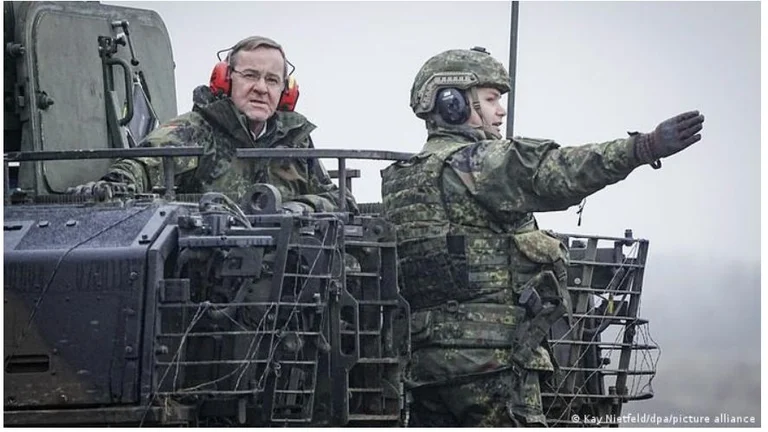
Time is already running out and 100 billion euros are made less without spending. According to Rafael Loss's data, defence expert at the European Council of Foreign Relations, “Europapean Council on Foreign Reviews” (ECFR), initially estimated that only 8 billion euros from the special fund would be the interest rate for this government debt. But due to increased interest rates, this amount has increased to 13 billion euros. So there's 87 billion left for the military. This adds to inflation and tssh, so that according to the estimate of all expenses at the end remains only 50-70 billion euros for the army -- “The longer this money stays somewhere and has no use, the more factors such as inflation or interest rates”, explains Loss for DW. Loss thinks the government should have acted faster. The “in a sense last year is the lost year for Bundeswehrin. ” As the new Defence Minister comes to office, Boris Pistorius is putting pressure on more paces, such as replacing Leopard tanks. Pistorius now requires more funds for the German Army, stressing that the special fund is not enough to cover army needs.
New Tons From the Weapons Industry
The German Army has suffered for many years from lack of effectiveness in ordering and providing necessary weapons and equipment. Last year it was a popular complaint by Hans Christop Attzpodeen, head of the Federal Association of Arming and Protection Industry, BDSV, of which are all major German heavy-arm suppliers like Krauss -Maffei Wegman, tank manufacturer Leopard 2. Attzpodeen argued that the bureaucratic colosus of the equipment insurance sector suffers from a “perfectionism” of regulations. That doesn't make the bodies get what they want. This critical point appears to have already been resolved. Attzpodeen also confirmed this to Deutsche Welles. New ones are heard from the arms industry. “We are very optimistic”, the head of the BDSV said, that processes that were first of all blocked by budget bureaucracy “are being put in motion at the right size. ”
And expert Rafael Loss is of the opinion that the complexity of law - giving procedures and noncompliance is a problem that is not easily solved. There is a highly complex ecosystem among parliament as decision-makers, the Ministry of Defence, production factors and armed forces”, he says. After the Cold War in the German Bundeswehrin, a culture that has no priority. ” There's been a high change in risk, there's been a mistake, and maybe the fear of spending too much money to make things move faster before” says Loss. This adds to the MP's regional interests in the decision to deliver orders, for Baharez deputies insisted that the federal aviation enterprise receive certain orders. ”
In other words: Scholz's “Alternal crema” stands at the turning of the colossus which are part of the German army, the culture of ordering and the bureaucracy created in it. A year seems not enough for this colossus to take the turn. /dw