 33 minutes ago
Five Key Things From Ohrid Summit
Periskopi(3 years ago)
(3 years ago)The European Union has described the March 18th meeting in Ohrid between Kosovo Prime Minister Albin Kurti and Serbian President Aleksandar Vuciq as very successful, within high-level dialogue between the two countries. The EU has said that on it the sides have agreed to implement the agreement towards normalising relations between [...]
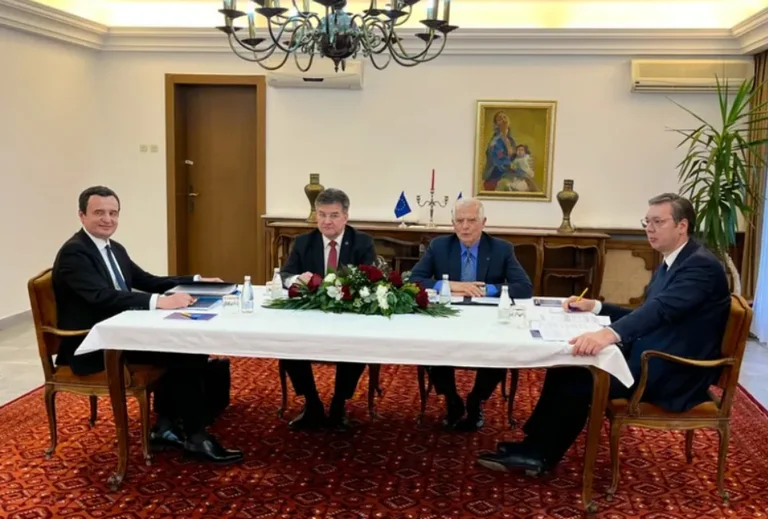
The European Union has described the March 18th meeting in Ohrid between Kosovo Prime Minister Albin Kurti and Serbian President Aleksandar Vuciq as very successful, within high-level dialogue between the two countries.
The EU has said that on it the sides have agreed to implement the agreement towards normalising their relations, supported by the EU.
This time again, however, no different interpretations of what agreement was reached have been missed, writes the REL.
The following are five main things from the outcome of the meeting in Ohrid.
1. The agreement has not been signed and seems to have given up on something like this, even though EU officials have insisted until the last moment on signing both agreement and annex. Now the European Union must find ways to convince the parties to understand the agreement as a duty, and implement all points. This, in Serbia's case, is thought to be done through the inclusion of the Agreement in the framework of EU membership negotiations, while for Kosovo on the Commission for Normalisation. With that, conditioning the process of European integrations with normalisation of reports becomes even clearer, even broader.
2. It will not be easy for the EU top diplomat's statement, Josep Borell, to have the weight of the deal reached. It, without signing the parties, is not formally a legally binding agreement, but is just a political statement. Therefore, implementation will also depend on the political will of the parties, on the political pressure of the international community, more than on legal obligation. This presents a major challenge because the parties have not observed even the obligations they have signed on before.
3. For Kosovo, of particular importance is the part of the annex, which explains that ranking points in the Agreement does not reflect priorities in terms of importance, and that all points should be implemented independently by one another. So I won't be able to block the application of one point by reasoning that another has not been implemented. That is also true of Serbia's obligation not to oppose Kosovo's membership in international organisations.
4. For Serbia, particular importance is the requirement that Kosovo immediately start working to ensure a proper level of self-awareness for Serbs in Kosovo. This is believed to have something to do with forming the Association of Serb majority municipalities, even though it is not named either in the annexes or in the Agreement. However, in annexes it is said that this should be done in line with obligations from past agreements to dialogue, which is believed to refer to the obligation to create association.
5. Even though the word “sanction “is not mentioned, they are included in the order that non-invention on the sides will have consequences for their EU integration process, but also for the financial assistance of the European Union. Both Kosovo and Serbia are major beneficiaries of assistance from the European Union funds, and this will increase even more through a donor conference that should be held within 150 days. Something like this is important because the EU will have greater opportunities than in the past, to sanction the parties, if they fail to comply with their obligations












