a few seconds ago
US and EU <x0)
Periskopi(3 years ago)
(3 years ago)The international community's current insistence on Kosovo and Serbia reaching agreements on normalisation of relations is the largest since the parties have started talks on that goal in 2011, says political awareness in Kosovo, Agon Maliqi. Regional policy expert from Serbia Aleksandar Popov agrees with this assessment. [...]
With this assessment, regional policy expert from Serbia Aleksandar Popov agrees, who says Pristina and Belgrade “have played hard to avoid obligations they have taken of”.
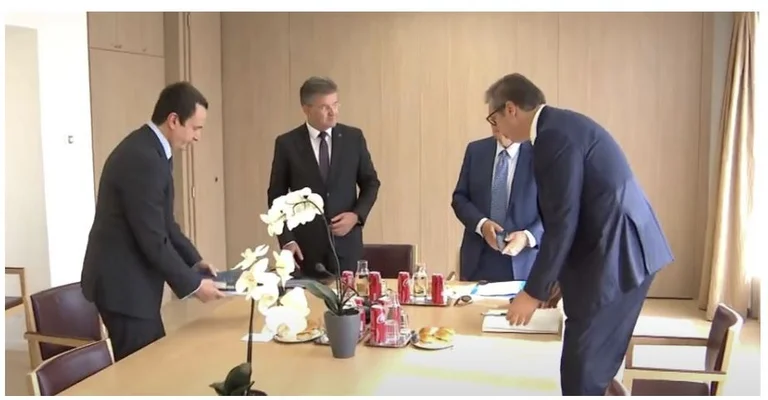
The two countries have agreed in principle on the text of an EU proposal for normalisation of relations, but, now, should follow the roadmap for its implementation. That is why a meeting warned by the EU between Kosovo Prime Minister Albin Kurti and Serbia's president, Aleksandar Vuciq, on March 18th, in Ohrid, North Macedonia.
In recent days, however, conflicting statements were made on the opinion.
Kurti said he is willing to sign the European proposal, while Vuciq said he will not sign Serbia's “conclusion”.
The statements imply changes of attitudes, taking into account that Vucic said earlier that he is willing to work on implementing this plan, while Kurti has considered it a good “basis for continuing dialogue”.
The EU's proposal, among other things, calls on the parties to implement all agreements reached within dialogue and not to prevent each other from integration processes.
The EU's special envoy for Kosovo-Serbia dialogue, Miroslav Lajcak, said he does not expect any <x0-cereemon of the signing” proposal for normalisation of relations, on March 18th in Ohrid.
After visiting Pristina on March 9th, Lajcak told a television in Kosovo that “after the agreement [EU proposal] is finalised, it will be known how to apply on the ground”.
Will the European proposal be implemented?
Aleksandar Popov, head of the Centre for Regionalism in Novi Sad, says the upcoming meeting between Kurti and Vuciqi may be a <x0-phase preparation for approaching the finalisation of the Kosovo issue” and expresses the conviction that the EU and the US will not allow the “to stumble on what reconciliation has been achieved”.
According to him, Kosovo and Serbia, so far, have reached “smangin” implementing agreements, because there has been no synchronised action between the US and the EU.
He says American diplomats are warning Pristina and Belgrade more openly and can face consequences if they are not co-operative regarding the European proposal.
The US and other Western countries support the EU's proposal for Kosovo and Serbia. The US envoy for the Western Balkans, Gabriel Escobar, is also involved in diplomatic efforts, the approach of the parties.
If this were not the case, so a synchronized move between the US and the EU, there would be no progress on this common Franco-German document, which the EU has accepted as its own... and there would be no further steps. Here, the next step is Ohrid”, Popov tells Radio Free Europe.
He adds that the parties have been made clear that they will suffer consequences if they refuse to accept the EU proposal and believe it is a kind of guarantee that it will be implemented.
Kurti and Vuciq have said earlier, through separate statements, that European and American diplomats have warned them there will be consequences if they do not accept the EU plan. Also, both have said it is a “receive or leave”.
Lajcak reiterated on March 9th that obstructing the agreement on normalisation of relations will affect the European integration of the side that does so.
Previous Agreements in European Proposal
European proposal for normalising Kosovo- Serbia should also lead to mutual recognition of national documents and symbols, including passports, diplomas, license plates and customs seals.
Almost all these issues, Kosovo and Serbia have reached agreement within the dialogue that the European Union is mediating.
For example, the issue of license plates and personal documents has been regulated by the Movement Freedom Agreement. However, this is precisely what has caused tensions during 2022 because the agreement has not been fully implemented. More specifically, in northern Kosovo, the Serb-run residential area has never been reregistered by Serb license plates to Kosovo.
In 2011, Pristina and Belgrade have also reached agreement on mutual recognition of university diplomas. In Serbia, it has been implemented until 2014, while even in Kosovo the verification of Serbian diplomas has been halted.
There is also a special agreement on customs stamps and about 30 others, but most of them have not been implemented on the ground.
The agreement in which Belgrade insists most is that of establishing the Association of Serb majority municipalities in Kosovo.
Pristina refuses to form, with the argument that it cannot allow one-ethnic associations with executive competencies.
Will it be different this time?
Maliqi says that in the case of the EU proposal, the situation changes because of the involvement of the United States of America, not only in the background, but also as “mative of the entire process”.
He suggests that the EU's proposal implementation plan, in the end, will be provided as a “accept or leave” document. If the parties sign it, it will have a binding character, Maliqi says. But, according to him, if no signing reconciliation is reached, then the EU document will remain uninvolved, since it is only a verbal agreement.
“at this moment, then, Kosovo and Serbia are forced to judge how ready they are to face the consequences. The point is that Vuciq is in his deadlines, the geopolitical game and the perception he has created in the West, especially in the US, that he is willing to head towards the agreement with Kosovo. After a decade of dialogue, I think his maneuvering space in the United States is near-ex1>, Maliqi says Radio Free Europe.
Popov says both leaders have tried to avoid responsibility, hoping that the other “ai will not accept the proposal”.
“Vuchic accepted [the proposal] and placed it [the Quran] in a difficult position. Under pressure from the West, Kurt had to accept it. Vuciq, meanwhile, found himself under great pressure from local opinion, especially from right-wing forces”, Popov says.
The European proposal in Serbia is not supported by opposition parties, while the situation is similar in Kosovo, where the largest opposition parties -- the Democratic Party of Kosovo and the Democratic League of Kosovo -- have also expressed reservations.
For Serbia, the fourth point of the proposal remains controversial, which says it cannot challenge Kosovo's membership in international organisations.
Vuciq has repeatedly reiterated that he will never accept Kosovo as an independent state, or its membership in the United Nations.
The second point of the proposal, which says that the two sides will respect the principles set out in the UN Charter, especially those for sovereign equality of all states, respect of independence, autonomy and their territorial integrity”, has not been well accepted in Serbia.
For Kurti's Government, on the other hand, problematic is the part at the seventh point, referring to the “special occupation for the Serb community” and formalising the status of the Serbian Orthodox Church.
There is similar hesitations to point ten, which forces parties to implement all previous agreements reached within dialogue. This implies that Kosovo would have to form the Association of Serb majority municipalities.
Buying out time?
Kurti and Vuciqi's recent conflicting statements, political analyst Agon Maljqi, see them as a tool for internal use, but also a way to strengthen their position in negotiations, or to gain time.
According to him, Vuciq uses the UN membership issue “as a kind of improvised boogeon”, because this membership is difficult because of the veto that Russia Allies in Serbia can use.
The fact that he has chosen the UN issue as a red line, as well as recognition, indicates perhaps more willingness or openings to sign the agreement, because these two issues, so-so, are not on the table... I see it more as a strategy, ground preparation, perhaps to reconcile”, Maliqi says.
On the other hand, Kurti, he says, is trying to establish the Association of Serb majority municipalities by another name. This effort, he claims, has more to do with a semantic rhetoric to communicate the opinion later the final outcome as a victory.
After the international community's pressure, Kurti has presented a series of conditions that could be formed among other things: not to be single, to change its name, and not to have executive power.