a few seconds ago
Tie-up strike
Periskopi(4 years ago)
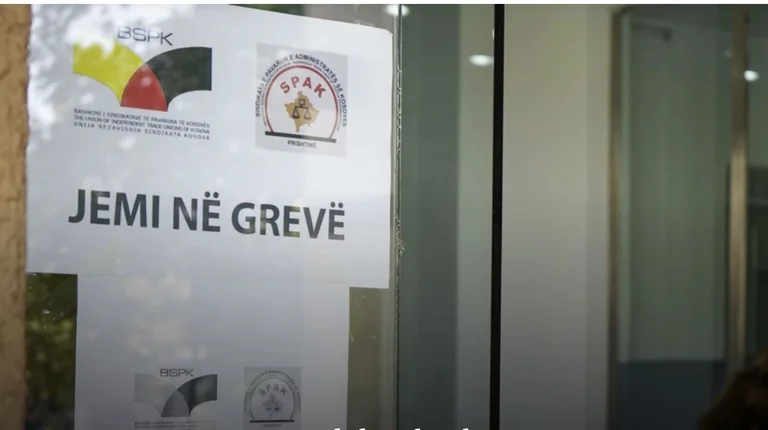
(4 years ago)Hundreds of thousands of students in Kosovo remain out of school on the day the second week of instruction should begin. Education unionists insist that they will continue the strike until their demand for 100 euros monthly financial support is met for all education workers. The Kosovo government, in response, [...]
Education unionists insist that they will continue the strike until their demand for 100 euros monthly financial support is met for all education workers.
The Kosovo government, in response, says the Bill on Salaries, which envisions growth, will come up in approval soon and requires opening schools.
The Kosovo Parents' Council, on the other hand, calls on both sides to find a solution to the strike, saying blocking the education system is unacceptable.
The teachers themselves seem to be divided.
Radio Free Europe visited the Initiation School on Tuesday (September 6th) “Faik Konica” in Pristina, where he saw at least two teachers waiting for students.
One of them, who asked not to be identified, confirmed for REL has begun teaching first-class students from September 5th.
Not giving more details, she said she has asked parents to bring the children to school.
Despite the effort, THE REL failed to see if the teacher had to get the approval of the school director for teaching.
Social networks have circulated information and images of several other schools in Kosovo, where it allegedly started teaching, but the REL could not verify independently.
On September 6, REL also visited the Initiation School “Elena Gjika” in Pristina, where the lesson had not started in any class. There were some teachers who did not carry watches.
The closed door for students had another school started “Ismail Kemali”.
No teacher wants the strike, but they keep it to meet demands”, said Naim Bytyci, Mathematics educator at the school.
According to him, “fein” has Government, which “does not accept dialogue” with education unionists.
Kryeziu: Characterism with conditions and threats is not dialogue
Kosovo Government spokesman Korypziu told Radio Free Europe that Prime Minister Albin Kurti has had meetings with union representatives and that any request of their “has had an answer and attitude”.
He said unionists have replaced the salary Law requirement with a 100-euro extension requirement, “conditioning the ban on the strike, especially in education”.
“We aim for treatment and systematic solutions to the challenges of the education system. Our goals and plans cannot be hindered and conditioned by arbitrary demands. The dialogue with conditions and threats is not dialogue. Learning should start as soon as possible in all schools in the country”, Kryeziu said.
He added that the teachers, in the draft wage bill, have the highest cofficient sometimes, what is meant by higher wages.
Social Dialogue as a Solution?
Free Europe radio failed to come into contact with representatives of labour unions from the Social Economic Council.
This council includes Kosovo employers, employers and Government.
Under the Law in Kosovo, the Social Economic Council must deal with resolving economic, social and professional disputes, with bilateral or trilateral agreements.
The strike of education workers and civil servants has started on August 25th, but since then there has been no official communication on the part of this council as a whole.
The Union of Independent Unions of Kosovo, which is part of this council, said earlier through a communique for the media, that the solution to the strike is achieved only through social dialogue.
Social dialogue implies negotiations between government representatives, employers and employees on issues of common interest.
Former Minister of Labour and Social Management in Kosovo Skender Recica agrees that social dialogue would lead to resolution of the problem.
Speaking of Radio Free Europe, Recica recalls that even in the past, when he served as minister, there have been similar demands of strikers.
The “has often occurred that their demands have not been met because there have been no budgetary opportunities, and often the legal capacities have been limited, but when we sit down and discuss, even labour unions have seen the situation”, says Recica.
According to him, the Social Economic Council is the best mechanism Kosovo has to solve these problems, but, as it adds, the problem is with the Government.
“... it has placed barriers in relation to demands and dialogue with unions. The government, as part of the council, has to propose something to get out of this” situation, considers Recica.
At a media conference on 3 September, Kosovo Prime Minister Albin Kurti has asked the teachers not to boycott the lesson.
The union organisation is extremely important for workers' rights, but absurd, irrational demands that, in fact, more are arbitrary desires than real opportunities, cannot move forward”, Kurti said.
Kosovo President Vjosa Osmani is involved in discussions, meeting representatives of the United Education, Science and Culture Union (SBASHK).
Osmani, too, has called for opening schools.
The strike does not stop without meeting the requirements, has in some cases repeated the chairman of the SBASK, Nundman Jasharaj.
Public Sector Status
The average gross salary in the public sector in Kosovo is around 480 euros.
The Kosovo government has announced on September 3rd that it will support public sector employees with 50 euros per month by the end of the year, due to the crisis with price hikes.
The inflation rate in Kosovo has reached 14.2 per cent in July, up from 0.9 per cent in July last year.
The Ministry of Internal Affairs has already drafted the draft draft bill on wages, which is expected to appear in public debate these days and, then, be submitted for approval to Government.
Status in Education
The quality of education in Kosovo has been criticised in several international reports and estimates.
In a report published in 2020, the World Bank has estimated that students in Kosovo “have a major impasse in learning”.
Kosovo, too, has come to the bottom of the list on two PISA tests, international student evaluation programme.
During the first two years of the coronary pandemic, in 2020/21, students in Kosovo have gone to instruction online in certain periods of time.
Now, when the pandemic is calmer and s'e prevents classroom learning, it's the strike that keeps students away from them.