15 minutes ago
Six main points from Ursula von der Leeyen's speech
Periskopi(4 years ago)
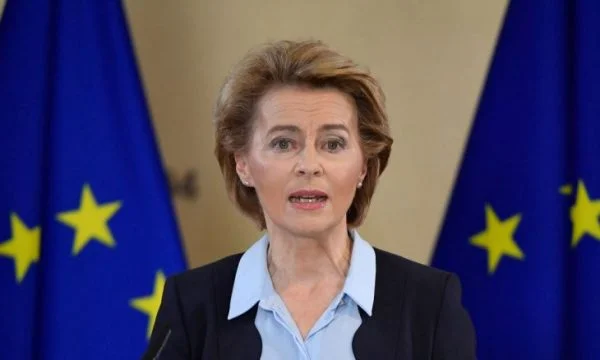
(4 years ago)European Commission President Ursula von der Leyeen gave her annual speech “the state of the European Union” on September 14th, ahead of European Parliament deputies Radio Free Europe takes a look at the six main points from the speech that will shape political autumn in the European Union. Currently, there are no new sanctions [...]
Currently, there are no new sanctions on Russia.
The European Commission president sent a strong message to those who probably thought it was time to lift some of the EU sanctions imposed on Russia in the face of rising inflation, high energy prices and growing discontent among voters:
I want to make it very clear, sanctions are here to stay. This is the time for us to show determination, not fluctuation”.
However, in President Von der Leyen's speech, there was clear a lack of mention of new measures against the Kremlin.
After seven EU sanctions packages agreed on despite clashes between EU member states since the outbreak of war in February, there has been no more desire and unity left at the Brussels camp on the eve of that, which many expect to be a long political winter.
Sanctions on the remaining flows of Russian oil and gas towards the union, as well as the target of Russia's nuclear industry, will have to wait for a second moment, if not set at all.
More help and playing for Ukraine free?
Let's be clear, Ukraine was at the center of the European Commission president's speech. The first Ukrainian lady, Olena Zelenska, was the guest of honour in Strasbourg and Von der Leyen, dressed in Ukrainian, blue and yellow national colors, announced she would travel later in the day to Kiev to meet with Ukrainian President Volodyr Zelensky.
But if we look closely, there was not much innovation about what the EU wants to do with its big eastern neighbour. The EU and its member states have so far provided 19 billion euros in financial assistance to Kiev, Ukraine's electricity network connected with the union in March, and the country has already received EU candidate status.
During the speech, Von der Leeyen pledged 100m euros' support to rebuild the damaged Ukrainian schools and pledged that the Commission would work with Ukraine to ensure continued access to the single European Union market a decision that is already under way, but for what it will also take time.
Perhaps the most interesting promise was Ukraine's permanent involvement in the free European Ringing area. EU and Ukrainian telecom companies made it possible at the start of the war that Ukrainian mobile phone users can use for free or at reduced costs services in European Union countries. According to some EU officials, with whom I discussed, the permanent adjustment of this agreement would be “as a digital visa liberalisation”.
The Promise of Enlargement
There was a time when the European Commission presidents avoided discussions on future enlargement of the union so that they would not upset some EU member states, especially those in the western part, which wanted to hear more about reforms and “deepening” of the union. But not anymore.
“Road to strong democracies and the road to the European Union are one and the same. So I want people of the Western Balkans, Ukraine, Moldova and Georgia to know: You are part of our family, your future is in our community and our Union is not complete without you”, said Von der Leyen, amid numerous cheers from the MEPs of the European Parliament.
Of course, some countries are still quite skeptical, and the road is still long, such as Vaughn der Leeyen, for good reason. Just look at the Western Balkans. That was the only sentence in which the region was mentioned during its 60-minute speech.
The countries of this region started their path towards EU membership more than a decade ago, and there they dealt equally with the declared candidate countries several months ago, Ukraine and Moldova. Perhaps this is not the grouping in which the Western Balkan countries want to be, but this is the reality after years when the EU door has not really been kept open for them.
“Mea Culpa” for Central and Eastern European countries
For years many of the countries in the central and eastern parts of the European continent have warned their Western counterparts of Putin's Russia, while often they have been criticised as hysterical and Russian-Russian.
Perhaps the most special sentence in the entire speech of Von der Leyenne was when she admitted that they were right all the time. The European Commission president and former German Defence Minister was very direct in her speech:
A lesson we learn from this war is that we should have heard those who know Putin. For Anna Politkovskayan and all Russian journalists who published the crimes and paid the price on their backs. Our friends in Ukraine, Moldova, Georgia and the opposition in Belarus. We should have heard voices within our union in Poland, Baltic, and throughout Central and Eastern Europe. They've told us for years that Putin won't stop. And they acted in accordance with the” circumstances.
Although it may be the case of the “a little later than it was needed”, this was one of the most sincere statements by a Western politician about failure since the war broke out.
Restrictions on Russian gas, right?
Perhaps the hottest point of negotiations in recent weeks has been whether the EU will impose a limit on Russian gas (or not all gas) coming to the European Union. EU member states remain divided on the issue.
While Von der Leeyen made known other measures to cut energy prices in the coming months -- from mandatory targets to reduce energy consumption -- to impose unexpected taxes on power producers who do not use natural gas to produce both nuclear and renewable energy -- it was somewhat reserved for Russian gas:
“We must ensure our continuation of the supply and, at the same time, ensure our global competitiveness. So, with member states, we will develop a series of measures that take into account the specific nature of our relations with suppliers, ranging from unreliable suppliers like Russia, to reliable friends like Norway”.
It is fair to say that the debate on this issue will continue until autumn.
A mandatory Magnitsky act?
The EU first used its regime of sanctions on human rights violations in 2021 when it decided to freeze assets and ban visas for a number of people from China, Eritrea, Libya, North Korea, South Sudan and Russia.
But what has always been lacking in this regime of sanctions, and as a result, it has made it different from the Magnitsky” laws of other countries, is that, according to him, corruption has never been a penalty offense.
By now, the European Commission will propose it. The question is whether it will pass. The amendment to the legal act will require bias and there is currently dilemma if reconciliation exists among the 27 EU member states. Hungary will surely reject it, as it has previously expressed reservations to this regime of sanctions and some of its provisions.