33 minutes ago
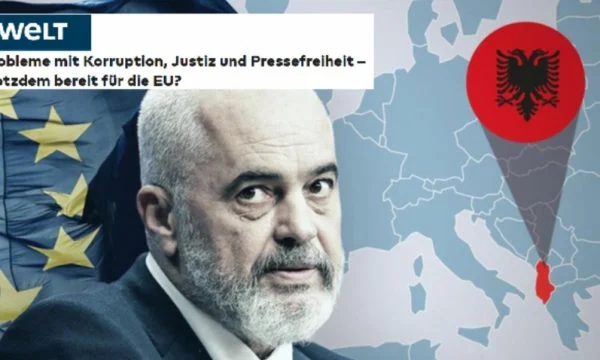
German newspaper: Albania, problems with corruption, justice and press freedom
Periskopi(4 years ago)
(4 years ago)One of the largest newspapers in Germany, Die Welt, has published a long writing for Albania. It notes that the country has deep problems with corruption, justice and freedom of the press. The scripture opens with a question that with all these problems is Albania ready for the EU. The negotiations reportedly were [...]
The scripture opens with a question that with all these problems is Albania ready for the EU. The negotiations reportedly opened more due to the geostrategic situation created by the war in Ukraine.
The Ukraine war on Europe's doors has given Western alliances a moment of rebirth. There is a consensus that the West must draw closer to confronting Russian aggressor Vladimir Putin. No fewer because of this, Ukraine and Moldova received the status of EU membership candidates in June.
The Western Balkans are also strategically important for the EU, as they form the land bridge between the southeastern wing of NATO and Central Europe. However, it is becoming clear that, regardless of the current moment, there are still a series of challenges standing in the way of EU enlargement in the Western Balkans. This is evident in Albania”, the article says.
ART PLOCLE:
Problem with corruption, justice and press freedom is it ready for the EU?
By Mandoline Rutkowski, Die Welt
The leaders of the governments of Albania and Northern Macedonia seized the hand of Ursula von der Leyen by holding tight. Almost feared that the president of the European Commission could change his mind and separate himself from the handshake. And so it is from a promise the European Union had previously made to statesmen Edi Rama and Dimitar Kovachevski.
The scene was filmed on July 19th. The day negotiations for the two countries' EU membership officially began. With this announcement, the two states are now officially in front of Western Balkan countries in the EU enlargement process.
Photos of unity came to Brussels at the right time. Because Ukraine's war on the doors of Europe has given Western alliances a moment of rebirth. There is a consensus that the West must draw closer to confronting Russian aggressor Vladimir Putin. No fewer because of this, Ukraine and Moldova received the status of EU membership candidates in June.
The Western Balkans are also strategically important for the EU, as they form the land bridge between the southeastern wing of NATO and Central Europe. However, it is becoming clear that, regardless of the current moment, there are still a series of challenges standing in the way of EU enlargement in the Western Balkans. This is evident in Albania.
Albania celebrated the historic moment after nearly three decades. In 2003, Tirana submitted its application for membership. In the days following the announcement, a huge EU flag decorated the government building at CHAnderbej Square in Tirana.
The equity with the EU is very high in the country with 2.8 million people. According to the Balkan Public Barometer, 89% of Albanians value EU membership as positive. In conversations with locals, proximity to the EU is certain. European shops cover the city's landscape in Tirana, while the euro is at least unofficially the second national currency.
Far from China
Tirana's relationship with the EU is close. For years, the country, which was liberated from communism in 1991 and devoted itself to Western and democratic values, has been trying to go along the same line with Brussels in foreign policy.
In the Ukraine war, Tirana unconditionally backed EU sanctions against Russia. Unlike other Western Balkan countries, Tirana is holding back from investments from China, with which Beijing seeks to strengthen its influence in the region.
In recent years, a reform of justice and the introduction of the so-called Anti-Corruption Task Force SPAK as a special independent prosecutor has led to efforts in the fight against organised crime and drug trafficking.
“We have made remarkable progress in the area of rule of law and in fighting corruption” said Christiane Hohmann, the EU delegation's ambassador to Albania. She welcomes us into her office with a panoramic view of the capital for an interview. “But our work is far from finished, there is still a giant task before”.
In fact, corruption is a plague in Albania, which is very difficult to heal. The country ranks 110th out of 180th in the Transparency International Corruption Perception Index. Aranita Brahaj, head of the Albanian Institute of Science/Open Data Albania, knows how serious the problem is.
“Corruption is an extraordinary problem in Albania” ) says data analysis expert with the focus of transparency, control and anti-corruption. “is not only present at the top ranks, but also in the daily life of every citizen. Whether it's visiting a doctor or choosing primary school”.
Albania is unable to exercise judicial, constitutional and parliamentary control over the government, Brahaj says. So, de facto, Prime Minister Rama has free hand.
The list of scandals around Rama confirms that statement. The leader of the Socialist Party, who once campaigned for the fight against corruption, is accused of links to the mafia.
Scandals are also multiplying in its orbit of power. Recently, SP politician Alqi Blako was arrested late in April after reportedly involved in a 430m-euro corruption scandal. The opposition accuses Rama of organising criminal activities.
In fact, the government has made efforts to bring corruption under control in the country. In 2016, with the EU's promotion, it adopted a judicial reform involving intensive review of all judges and prosecutors regarding professional competencies, wealth and integrity.
According to “Report for Albania 2021” EU Commission data, 62% of the revision procedures have ended with leave or dismissal. The reform was positively assessed in Brussels, and EU Ambassador Hohman also called the property procedure a successful range, which has never been seen in the region.
But corruption expert Brahaj disagrees. Controls were well intended, but badly planned. The Supreme Court and Constitutional Court had no full staff for years and de facto were unable to act. A flawed judiciary has allowed the government to adopt corrupt laws.
Far back when it comes to press freedom
One area Brussels is considering closely for the performance of the EU membership process, and which concerns EU Ambassador Hohmann, is freedom of the press in the country: “The selection of the press needs development in Albania”. The country is ranked by Reporters Without Borders 103rd from 180 countries.
Transmitting media are mainly in the hands of some wealthy entrepreneurs with political connections. Prime Minister Rama made quite a stir after threatening reporters with education after critical questions and expelled them from press conferences. We expect all politicians to treat journalists with respect,” says Hohmann.
The candidate country still has much to do before Albania membership in the European alliance. For Sokol Dedjan, head of political affairs in the foreign ministry, efforts are not required only by Tirana. “at war function in Europe and granting the candidate statute for Ukraine and Moldova, the EU must now show more credibility than promises made for candidate countries that EU enlargement is a serious process”.
In other words, the EU must testify to Russia that the unity of European countries goes beyond the terminology, even in the sign of curbing. According to him, Western Balkan countries have priority to join the alliance because they are more advanced in preparation.
On the other hand, EU Ambassador Hohmann stresses that the war in Ukraine does not result in EU automatic enlargement. “Each country will continue to be considered individually. Geostrategic argument should not conceal the fact that countries should, of course, meet their demands to enter the EU”. According to Hohmann, Tirana must now prove that the member states' trust is justified. “Albania is now facing a marathon”