16 minutes ago
EU chief in Kosovo: It is time for Kosovo to implement the Decani Monastery decision
Periskopi(4 years ago)
(4 years ago)QUINT ambassadors to Kosovo several times this year have called on the Kosovo government to comply with the Constitutional Court's decision to act without delay for the full implementation of the legal registration of the Decani Monastery's land. In May 2016, Kosovo's Constitutional Court confirmed ownership of the monastery [...]
QUINT ambassadors to Kosovo several times this year have called on the Kosovo government to comply with the Constitutional Court's decision to act without delay for the full implementation of the legal registration of the Decani Monastery's land.
In May 2016, Kosovo's Constitutional Court confirmed ownership of the Decani Monastery on several hectares of land. Despite this legal decision and subsequent requirements, the Court's decision has yet to be carried out.
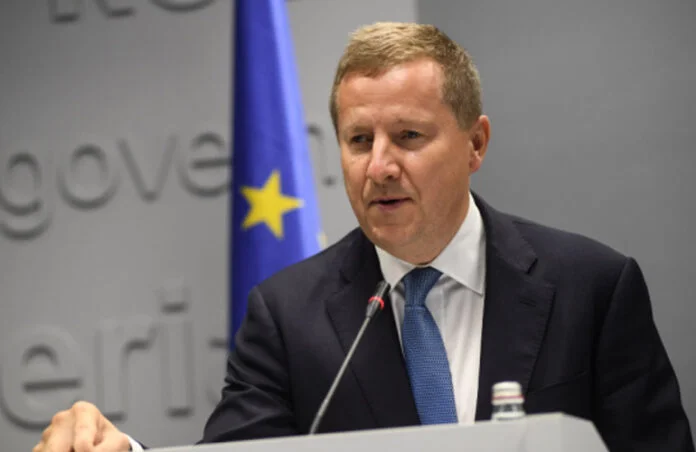
Now the chief of the European Union Office in Kosovo, Thomas Szunyog, says it is time for Kosovo institutions to implement this Constitutional decision.
Szunyog, in an exclusive interview for Albanian Post, points out that more than six years have passed by the Kosovo Constitutional Court Act and nearly ten years since the Supreme Court's Special Chamber decision confirming ownership of several hectares opposed to land in Decani.
“think it is time for Kosovo's institutions to implement quickly and in all, the Constitutional Court's act on land of the Decani Monastery”, he told the AP.
It is our position that the implementation of the act would demonstrate Kosovo's commitment to rule of law, set out one of the guiding principles of the European Union and the European Convention for Human Rights, and contribute to a much needed intercommunity of dialogue in Kosovo”.
Kosovo- Serbia
On August 27th, within the dialogue mediated by the European Union, Serbia has agreed to lift the entry documents for citizens with Kosovo IDs, and Kosovo has agreed not to issue such documents to citizens who own Serbian ID cards.
Szunyog, this interview for The AP, until it has spoken of the process of dialogue between Kosovo and Serbia, has added that the EU facilitates dialogue, but the “process is co-owners of the two parties that define the agenda, speed, depth and result of the” discussions.
“The EU's facilitator of dialogue is working with both sides towards a comprehensive normalisation of relations, addressing unresolved issues, and we expect the parties to quickly meet their commitments to dialogue given the direct relationship between the comprehensive normalisation of relations and concrete prospects for their EU aspirations, he explains.
The European diplomat reiterates that the road to the European Union for both sides runs through EU facilitated dialogue and is also part of the Stabilisation and Association Agreement between the EU and Kosovo, which talks about political dialogue and regional co-operation and good neighbourly relations.
When asked about the criticism of Kosovo Prime Minister Albin Kurti and Justice Minister Albulen Hadziu, against prosecutors and judges, he has said that independence of the judiciary and prosecution is crucial to the rule of law, and that such approach is sanctioned in the Kosovo Constitution.
The Kosovo Prosecutorial Council and Judicial Council play a key role in this direction, sʹi and local and international monitoring initiatives”, the Czech diplomat says, but adds that “this does not mean that the work of the judiciary and the prosecution does not undergo scrutiny.
“The EU closely follows the work of institutions of rule of law, as well as possible interference in their independence, and has reported on the issue in annual reports. The next report will be released this October”.
Kosovo Interethnic Soulms
The cases of interethnic violence have increased in Kosovo in 2021 compared to the previous year, but contrary to Thomas Szunyog, the victims of these cases are not the Serb community, but the Albanian community.
On May 31st, the chief of the European Union Office in Kosovo was visiting the village of Gojbula in Vushtrri. There he had talked with local residents, and because of conversations with them, he realized that cases of violence have increased.
With his return from the visit, Szunyog wrote in his Twitter account that from conversation with local Serbs he realized that “since the pandemic interethnic incidents have intensified and must be addressed”.
But, despite police data, he still claims that “we have made our statement in the context of the significant increase in security incidents throughout Kosovo, including the Vushtrri zone”.
Of course, if such a trend of incidents is seen, it should be addressed, and we have also noted that work on prevention is key to this” effort.
The main EU man in Kosovo adds that the information they work with comes from numerous sources, including security providers, municipal officials and local community representatives.
“Speaking of ways to improve public security with local residents in Gojbula, we discussed improvements in local infrastructure, including street lights, and they also praised Kosovo Police professionalism and good work. In addition, the fact that President Idriz visited Gojbula was a good example and a part of addressing the matter”.