15 minutes ago
Discussion framework points for Kosovo- Serbia

Periskopi(4 years ago)
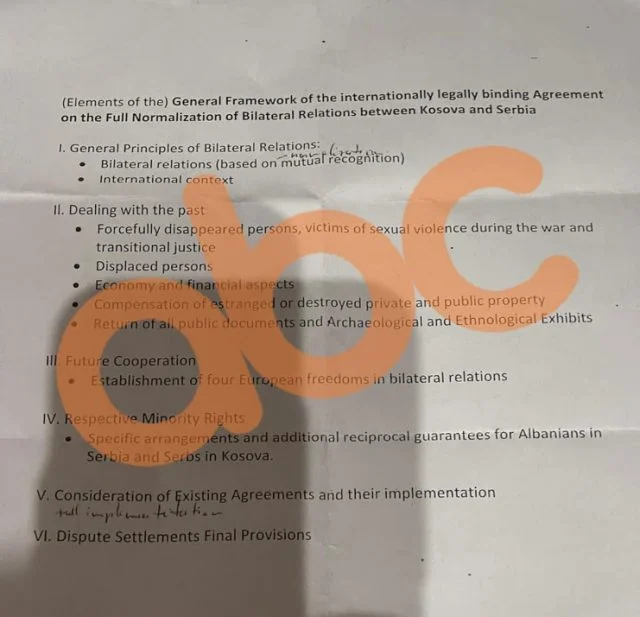
(4 years ago)While Kosovo and Serbia continue dialogue to normalise relations between the two countries and reach the final point, mutual recognition, few have been told in public what is specifically discussed and discussed. The public has not seen [...]
Abbot. al has secured a framework document of these negotiations, which contains elements of the “general framework of the legally binding international agreement for the full normalisation of bilateral relations between Kosovo and Serbia.” The document discusses general principles of bilateral relations based on mutual recognition (normalisation) and international context. It's also talking about “of the specific management and additional mutual guarantees for Albanians in Serbia and Serbs in Kosovo”, full implementation of existing agreements and final provisions for resolving disputes.
The issue of Kosovo-Serbia dialogue, especially after the visit of French and German envoys, has also been discussed in the unforeseen meeting and <x0 emergency” of the prime ministers of Kosovo and Albania in Tirana.
The same media sources say the latest document given to the leading politicians in Kosovo and Serbia contains at least two sensitive points, which it seems difficult to have. It's about the boundaries and the way it's going to refer to them in the document.
It has been talked about various forms of final document to the Kosovo- Serbia and how this issue would be handled, but there is still no official confirmation of the proposals made. One of the controversial models dealing with the boundaries and consequences of lack of clear and final demarcation is that of Israel.
The state of Israel was admitted to the United Nations (OKB) as its 59th member on 11 May 1949, but more than 70 years after declaring citizenship, its borders have not yet been fully resolved. The Jewish leadership in Palestine declared the establishment of Israel's State on May 14, 1948, at the moment when the British mandate ended but without declaring its borders.
The next day, Israel was conquered by five Arab armies, marking the beginning of Israel's Independence War. The wars ended in 1949 with a series of ceasefires, producing ceasefire lines along Israel's borders with neighboring states and creating the boundaries of what became known as the Gaza Strip, East Jerusalem, and the West Coast. The surrounding Arab countries refused to recognise Israel, which means its borders remained indefinitely.
Kosovo has declared its independence on clearly defined borders, even on its flag, and has been recognised by more than 100 countries. Its most sensitive border remains the northern one where Kosovo's borders on one side face Serbia and on the other, the northern Serbs, who make up the vast majority of the population in the northern part.