14 minutes ago
Designed by 2050. Where is Kosovo today?
Periskopi(4 years ago)
(4 years ago)Since 1 September, Kosovo citizens have no longer faced electricity restrictions. Although this concern has been solved at least temporarily, coal addiction remains problematic, as Kosovo intends to be defuelled by 2050. Designation means carbon reduction, or lowering greenhouse gas emissions [...]
The term defuelisation means reducing carbon, or reducing emissions of greenhouse gases into the atmosphere, and is seen as one of the possibilities for combating global warming. Kosovo has joined this European initiative with the aim of preventing risks, which also warns the Climate Links organisation, financed by the US Development Agency (USAID).
key sectors of economic development in Kosovo -- such as agriculture and industry -- are vulnerable to water shortages, heat waves, droughts and floods” -- are said in a summary of the Climate Links for Kosovo.
The data regarding the emissions of greenhouse gases in Kosovo is flawed, but the United Nations Development Programme (UNDP) reports that the main pollutants is the energy sector, which was responsible for 86% of carbon dioxide emitted in the atmosphere during 2019.
The European Union's (European) Statistics Office provides data that illustrates the difference in this regard between EU countries, Kosovo and some countries in the region.
Energy Finance analyst from the United Kingdom Institute for Energy Economics and Financial Analysis (IEEFA), Arjun Flora, believes Kosovo can achieve the goals of designing by focusing on projects for reducing lost energy due to the old network, as well as the installation of solar and wind power plants.
Because these [projects] are seen as sustainable investments, Kosovo should have access to international markets and foreign investors for financing this transition [from fuels to renewable sources]”, Flora tells Radio Free Europe.
The Effect of coal Dependence
Both last year and this year, Kosovo has been affected by a global energy crisis that has challenged consumers not only with more expensive bills but also with a lack of electricity.
According to Lencej, energy expert from the Institute for Development Policy (INDEP) in Pristina, the problem lies with coal addiction as the only source.
When we have the variety of resources, then the prevention of crises, but their overcoming becomes much easier. This, because when we have only one weapon, as we have the coal, the confrontation with such a huge crisis is very difficult”, says Dzecaj for Radio Free Europe, referring to the global energy crisis, which has deteriorated after Russia has begun its invasion of Ukraine in late February.
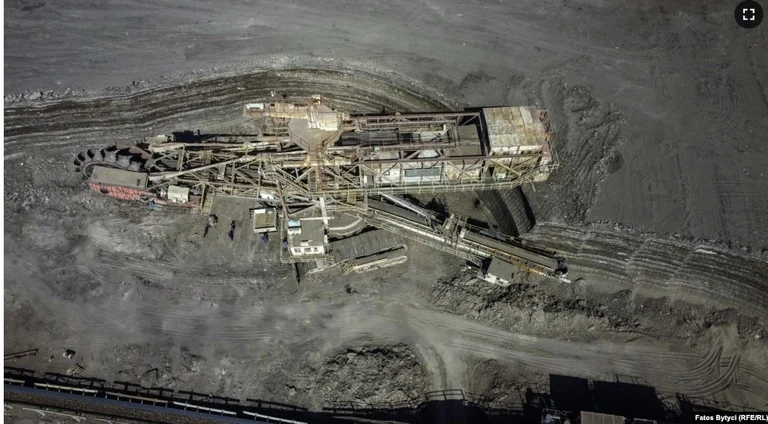
About 94% of electricity in Kosovo is produced from coal, while the rest from renewable energy sources -- including hydro power plants, windmills and solar panels.
This dependence on coal is problematic not only with concerns about climate change and electricity supply but also with health costs.
A review of this year's “Mousine Koklari” Institute in Pristina found that the health cost for 2019 has reached over 11m euros. This cost is calculated on the basis of the amount spent on treating respiratory diseases, lung cancer, heart disease, kidney and reduced quality of living.
“Keeping the price of coal artificially low and not calculating the current cost of production is maintaining the myth that coal is the freest solution for energy generation. Consequently, this is excluding other alternative energy sources as unaffordable”, the report says.
Alternative option: Renewable Energy Sources
Kosovo's Economy Ministry, responsible for the energy sector, has warned concentrations of renewable energy sources in the future. By 2031, the capacity of energy produced by these sources is intended to increase to 35% of total consumption, Flora.
“It is difficult to comment extensively without knowing individual limits to any renewable resource technology. But, in general, I think the 35% target is a good level of ambition for Kosovo by 2031”, Flora says.
Yet, there is still time to reach that goal. The economy ministry is still working on the final draft of the Energy Strategy.
“The strategy has not yet taken the final form, it is still working on it, based on the comments that have come, so there is no [final] date I can say today”, tells REL Sabit Gashi, deputy director of the Energy Department at the Ministry of Economy.
Meanwhile, Gjacaj, from INDEP, says he is satisfied with the content of draft-Strategia, but expresses concern for, as it says, the lack of objective achievement methods.
“The way it will be achieved by 2031, we still don't. Still missing, let's say, the foundation of achieving these goals, because we can say that in 2031 we'll have 1,400 megavats with renewable resources, but first we don't have support schemes, we don't have foreign investments, domestic investments are few --x1>, says Jocaj.
According to Gashi, adding energy production capacities from solar panels could start even before the completion of the Strategy. The ministry intends to do so through planning the auction scheme, which means announcing a call for candidates, from whom better offers would be selected.
The way candidate companies are chosen so far on these calls is problematic for legal regulation, says the director of the Euroenergie company with headquarters in Pristina, Hamdi Malushaj.
The legal correction has blocked the energy sector, especially the energy of renewable resources. There has been no possibility [for] small investments. On the other hand, the person who comes first receives permission. Permissions have taken on all those who haven't even had money to invest... and unmade permits have remained, Malushaj tells Radio Free Europe, but without specifying who he's talking about.
From the Energy Regulatory Office (ZRRE) lets know about The REL that no authorisation has yet been issued for building new large capacities for renewable energy, as opposed to authorisations for smaller generators for self-consumption.
What is Kosovo doing to increase the capacities of these resources?
This year, when the war in Ukraine has faced Europe with an energy crisis due to Russian gas stops, Kosovo has signed agreements with the US Millennium Challenge Corporation (MCC), which focuses on energy sector projects and amounts to $236.7m.
This grant envisions $202m being invested by the US government, while the rest are covered by the Kosovo government and serving on Kosovo's road towards defuelisation.
The key role for achieving this goal is expected to play the Energy Conservation Project, as batteries that enable energy conservation are an important part of infrastructure for renewable energy sources.
An agreement with Denmark for investments in Kosovo's renewable energy sector has also been signed late last year. The deal, which includes projects that do not concern the energy sector, amounts to 30m euros and has already started working on implementation.
They [the Danish government] are designing a support plan for developing institutional capacities, including the Ministry of Energy, Z. RRE and COSTT [system, Transmission and Electricity Market Officer in Kosovo]”, Gashi shows, from the Ministry of Economy, adding that this is only the first phase of the project.
Are energy renewable sources solutions?
Despite foreign investments and Kosovo's intentions to be designed by 2050, energy expert and management partner at the Ellen company in Pristina, Lulzim Syla, is more sceptical of the potential of renewable energy sources.
“ [Energy from renewable sources] cannot be a complete solution to problems, since solar energy produces energy only during the day. Also, new wind - powered capacities are not stable, the reason the wind does not blow every minute, every hour, or every day. Therefore, these renewable energy sources need stable generators that supply Kosovo with electricity and thermal energy to regular ground”, says Syla for Radio Free Europe.
As for the current potential of renewable energy sources, from the ZRRE have indicated that Kosovo can cover about 25-30% of total annual consumption through wind power plants, while about 15-17% through solar energy.
“For the integration of renewable resources would also have to be built up in acumulating capacity, for the fact that energy from renewable energy sources is unstable and difficultly predictable”, say the ZRE.
However, a report of I EEFA estimates that Kosovo has more potential for solar and wind energy than Great Britain or Germany. For this reason, Flora, from this organisation, believes that renewable resource energy is the most reasonable option for Kosovo.
“Since the publication of that report in 2020, gas and coal have been very expensive and prices are expected to remain high for many more years. That would have to exclude discussions on gas as a source of energy in Kosovo”, Flora says.
Free Europe Radio has also contacted the Kosovo Energy Corporation on this subject, but has not received answers.