3 minutes ago
Western experts concerned by tensions in northern Kosovo, Russia's role in region
Periskopi(4 years ago)
(4 years ago)Temporary suspension of a 30-day period by the Kosovo government of the reciprocity move with Serbia may not be enough to resolve the differences between Pristina and Belgrade, say security experts and developments in the Western Balkans. Experts say Russia, which [...]
Experts say that following recent tensions in the country's north, Russia, which according to them, is intended to shift Western attention from war to Ukraine.
Security experts estimate that calm in northern Kosovo may be temporary and that the situation could be tense again in September.
They say that from the announced meeting of Kosovo Prime Minister Albin Kurti and Serbian President Aleksandar Vuciq in Brussels during August, no concrete results for tensions following the government's decision in Pristina to implement the measures of reciprocity for car plates and identification documents issued by Serbian authorities are expected.
The “Serbs consider that at the moment time is on their side and that they are in a stronger position than Kosovo, either economically or in the capacity to promote Brussels, Washington, Moscow and Beijing against each other. This is something we've always seen on different issues. This seems to be the way President Vucic has chosen. While options for Kosovo are more limited”, former Director General for Enlargement at the European Commission Michael Leigh says in an interview for the Voice of America.
Leigh is a German Marshall Fund researcher and academic director for Europe of advanced international studies school at Johns Hopkins University.
On August 1st, Kosovo began implementing reciprocity with Serbia, but later, in co-ordination with the international community, suspended it for a 30-day period.
According to this move, cars entering from Serbia to Kosovo to replace Serbian license plates with temporary billboards issued by the Government of Kosovo, something Serbia has requested from cars entering Kosovo on Serbian territory over the past 11 years.
Kosovo also planned to prevent the use of identity cards issued by Serbia during the introduction of Serbian citizens to the border -- a mechanism Serbia uses for Kosovo citizens.
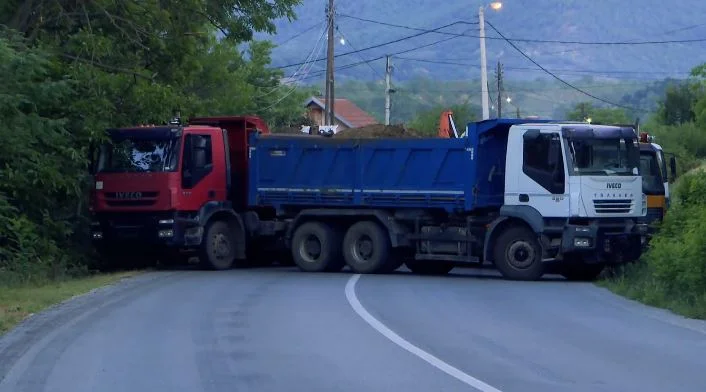
Following the decision, residents in the country's north blocked roads leading to the Jarinje and Brnjak border points, activated sirens for air strikes and fired gunfire into the air in sign of riots.
Ivana Stradner from the US Institute of Enterprises says Russia is behind developments in northern Kosovo, which according to her, exploits the destabilisation of the region for its interests.
“Using ethnic divisions as weapons. When people tell me Putin is too weak to launch tanks, I tell them Putin does not want to launch tanks in the Balkans. It is not necessary because it is absolutely sufficient for the Russian government to see more ethnic tensions in those countries distracting the West from what is happening in Ukraine”, Stradner says, while adding that it is necessary to take protective measures to protect Balkan countries from falling prey to these provocations.
Serbia is seen as Russia's main ally in the Western Balkans.
Kurt Bassuener of the Democratisation Policy Council stresses that the West is allowing this situation, tolerating Serbian President Vucic to pursue his political plans and ambitions.
He must have felt in a difficult position shortly after February 24th, when Russia attacked Ukraine, but when he saw that there would be no serious consequences, he was released. We're playing his game instead of pointing to his blog. That's not in the interest of the West. I don't think it's in Serbia's interest and much less of other countries in the region”, he said in an interview for the Voice of America.
But according to expert Stradner, the balance that President Vuciq maintained between European aspirations and centuries-old ties with Russia has begun to fluctuate.
I'm not sure Vladimir Putin is happy with his efforts to maintain the balance between East and West. If you read Russia's statements carefully in recent days, they have criticised the government in Belgrade for lack of patriotism, not defending Serbia's interests in the region as it should”, Stradner says.
Kosovo had faced a similar situation even before a year when Serbian residents blocked roads in another series of disputes over car plates between Pristina and Belgrade.
The government in Kosovo deployed special police forces in the north as Serbia activated warplanes near the border.
Now, more than five months from Russia's unprohibited attack on Ukraine, the situation becomes even more frightening, amid growing concerns about the possibility of expanding conflict in the most fragile parts of Europe.
However, expert Bassuener sees no real danger to the Western Balkans.
“I don't think Serbia will challenge NATO and I do not believe that the opinion in Serbia is ready to enter the war, which needs to be done to change a territory by force. While a serious concern remains, I don't think hyperbolised rhetoric or fear is justified”, he said.
After the last tensions, NATO said the alliance would intervene in the event stability is jeopardised in Kosovo.
The United States and the European Union have called on the parties not to take unilateral action that could escalate the situation and have called for overcoming divisions through dialogue in Brussels.
But expert Leigh says that in recent years, the EU has lost credibility in the region and that it needs new means and better co-ordination with the US to promote the parties towards normalising relations.
“to avoid providing conflicting messages. For example, the EU has tried to avoid insisting that full recognition of Pristina from Belgrade is needed as a condition for progress, knowing that this is something opposed by Serbs. But we constantly hear voices from European Union and Washington capitals saying mutual recognition is a precondition. So it takes a better coordination to give stable messages”, Leigh says.
Reaching progress will be difficult as long as the European Union does not change its approach, adds expert Kurt Bassuener.
The problem is that the European Union's conditions for commitment to the parties have been just keep talking, keep gathering at the table. That's enough. Compromise is the reward, no matter how insufficient it is. Hence, neither side has given up on the goals they have always had. Now, the only thing that can bring stability to the region is clarity not only in Kosovo”, he said.
The results of the EU-launched talks that began in 2011 are estimated to be dim, as for more than 11 years of negotiations have been reached a set of agreements on many issues, but implementation of them in practice continues to remain a difficult challenge.