11 minutes ago
Who is Salman Rushdie, the writer who troubled the world with Satanic Wargs?
Periskopi(4 years ago)
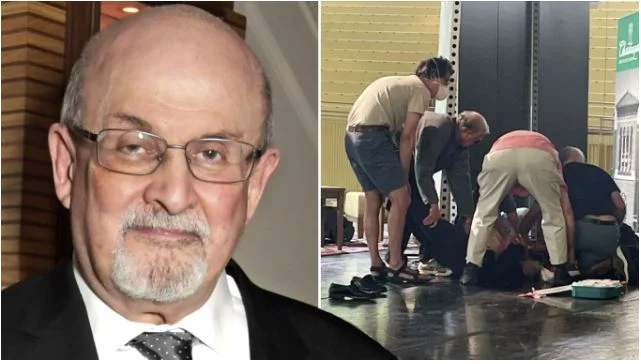
(4 years ago)Indian-born novelist Salman Rushdie, who was stabbed while on stage in New York, has been threatened with death because of his work during a five - decade literary career. Many of the books of 75-year-olds have been extremely successful, with his second novel, Nights Children, which won [...]
Many of the books of 75-year-olds have been extremely successful, with his second novel, "Midnights Children, which won the Booker Award in 1981, writes BBC.
But it was his fourth novel, Satanic Wargs, published in 1988, which became his most controversial work, bringing unprecedented international unrest to size.

So Rushdie's death threats were made, so he was forced to hide after his publication, and the British government placed the author under police protection.
Salman Rushdie was born in Bombay two months before India's British independence.
At the age of 14, he was sent to England and Rugby's school, while later won a history degree in Kings College, Cambridge.

He became a British citizen and allowed his Muslim faith to be shattered. He worked a short time as an actor and then as an advertising author while writing novels.
His first published book, "Grimus, did not achieve great success, but some critics saw him as an author with considerable potential.
Rusdie took five years to write his second book, the children of midnight, who won the Booker award in 1981, was widely appreciated and sold in half a million copies.
The third novel in Rusdie 'Shamé, published in 1983, involved an almost masked Pakistan. Four years later, Rushdie wrote the Jaguar Smile, a confession of a trip to Nicaragua.
In September 1988, the satanic verses were published that would risk life. The post-modern surrealist novel caused anger on some Muslims who considered its contents blasphemy.
India was the first country to stop it. Pakistan followed the example, as did other Muslim and South African countries.

Roman was praised in many circles and won the Whitbreak Award. But the response to the book increased, and two months later, street protests gained momentum.
Muslims considered it an insult to Islam. They objected, among other things, that two prostitutes in the book were given the names of the wives of the prophet Muhammad.
The title of the book referred to two verses that Muhammad removed from the Koran because he believed that they were inspired by the devil.
In January 1989, Muslims in Bradford burned a copy of the book, and newspaper vendors stopped showing it there. Rushdie rejected charges of blasphemy.
While in the United Kingdom, some Muslim leaders sought fashion, others supported Ajatotha. The United States, France and other Western countries condemned the death threat.
 Rushdie, now hiding with his wife while guarding himself with police officers, expressed deep regret over the concern he had caused the Muslims, but Ajatotha reiterated his call for the author's death.
The offices of the editor Viking Penguin in London were spotted and death threats taken in New York's office.
But the book became a best-seller on both sides of the Atlantic. Protests against the extreme Muslim response were supported by other countries, all temporarily withdrawing their ambassadors from Tehran.
But the author was not the only person threatened with the contents of the book. The Japanese translator of Satanic Verses was found killed at a university in northern Tokyo in July 1991.
Police said the translator, Hitoshi Igarashi, who worked as assistant professor of comparable culture, was stabbed several times and left in the corridor outside his office at Tsukuba University.

Early in the same month, Italian translator Ettore Capriolo was stabbed in his home in Milan, although he survived the attack.
The death penalty, fetva, against Rushdie, stopped officially supporting Iran in 1998.
Rushdie has been married four times and has two children. He now lives in the U.S. and was proclaimed a 2007 literature service.
In 2012, he published Josef Anton: A Memoire, a story of his life in the course of controversy over Satanic Wars.