3 minutes ago
NASA missile launch off to moon
Periskopi(4 years ago)
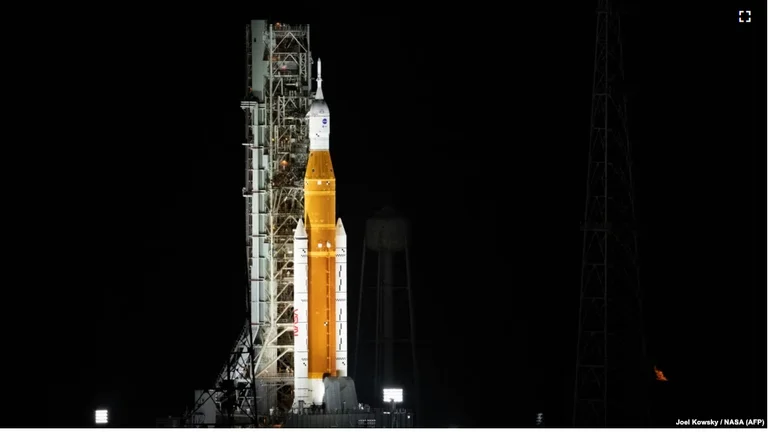
(4 years ago)The August 29th attempt to launch NASA's new missile towards the moon has been cancelled for technical causes. NASA's team of engineers has failed to fix a problem one of the rocket engines called Space Launch System (SLS), as it contained fuel leaks. The next starting date of [...]
NASA's team of engineers has failed to fix a problem one of the rocket engines called Space Launch System (SLS), as it contained fuel leaks.
The next date of launching the missile could be September 2nd, but the team NASA will assess what will be the most appropriate time to launch the missile.
SLS is the most powerful tool ever developed NASA and will be the foundation of its project, Artemis, aimed at sending people to the lunar surface after 50 years.
The rocket was meant to be launched by Kennedy Space Center in the United States.
This rocket is designed to send a test capsule called Orion, far from Earth.
The space shuttle aims to orbit the moon on a large arch, and after six weeks it will return to Earth and is expected to descend into the Pacific Ocean.
The Orion capsule will not have crews on this route, but if the hardware works properly, astronauts will then be able to board its board on future and more complex missions, which are expected to start in 2024.
“Everything we're doing with this flight of Artemis I project, is that we're looking at what we can prove and what we can demonstrate to reduce the risk of mission with the team Artemis II”, the astronaut said NASA, Randy Bresnik.
SLS has a huge 39.1 meganton power at the time of departure. This means that its engines have the power to launch almost 60 accounting supersonic aircraft together.
This rocket will be larger, more noisy and impressive than any rocket you've seen so far”, Lorna Kenna said from the Jacobs Space Operations Centre.
Engineers earlier said they are concerned about how to cope with the protection of Orion capsule, the extreme temperatures he will face when he returns to Earth's atmosphere.
Orion will return to Earth at a high speed of 38,000 miles per hour or 32 times faster than the speed of sound.
Leaving this rocket toward the moon is not a moment of importance only for NASA, but also for the European Space Agency, which has created the Orion Service module. This module is found in the back that drives the capsule into space.
With this contribution, the European Space Agency hopes to include in the future trips to the moon and European citizens.
For the first time in the moon, Neil Armstrong and Buzz Aldrin set foot in 1969 under the Apollo programme, launching the so-called golden age of space exploration.
But the new NASA missions are expected to be different than the Apollo programme, as the US agency wants to send the first woman and the first colored person to the moon, showing that space exploration is open to all. /rel