26 minutes ago
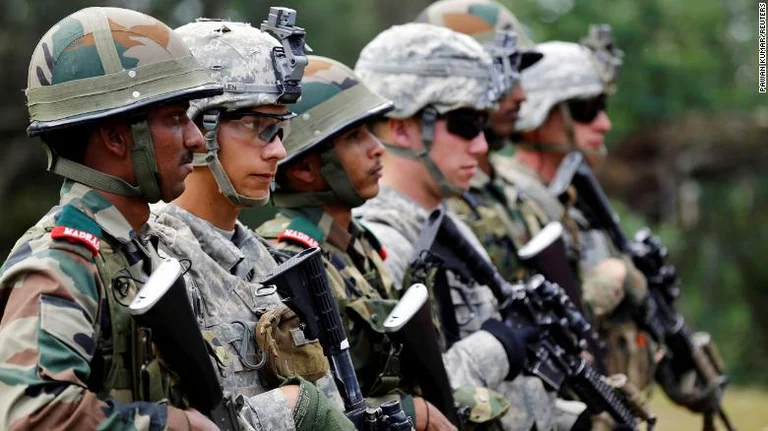
US to hold new military exercises with Northern Macedonia
Periskopi(4 years ago)
(4 years ago)The United States will hold new military exercises with the North Macedonia Army. This announcement has become known, as the Macedonian Army marks the 30th anniversary of the establishment. According to political and military affairs connoisseurs, this step clearly speaks of Washington's commitment to maintaining stability in the Western Balkan region. In one [...]
This announcement has become known, as the Macedonian Army marks the 30th anniversary of the establishment.
According to political and military affairs connoisseurs, this step clearly speaks of Washington's commitment to maintaining stability in the Western Balkan region.
In a change to the National Defence Law, the US Congress urged the Pentagon to propose more military exercises with Northern Macedonia next year, according to the Defence Budget Bill for Next fiscal Year.
With this federal law, the US determines the Pentagon's annual budget and expenditures, and this year for the first time, even North Macedonia is involved.
“The Commission strongly supports the role of North Macedonia as NATO ally and emphasises the value of NATO's rapid reaction to northern Macedonia to the interaction of NATO, regional integration and prevention against Russian aggression”, the bill reported.
It says that “is of crucial importance for the United States and other NATO members to continue conducting exercises similar to North Macedonia and to try further integration”.
The message that the US sends is that it is focusing again on Northern Macedonia and the region, after a several-year pause in which not only the US, but the EU also dealt with their problems, says Methodius Haxhi-Janev, professor of International Law at the Military Academy in Skopje.
“Joint exercises are one of the stages of prevention to send a clear signal to those who want to challenge the region that they are serious not to leave space for other foreign influences”, says Haxhi-Janev.
According to him, such steps are the result of changes in geostrategic and geopolitical plan, especially the unification of China and Russia.
With this US will ensure its partners that democratisation processes, and therefore Euro-Atlantic integration, must continue”, says Haxhi-Janev.
Mersel Bilalli, professor of International Law at FON University in Skopje, tells Radio Free Europe that the US decision to strengthen co-operation with the countries of the region, in concrete cases with Northern Macedonia, is a powerful message that it will not allow other countries -- in particular Russia -- to extend its influence or try to destabilise the region.
“With the extension of the Russia-Ukrainian conflict I think all Russian military activities are compromised in that region, and now as if Russia wants to carry the conflict in other parts in order to distract attention from the debakli that is taking place there [Ukraine] that is in disproportionate with its original purpose... the Western Balkans is a new Neural point that can quickly be lit up and Russia hopes that such a thing is possible, so the United States with the last steps, in a way, yes, yes, the western Balkans, says Bili.
Now that the Macedonian Army is part of NATO, it must engage in modernisation, but prior to addressing its framework as well as economic development, Bilall adds.
“The state must do two things, focus on economic development and defence capacities. The financing of internal military capacities and, of course, that includes the existing real economic power of the state. Therefore, North Macedonia much more needs to be guided into practical treatments than in technology for which there is another security channel”, he points out.
Northern Macedonia has marked on Thursday the 30th anniversary of its military formation, consisting of about 9,000 professional soldiers, mainly equipped with light weapons.
Skopje has been a NATO member since March 2020.
Macedonian Army members have participated in various military missions, such as Afghanistan, Iraq, Bosnia and Herzegovina, Lebanon and recently Kosovo.