5 minutes ago
The Guardian: Albania gets beaches, mountains, ancient cities and cheap prices
Periskopi(4 years ago)
(4 years ago)Despite the dark past of the 20th century, Albania is now a traveler's paradise with amazing landscapes, coastlines and historic cities, writes Jamie Fullerton for the renowned British newspaper” The Guardian”. ” It was rare that journalists came here”, says Elton Caushi, head of the tourist operator” Albian Trip”, whom I meet in the capital, [...]
Despite the dark past of the 20th century, Albania is now a traveler's paradise with amazing landscapes, coastlines and historic cities, writes Jamie Fullerton for the renowned British newspaper” The Guardian”.
” It was rare that journalists came here”, says Elton Caushi, head of the tourist operator” Albian Trip”, whom I meet in the capital, Tirana.
When they arrived, they wanted to talk only about blood feuds and sworn virgins”, he adds.
Traditions that once dominated tribal policy in the mountains of Albania are interesting, but I am here to investigate a recent view of the country of Southeast Europe.
Thanks to its beaches, U-based cities NESTO and mountain trails -- Albania, once communist -- is emerging as the new modern European travel” destination for” beyond tourism with backpacks.
For decades, Albania had a reputation as a dangerous and banned country, largely thanks to its political isolation under dictator Enver Hoxha, who died in 1985. After the riots in 1997, more visitors began coming to Albania, partially attracted by the lowest prices in Greece and Italy.
In 2009, 1.9 million tourists traveled to Albania; in 2019, the last year before Cavid-19, the figure was 6.4 million.
Food here can be a factor in this change.
I'm with Elton at an unnamed restaurant near downtown.
“The tourists haven't found it yet, mostly are drivers eating it”, he says. I eat a abundant bowl, a tasty mixture of beef, garlic, onions and tomato sauce, before it leads me to a dessert at”Mon Amour”, a Parisian-style pastry pastry. We pay $390 ($2,80 pounds) for coffee and baklava for ice cream.
After breakfast I left for Dhermi, a village that has seen a host of hotels emerge along its coast over the past decade.
Dremi's main beach is clean, covered with herzlongs and surrounded by restaurants. It's okay if you just want to lie down. Small beaches like” Splendor Del Mar” and” Empire Beach Resort” are the same as those in Balneare. Time passes slowly as it swims in the clean, flour sea near” Splendor”. I haven't had a better moment outside Asia.
Later, on a walk on a nearby beach near Gjipe, I can see a concrete bunker and see this dome overlooking the sea: a gray hump of the Cold War paraning on an idyllic coast.
I see another bunker. Then another one. I start counting them, but I soon realize bunkers are common here. About 173 371 were reportedly built in Albania between 1975 and 1983, while Hoxha prepared for a possible attack.
Elton warns me that the resort cities of Durres and Saranda were already attracting quite vacationers. Instead, I stop in Gjirokastra and Berat, two smaller, beautiful towns.

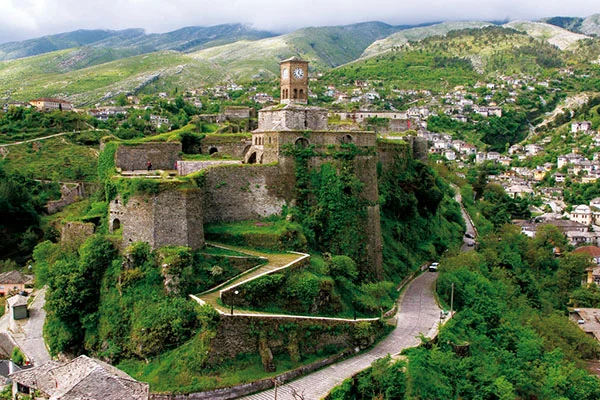
I was prepared after reading”Kronic stone”, the 1971 novel of Ismail Kadare. In a book on the steep and gnarly paths of Gjirokastra, snakes around buildings such as the Skedulls House and the House of Zekats owned by elite families and now museums shine through its history of the 1940s bombing.
Farther north, in Berat, also a city listed in U NESTO, I've gone all the way to the fort. Berat has a historical asset similar to Gjirokastra, with similar steep but more rugged climbs.
I've come to Albania because within a week you can take a beach, see cities and walk”, a US tourist tells me. Indeed, after a two-hour trip to Tirana, there is a bus ride to Shkodra, the Albanian Alps Gate.
Take a classic trip. The 17 - mile [17 km] route between Valbonne and Theth in Valbonne Valley National Park.
For information, I had read “Albania's top” of Edith Durham, the document of the British writer for the tribes of the area, based on its 1908 voyages.
The difficulty of climbing gives way to steep trails. Three hours later, though, I reach the top, and images do their magic. A Swiss-level marvel.
The winding road to Shkodra was paved with asphalt for the first time last year.
Elton says some fear that the new road to Theth could lead to overload in tourism.
But I'm happy for my friends there. Fifteen years ago you would see a cow, a chicken, a cornfield. Now they can go to school faster, to the hospital... it's good for locals”, Elton says.
It ends up again in Tirana, staying at the hotel” Coton” in the centre of the city, later at the most relaxed hotel”Morina”, attached to the”Grand Park” in Tirana. As the capital of a country with an anticapitalist regime until 1992, Tirana did not have the right bars until the 1990s, according to Elton. After a boom-building in the 2000s, the city now has a population of 560 000. Hoxha's former residence has a fashion coffee right in front of it.
I am in Tirana for a short time, but I visit”Bunkart 1”, Hoxha's underground complex, which is now a museum space and artistic space. The exhibitions describe decades of dictatorship, combined with artistic installations. Wrongly balanced, the mix of dark history and video-art may look like a hipposter in a disgusting way, but it's fascinating”, ends Jamie Fullerton for the famous British newspaper” The Guardian”.