29 minutes ago
Five days after dialogue, Escobar and Lajcak visit Pristina and Belgrade this week
Periskopi(4 years ago)
(4 years ago)The US envoy for the Western Balkans, Gabriel Escobar and the European Union's special envoy for dialogue between Kosovo and Serbia, Miroslav Lajcak, are expected to visit Pristina and Belgrade this week. Free Europe Radio has learned from its sources that Escobar and Lajcak will stay in Pristina on Tuesday. According to [...]
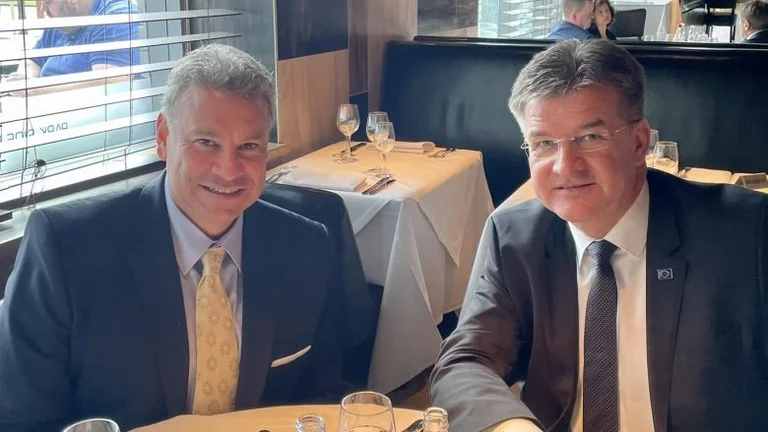
The US envoy for the Western Balkans, Gabriel Escobar and the European Union's special envoy for dialogue between Kosovo and Serbia, Miroslav Lajcak, are expected to visit Pristina and Belgrade this week.
Free Europe Radio has learned from its sources that Escobar and Lajcak will stay in Pristina on Tuesday.
According to these sources, they will make efforts to convince the parties to reach agreements on exceeding tensions in northern Kosovo, as well as on the issue of car license plates and Serbian documents.
At the last summit in Brussels, which was held on 18 August, Kosovo Prime Minister Albin Kurti and Serbia's president, Aleksandar Vuciq, have not reached agreement on these issues.
However, EU sources have said that “will continue the intensive search for resolution” and that “until the solution is reached, they will not consider this round of dialogue as being completed”.
In Brussels, diplomats agree there is room for increasing tensions, so they both want to be responsible, seek solutions, and avoid behaviors that could cause escalation of the situation.
In the EU, they have reiterated that “do not want to see in Kosovo -- scenes that were seen at the end of July and early August”.
The fact that Escobar and Lajcak are expected to go together to Belgrade and Pristina is seen as evidence that the EU and the US are working together in terms of reaching a solution to Serbian license issues and documents.
The United States has reiterated that it fully supports the process mediated by the European bloc.
EU officials, meanwhile, have thanked the US for its active and constructive role in seeking solutions and in support of dialogue.
Esobar has remained in Brussels on 18 August, when the dialogue between Kurti and Vucinqi has developed.
He has met separately with both Lajcak and leaders.
Diplomatic sources in Brussels claim that these days have added interest and commitment of some Western leaders to find solutions.
EU's own High Representative for Foreign Policy and Security, Josep Borrell, has said after the meeting of Kosovo and Serbia leaders that there is until September 1st, although he has warned that the time “is running”.
The meetings of the EU and US special envoys in Pristina and Belgrade will depend on whether there will be a new meeting within the dialogue in Brussels, and if so, on what level.
Why were there tensions in the north?
Meetings in Brussels were called after local Serbs on July 31st and August 1st set barricades as a sign of dissatisfaction with the Kosovo Government's decision to implement two decisions -- for license plates and Serbian documents.
Kosovo and Serbia have free movement agreements since 2011.
Serbia has implemented it immediately.
Kosovo has implemented the decision on August 1st for a few hours . . . . . . . . . . . . . the point for the entry/ outline document and has postponed implementation of September 1st, with the aim of reducing tensions in the north.
Meanwhile, Serbs have removed the barricades.
The United States and the European Union have also urged such a postponement, though they have said Kosovo has the right to implement those decisions.
The Kosovo government has said Prime Minister Kurti has discussed two topics at meetings on August 18th.
According to the Government, the general framework of the final agreement has been discussed at the meeting.
According to her, Kurti stressed that this agreement should be centralized by mutual recognition, so even “has introduced several chapters with relevant elements that should contain this”.
The second <x0me was the current political and security issues for which Prime Minister Kurti pointed to the importance of legitimacy and constitutionality in our country as guarantees of peace, security and equality for all citizens indiscriminately”, is said among other things in the Government Community on 18 August.
Serbia's President Aleksandar Vuciq has said on 21 August in Belgrade that he has received the support of representatives of Serbs from Kosovo for a compromise solution to the issue of Serbian license plates and documents.
According to him, Serbia will not allow refugee columns and that in the latest round of dialogue, Kosovo has spoken of a final six-point agreement.
After meeting with Serbian representatives from Kosovo, Vucic has said before the nation that he does not know what the compromise solution to the issue of Serbian license plates and documents could be.
“As soon as I know, I'll let you know. We'll try, we'll do our best. If we can, we can, we can't, we can't-
Dialogue between Kosovo and Serbia started 11 years ago.
More than 20 agreements have been reached in areas such as energy, telecommunications, justice, customs, freedom of movement, but not all have been implemented.
Kosovo insists that dialogue on normalising relations be closed with mutual recognition between the two countries.
Serbia, on the other hand, seeks compromise solutions.