18 minutes ago
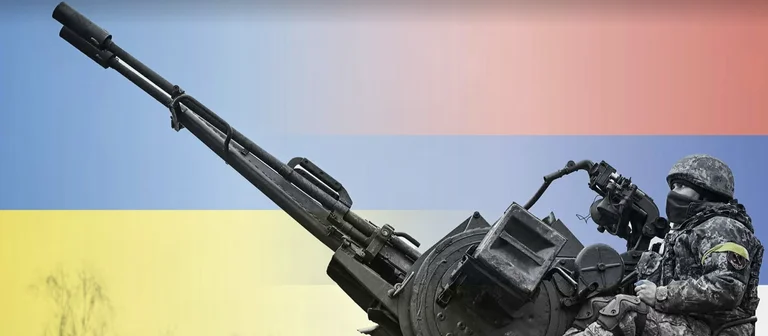
What if the war in Ukraine gets out of control?
Periskopi(4 years ago)
(4 years ago)The war in Ukraine will soon enter its sixth month. Despite the discussions that Russia has violated Russia's “red lines of the West with its conduct in war, and that the West itself has crossed Russia's “red lines” with its military help to Ukraine, the “lines -- real” [...]
At the start of the war, both sides determined a series of invisible rules. Officially unsaid, but still real. These include Russia's acceptance of shipments to Ukraine of heavy Western weapons, as well as support with intelligence data, but not the use of Western troops in the battlefield.
They also include silent acceptance by Western states of the conventional Russian war within Ukraine's borders, as long as the conflict does not lead to the use of weapons
of mass destruction. So far, these invisible rules have continued to function, a testimony that neither US President Joe Biden nor Russian Vladimir Putin wants an expanded war.
However, a broader war is certainly possible. After all, the current conflict does not control any international mechanism. The United Nations has been on the outskirts, and the European Union stands on one side. The United States is unable to end the war under its terms.
But neither Russia nor Ukraine. Talks between Kiev and Moscow have been launched and interrupted several times, and despite continuing efforts to end fighting, there has been no US-Russia diplomatic commitment since February 24th, the date the war began.
If we add the size and complexity of the conflict, the number of countries involved and new technologies in use, then the mixture becomes potentially toxic. Therefore, Putin and Biden's shared desire to avoid a broader war is not guarantee that war would not be further expanded.
A conflict may come out of control, even if neither side makes a deliberate decision to escalate it, or use nuclear weapons. And although it's not likely to happen, a nuclear attack is still possible, given Russian capacity, and uncertainty as the central element of Moscow's current nuclear doctrine.
In fact, the accidental escalation of the conflict may be even more frightening than the intention, as the latter carries within itself the possibility of deliberate de-scalpation in the end, a deliberate trajectory is easier to turn back than the one moving forward beyond its will.
The Cold War can be a useful guide to what appears on the horizon. Given the length of that conflict, and the error of both political and military leaders on both sides, it was remarkable that the US-Soviet Union ended peacefully.
But after the miracle of humanity's survival in a nuclear era, dark episodes of collisions and almost escalations are hidden, which marked the second half of the 20th century. The war in Ukraine is likely to follow this pattern, including stages in which general confrontation is well managed, followed by stages in which conflict is intensified suddenly and in anarchically.
Policymakers and diplomats on both sides of the Atlantic should prepare even better for this scenario. Biden has been clear that he will not intervene militarily in Ukraine. He does not want NATO's involvement in this conflict either. It will not dictate Ukraine's more maximum war goals (or minimalistic) than those set by Kiev itself.
And although the U.S. is supplying Ukraine with large quantities of weapons, Biden has often made the distinction between the defence of Ukraine, which Washington has committed unequivocally, and Ukraine's attacks on Russia itself. Military support for Ukraine has been calibrated along these lines.
Beden wants Ukraine to win according to its terms and its territory. He does not want it to turn into a regional war. He even used an article published in the New York Times to communicate these goals to Moscow. Putin, meanwhile, has been more unclear, promising “serious consequences” for military assistance of allies to Ukraine. Russian state propaganda regularly speaks of possible nuclear attacks on Berlin or London. In excess, such messages create a consensus within the Kremlin and Russian society. In June, following a disagreement over sending goods to Kaliningrad, a Russian enclave separated by continental Russia, Putin threatened Lithuania with undesigned penalties.
Lithuania is a NATO member, and a Russian attack would cause a direct military conflict. Somewhere else, Putin can create or exploit crises in the Balkans to improve Russia's position by organising coups, including in paramilitary activities, or launching a direct invasion.
Major cyber attacks on critical infrastructure in Europe and the United States pose another danger. If they happen, the United States and others are likely to retaliate, opening a new chapter in this war. Putin cannot afford a broader war.
Although Russia is likely to have money to continue its regime change policy in Ukraine, the Russian Army has major shortcomings in troops. Any additional conflict, especially against well-equipped NATO forces, would exacerbate these problems.
So Putin and Biden have the incentives needed to adhere to unseen rules of war. And in their respect, they have regained an important dynamic of the Cold War. Throughout the second half of the 20th century, the United States and the Soviet Union never officially agreed on how to wage war through representative parties.
For example, neither set the basic rules for the Korean War, the first heated conflict of the Cold War era. On the contrary, for nearly four decades, the two sides imposed their way towards a sustainable way of doing business. It was the legal things: mutual denouncing, cultural and ideological competition, spying, active measures as propaganda and disincentive campaigns, pursuing areas of influence, interfering in the domestic policy of other countries, and supporting opponents in peace and war.
And then illegal things: a direct war and the use of nuclear weapons. Today for Western countries, the most important seems to be keeping out of the war of their soldiers. In Ukraine, Washington and its allies have openly offered the Ukrainian Army heavy weapons, military training outside Ukraine, and intelligence data to identify Russian targets. For its part, Russia has not targeted weapons convoys that are headed towards Ukraine, while they are still on NATO territory.
It has not prevented continued visits by US political leaders and allies to Kiev either. What, though, can threaten the invisible rules that the US and Russia have set? One option is an absolute accident. The other is a cycle of events that “requires” escalation.
Of course, these possibilities can convert, and a single accident may be the pretext for a spiral - breaking spiral, as happened from time to time during the Cold War. Remember the Cuban Missile Crisis. Very often named as an example of American President John F. Kennedy, the 1962 confronting Moscow and Washington on Soviet nuclear missiles in Cuba, was almost a disaster.
War in Ukraine is also prone to accidents. Today, the main concerns are that of bringing the Russian side. Failing in the field of battle, logistical problems, insufficient troops, and the resistance of the Ukrainian Army may encourage the Russians to launch an air or missile attack outside Ukraine.
For example, to prevent weapons from being passed on to Ukraine. Of course, it would be a Russian attack on a NATO member state. From here comes the risk of Washington interpreting such an attack as an escalation directed by the Kremlin. A Russian War - NATO, would be very close.
Patience and calm and study can control the conflict in Ukraine. But another kind of accident can happen Ukrainian. While striking military targets in Russia, Ukraine's military could make the wrong calculation and hit a major civilian target within Russia.
This is obviously something Moscow does without concern and every day in Ukraine, where Russian missile attacks are killing hundreds of civilians, including children and older ones. But the Kremlin can use such an attack, especially with weapons sent from abroad, as a pretext to counter military military supplies very close or even within NATO territory.
Putin is likely to assume that Western states backed the Ukrainian attack, as he assumed Maidan's 2014 uprising, which led to the collapse of Russia-backed Ukrainian President Victor Janukovich, was a CIA conspiracy.
Finally, a cycle of unintentional escalation, which could be like the Cuban missile crisis, could expand into a regional or global war. Despite its peaceful solution, the 1962 crisis is a warning story.
In the case of an accident, an act of Russian war against a country outside Ukraine, even though not ordered by Putin, will be crucial for Washington and his allies to examine the situation correctly. Tests may be difficult to find, but the US response must be calibrated and have high-level logic. /abcnews. al