19 minutes ago
Can NATO Protect Eastern Europe?
Periskopi(4 years ago)
(4 years ago)It says: Sabine Fate 14 times mentioned Russia in NATO's new strategic concept, 11 times China. The fact that these two countries and a possible alliance between Moscow and Beijing are at this point in the spotlight illustrates the future risks that NATO countries see and for which they must [...] see.
It says: Sabine Fate
14 times Russia is mentioned in NATO's new strategic concept, 11 times China. The fact that these two countries and a possible alliance between Moscow and Beijing are at this point in the centre of attention illustrates the future risks NATO countries see and for which they must prepare in an encouraging way.
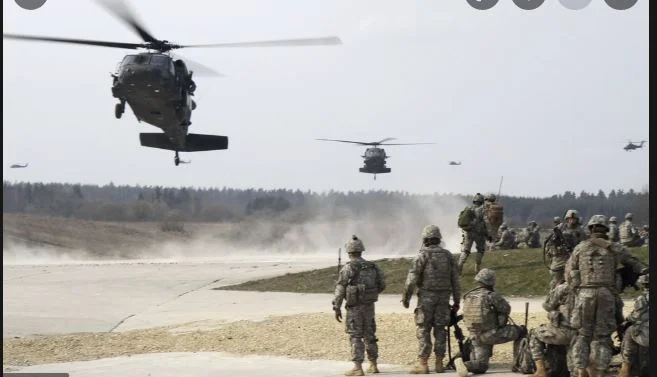
The eastern wing of the Alliance's territory is reinforced in several ways: Poland and Romania raised values as the core pillar of NATO in Eastern Europe. Troops under US direct command will be deployed in the region to curb Russia. In addition, NATO remains open to other new members and now classifies the Western Balkans and the Black Sea as “strategically important”.
Issues of Political instability and loyalty
The new strategic concept stresses that NATO could no longer realistically rule out the possibility of an attack on the sovereignty and territorial integrity of the Alliance's appointed members. The document describes the abyss at which Europeans are not the only ones who find themselves: Syria and Russia have already used chemical weapons in their recent history, China and Iran are secretly developing nuclear capabilities, and dangerous non-state actors continue to arm themselves.
Beyond this depressing general picture described in the new strategic concept, there are a series of threats coming from within NATO states. The alliance seems to be not taking them seriously right now. Some NATO countries have serious problems of loyalty to essential Euro-Atlantic values. Political instability in some member states is undermining the Alliance's cohesion, and the Balkans continue to waver under the burden of historical hostilities in the region.
NATO may be able to protect Romania and Poland from Russian aggression, but not from the damage these countries cause to themselves -- in the two eastern EU and NATO member states, justice is clearly dependent on politics. But this evil, which destroys rule of law, is ignored -- due to the necessary assistance from Romania and Poland for Ukraine and Ukrainian refugees.
Populism is even more dangerous in the East than in the West
Hungary seems to be closer to Russia than NATO. Turkey is pursuing its strategy of boosting influence in both the Middle East and the Balkans. Bulgaria finds itself on an unstable basis, which is unbalanced whenever it is not inclined towards Moscow. Similarly, Slovakia and the Czech Republic have never taken an irreversible route towards the West, while Croatia has a power centre focusing on Russia (president) and another preferring the West (Prime Minister). For its part, Bulgaria is undermining northern Macedonia, Tirana still dreams of Greater Albania, and political Serbia is still on Russia's side. All these cracks in the region are to Moscow's advantage: it can fish in turbulent waters and seek its advantages there.
In Romania, Prime Minister Nicolae Ciuca, a pro-Western general, remains vulnerable, even though justice saved him from charges of plagiarisation in the doctorate. Not only is the Romanian state becoming more and more pathetic, but it is also tending to autocratia: the dominomian policy and the judiciary, even the Constitutional Court. Victor Orban's model of Hungary is growing in other countries.
Populism is coming back strongly throughout Europe, but this phenomenon is even more dangerous in the East than in the West because institutions are still weak and do not want to be protected. In this part of the continent, democracy so far has been more a moment in a story dominated by dictatorships and autisms. The question is, can NATO trust states that increasingly give up democratic freedoms and kill the rule of law? / DW