14 minutes ago
A dying star and a spacer: Ancient galaxy discovered in photos of the telescope unseen
Periskopi(4 years ago)
(4 years ago)Unbelievable images show stars that <x0lind”, the effects of a dying star, a cluster of 4.6 billion years old galaxies, and the moment two galaxies unite. A completely new, detailed view of the universe that looks back into space and time before has been discovered in an extraordinary set of photographs. [...]
A completely new, detailed view of the universe that looks back into space and time before has been discovered in an extraordinary set of photographs.
NASA has published a full series of images from its space telescope James Webb, showing what is said to be the deepest “and the most detailed of the cosmos yet.
This new image of the universe is possible because Webb is large with a mirror more than twice the size of the Hubble used before.
It's the biggest and most powerful telescope ever sent into space.
The First Image - A Multitude of Remote galaxies
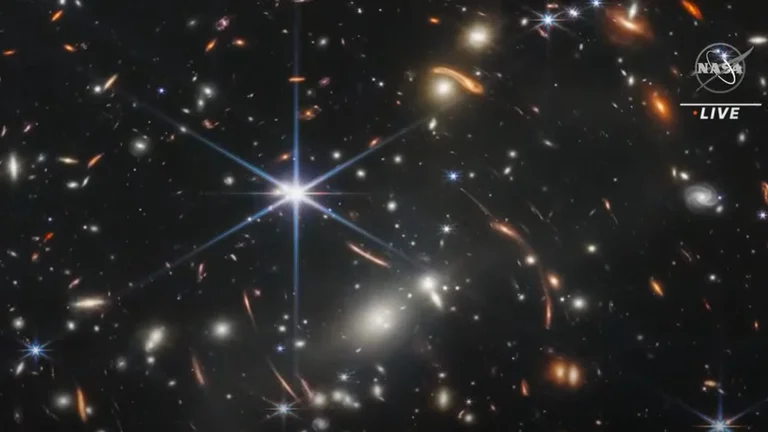
The above image shows a deep cluster of remote galaxies, as they looked billions of years ago.
Jane Riggy, who worked on the project, says this shows them from the time the sun and the earth were formed.
The image has a “sharpness and clarity” that we've never had before, she says, and under a close look, it is possible to view the individual “collections of stars that form, simply showing up as popcorn”.
Even if it seems a little familiar, it happens because it was first discovered by NASA as a bully yesterday.
Sky's science and technology editor Tom Clarke says this is a picture of a long display of a small part of the universe.
If you extend your arm with a grain of sand on your finger -- this is the size of the part of the sky that covers this”, he says.
The Second Image - A Giant Planet
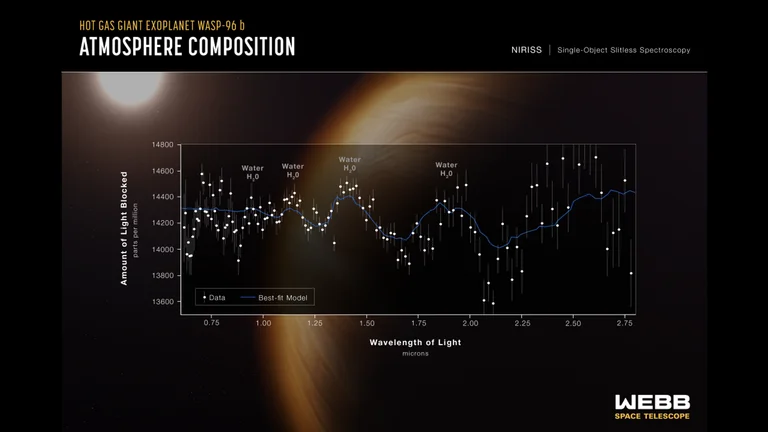
This image is an analysis of the atmosphere of a giant planet called W ASP-96 b and it's the first <x0analysis of spectre” of the atmosphere of an specimen.
The Webb will take a series of photos “perspective” in the coming months.
This process involves salivaing the light in its own <x0-edge”, in order to show what makes up a body, how fast it is moving, or even what its temperature is.
This analysis is of a giant gas planet located some 1150 light years from Earth that orbits its star every 3.4 days.
There are about half Jupiter's mass and his discovery was announced in 2014.
NASA said: “Webb noticed clear water signatures, fog indicators and cloud evidence (when it was thought to be out there)! ”
Third image: a planetary mist
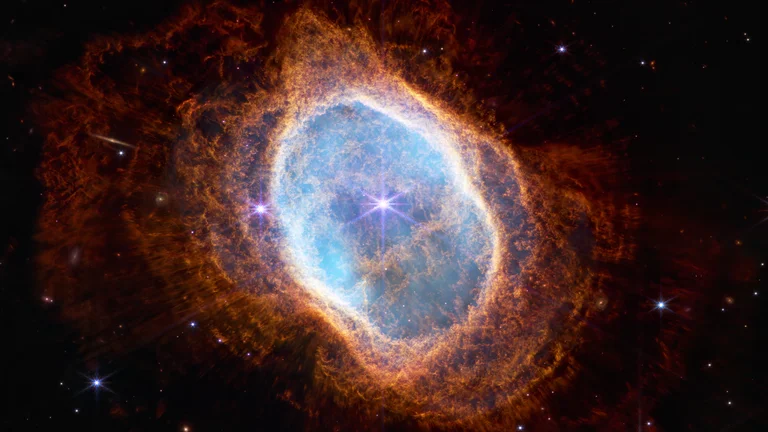
In this infrared image, we can see a planetary mist caused by a dying star.
It is about half a year in diameter, and it is about 2,000 light years from the earth. A year of light is 5.8 trillion miles.
The star can be seen driving away much of its mass.
The South Ring Nebula, sometimes called “te-ex1>.
Fourth image: The Quints of Stephen
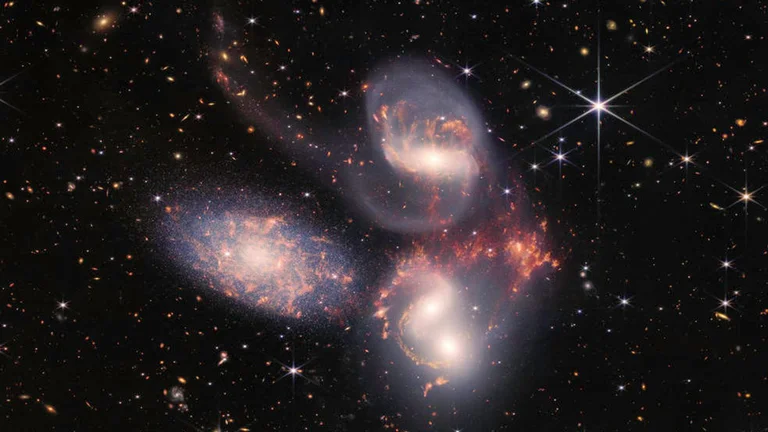
This image is of a group of five galaxies, two of which are under way.
It's a combination of infrared images near infrared that reveal star birth.
Although it's called “kint”, only four of the galaxies are really interacting in a cosmic dance that on the left is actually in the first plan.
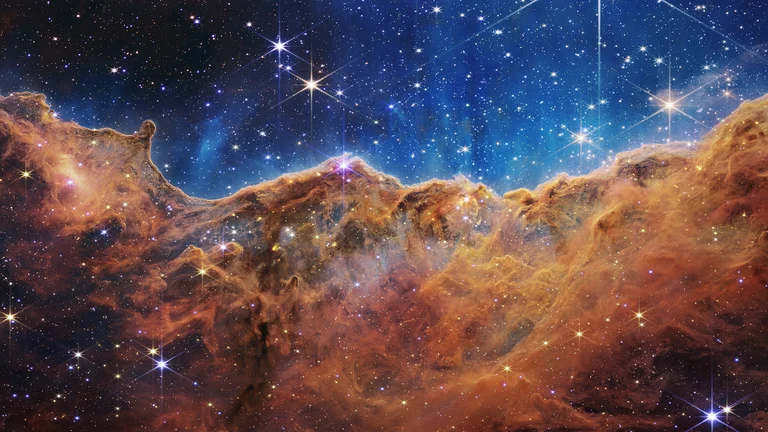
Fifth image: Carina Nebula cosmic rocks
This amazing image tells us that for the first time hundreds of stars were once completely hidden from our appearance.
The Carina Nebula is a close region (in space) starring within our Milky Way galaxy.
“Cosmic Skemies” were previously photographed by the Hübble telescope, but this new view gives us a rare view of the stars in their earliest, fast stages of formation.
Near-infrared shows hundreds of stars and galaxies of the background, while medium-red shows dust disks forming planets (red and pink) around the new stars.
The Telescopic Mission
A partnership of scientists and engineers was created between NASA, the European Space Agency and the Canadian Space Agency, and for 20 years they worked to complete the 8.4 billion-pound telescope. / Sky News/Perscopi/