23 minutes ago
What does the agreement with the Serbian Church contain, and how much does Abazovic risk?
Periskopi(4 years ago)
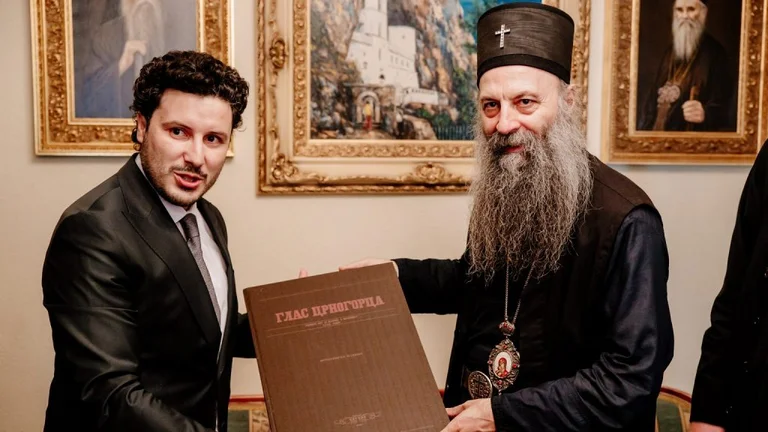
(4 years ago)The Montenegrin government is facing the possibility of early elections following Albanian-born Prime Minister Dritan Abazovic's decision to sign a basic agreement with the Serbian Orthodox Church two days ago. The deal has long been rejected by the largest party in government, the Democratic Party of Socialists (DPS) led by the president [...]
The deal has long been rejected by the largest party in the government, the Democratic Party of Socialists (DPS) led by Montenegrin President Milo ãokanovovic, who gave up support against Abazovic immediately after signing the agreement, calling for holding a no-confidence motion against him.
President ovic charges Abazovic that he has voted this agreement without first offering the possibility of a public dialogue.
Meanwhile, Prime Minister Abazovic defended his decision, saying signing the agreement was a key step towards resolving tensions in the country”, adding that if no solution is found, he would agree to move towards early elections.
What is Abazovic's basic agreement with the Serbian Church?
Montenegro has signed several fundamental agreements earlier, with smaller religious communities both with the Catholic Church in 2011 and with the Muslim and Hebrew communities in 2012.
The agreement with the Serbian Orthodox Church was signed on Sunday, with the support of 13 ministers from the Dritan Abazovic APUE Zeza coalition on White, the pro-Serbian Socialist party, as well as Albanian parties.
5 Party Ministers The DPS, the Bosniak Party and the Croatian Civic Initiative voted against it, while 3 abstained.
DPS has long accused the Serbian Church of promoting Serbian nationalism in Montenegro by undermining the sovereignty of the Montenegrin state.
What does this agreement predict?
The agreement between Abazovic and the Serbian Orthodox Church contains several points, allegedly addressing relations between the Montenegrin government and the Serbian Church.
Initially, the agreement defines Montenegrin state obligations to the institutions of the Serbian Orthodox Church:
- It obliges the Montenegrin government to recognise the diplomatic immunity or extraterritorial rights of Serb Orthodox Church institutions in the country, which excludes them from jurisdiction / local laws;
- The government is obliged to register all Orthodox churches in the country under the jurisdiction of the Serbian Orthodox Church and launch the payment process for all buildings confiscated by the communist regime after World War II;
- The agreement stipulates that the Serbian Church does not need to get permission from the Montenegrin government to move cultural heritage objects which are registered under its ownership;
- It also gives the Orthodox Church a legal status which in some areas is projected to be the same as that of government institutions;
- Recently, it envisions the possibility of expanding religious teachings in public schools and their control and approval only by the Serbian Church.
The main problem with placing such a large amount of power in the hands of a single Serbian church is that the Orthodox community in Montenegro does not belong only to Serb direction.
In fact, according to the 2011 provision, 72% of the Montenegrin population are identified as Christians orthodox, of which about 70% are identified as members of the Serbian Orthodox Church, which means that the rest of the remaining 30% are identified with its rival, the Montenegrin Orthodox Church.
Muslims then make up another 20% of the population, and Catholics or other religions, the remaining percentage.
The future for Dritan Abazovic?
Montenegro can now run early elections, following the government's largest party call (DPS) for a no-confidence motion against Prime Minister Abazovic.
According to a statement given to Euronews Albania by Montenegrin Human Rights and Minorities Minister Fatmir Gjeka, this “agreement was just a procedural issue, as has happened with other religious communities”.
“I see this as a political issue, this quick step to lift support from the government, was accelerated” he said, adding that the following days, the cabinet will forward developments, whether to move towards early elections or if another solution will be found.
Meanwhile, various analysts think Abazovic may have remained a last resort.
According to the Director Think tank CEM, Zlatko Vujovic, despite DPS calls for a no-confidence motion against Abazovic, has an opportunity for him to get away with it. And that, thanks to opposition parties.
There is expectations that three blocs can support Abazovic's cabinet. Salvation for this government can come from the Serbian Orthodox Church itself, which can influence the Democratic Front, and the “Peace is Our Nation to come to the aid of Abazovic,” Vujovic told the Montenegrin newspaper Pobjeda.
It remains to be seen whether Abazovic will eventually collapse, or if the topic that opposition parties will come up to him, he could return to his only opportunity to continue ruling.